


In a final ruling, the Supreme Court yesterday upheld a conviction against Kinmen’s Chinsha Township (金沙) Mayor Chen Chi-te (陳其德) of the Chinese Nationalist Party (KMT) for receiving bribes to help a woman flee to China and evade prosecution for fraud.
In the first and second rulings, the court found Chen guilty. He was handed an 11-year prison sentence and was deprived of his civic rights for six years.
The case involved a woman surnamed Wu (吳), who paid Chen NT$280,000 (US$9,390) to arrange a boat for her to travel from Kinmen to China’s Fujian Province in September 2012.
At the time, Chen was a detective and had been working for Kinmen police since 1993. He was later forced to quit for being involved in a separate criminal case.
Wu worked as a hotel executive, but she was convicted of fraud and the court imposed travel restrictions on her. She went to Chen to help her evade prosecution, and because the hotel she worked at required her to travel to Xiamen in China’s Fujian Province on business.
In the second ruling on the case, the High Court said: “Chen held a high-ranking police post. However, he took a bribe from Wu for personal gain and made arrangements for Wu to flee the country... He was deceiving when questioned, gave false statements and did not admit to wrongdoing when under investigation.”
In another case related to cross-strait security, the High Court yesterday convicted four Coast Guard Administration (CGA) officials for taking bribes of about NT$1 million per month from Chinese ship captains to allow them to fish in Taiwanese waters.
In the ruling, Huang Wen-che (黃文哲), a captain of the coast guard’s 9th Coastal Patrol Corps, and his wife, Chen Wen-chun (陳文君), an administrative clerk in the 3rd Coastal Patrol Corps, were handed prison terms of five years and 10 months, and two years and 10 months respectively.
Lin Huang-tsai (林黃財), a unit leader for coast guard’s mobile patrol fleet in central Taiwan, was handed a prison term of two years and nine months, and Hsu Liang-chi (徐良吉), a member of the CGA 3rd Coastal Patrol Corps, was given five years and nine months.
The case can still be appealed. All four have been relieved of their positions.
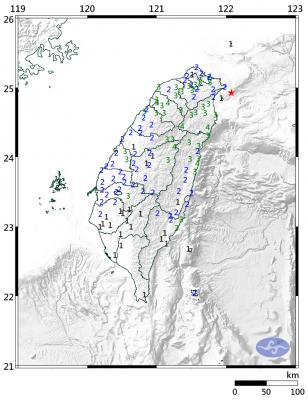
A magnitude 6.1 earthquake struck off the coast of Yilan County at 8:39pm tonight, the Central Weather Administration (CWA) said, with no immediate reports of damage or injuries. The epicenter was 38.7km east-northeast of Yilan County Hall at a focal depth of 98.3km, the CWA’s Seismological Center said. The quake’s maximum intensity, which gauges the actual physical effect of a seismic event, was a level 4 on Taiwan’s 7-tier intensity scale, the center said. That intensity level was recorded in Yilan County’s Nanao Township (南澳), Hsinchu County’s Guansi Township (關西), Nantou County’s Hehuanshan (合歡山) and Hualien County’s Yanliao (鹽寮). An intensity of 3 was
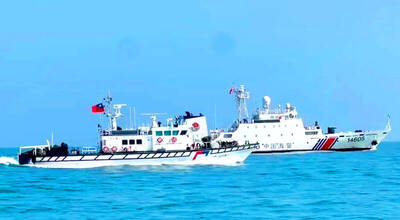
Instead of focusing solely on the threat of a full-scale military invasion, the US and its allies must prepare for a potential Chinese “quarantine” of Taiwan enforced through customs inspections, Stanford University Hoover fellow Eyck Freymann said in a Foreign Affairs article published on Wednesday. China could use various “gray zone” tactics in “reconfiguring the regional and ultimately the global economic order without a war,” said Freymann, who is also a nonresident research fellow at the US Naval War College. China might seize control of Taiwan’s links to the outside world by requiring all flights and ships entering or leaving Taiwan

The next minimum wage hike is expected to exceed NT$30,000, President William Lai (賴清德) said yesterday during an award ceremony honoring “model workers,” including migrant workers, at the Presidential Office ahead of Workers’ Day today. Lai said he wished to thank the awardees on behalf of the nation and extend his most sincere respect for their hard work, on which Taiwan’s prosperity has been built. Lai specifically thanked 10 migrant workers selected for the award, saying that although they left their home countries to further their own goals, their efforts have benefited Taiwan as well. The nation’s industrial sector and small businesses lay
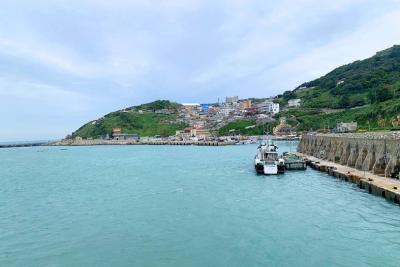
Taiwan has activated backup communications for its northernmost territory, the remote and strategically located island of Dongyin (東引), after poor weather conditions apparently shifted the wreckage of a ship onto an undersea cable causing it to break. The vulnerability of undersea communication cables linking Taiwan with its outlying islands has been a persistent cause of concern for Taipei, whose government has on several occasions blamed Chinese ships for intentionally causing damage. Dongyin, home to about 1,500 people, sits in a strategic position at the top of the Taiwan Strait and the island has a heavy military presence. It does not have an


 RSS
RSS