


Lawmakers yesterday passed an amendment to Article 190-1 of the Criminal Code, which introduced a maximum prison term of seven years and fine of NT$15 million (US$500,200) for companies that pollute the environment.
Under the amendment, people who discard or emit matter that is detrimental to health into the air, soil or water to the point that it jeopardizes public safety faces a maximum prison term of five years and a potential fine of NT$10 million.
If any of the aforementioned actions causes death, the culprit would face a maximum prison term of 10 years, while those who cause others grievous bodily harm would face up to seven years.
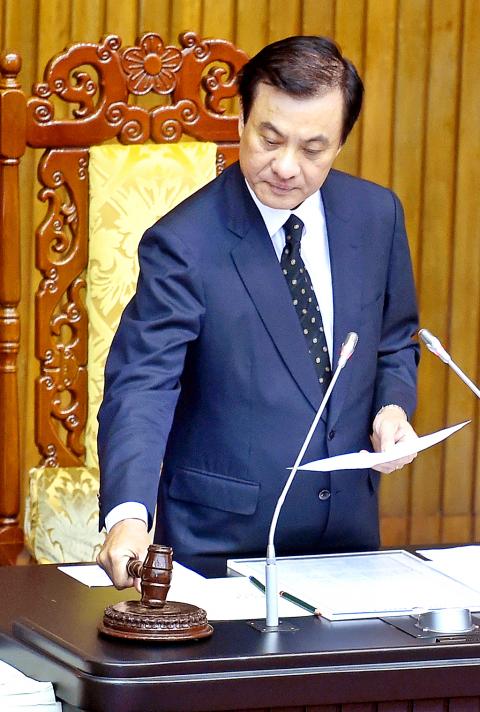
Photo: Chu Pei-hsiung, Taipei Times
Owners, supervisors or employees of businesses that commit the aforementioned crimes would face a maximum prison term of seven years and a fine of up to NT$15 million.
People affiliated with a business whose pollution resulted in loss of life would face a jail term of seven years to life, whereas those that cause grievous bodily harm face a prison term of three to 10 years.
Democratic Progressive Party Legislator Tuan Yi-kang (段宜康), who proposed the amendment, said that due to changes in the wording of the section governing businesses, any firm that pollutes the environment would face punishment, regardless of whether their offenses had been carried out “to the point that it jeopardizes public safety” — a stipulation that had stymied enforcement due to the red tape involved in proving guilt.
Lawmakers also approved amendments to the Political Donations Act (政治獻金法), which cap the sum of each donation to presidential candidates and their running mates at NT$25 million and that to mayoral candidates at NT$3 million.
Each donation to city or county councilor candidates must not exceed NT$500,000, or NT$300,000 to Aboriginal district office heads and NT$100,000 to township mayors or borough wardens, it stipulates.
People found in violation are to be fined twice the donated amount.
The amendments are to become effective once they are promulgated and could apply to the nine-in-one local elections in November.
The amount each candidate receives in campaign donations is to be uploaded online for public viewing six months after the deadline for declaring campaign funding.
In other developments, legislators also passed amendments to the Early Childhood Education and Care Act (幼兒教育及照顧法), which more clearly define rules on the establishment of non-profit kindergartens and introduced a fine of up to NT$500,000 for preschools that use corporal punishment.
Under the amendments, central government agencies, as well as municipal, county and city governments, township offices and Aboriginal district offices, may entrust certified non-profit foundations with the task of establishing non-profit kindergartens, while such foundations may also apply to establish non-profit kindergartens with local governments.
The act previously only permitted local governments to establish non-profit kindergartens.
The changes stipulate that preschool education should be carried out with equity across genders, races and cultures, and should prioritize children from financially disadvantaged households, ethnic minorities and mentally or physically disabled children.
Local governments should facilitate preschool education on outlying islands and in remote areas by collaborating with communities or Aboriginal settlements, it says, adding that the latter should help Aboriginal children learn their native languages, history and culture.
Preschool institutions that use corporal punishment would be fined between NT$60,000 and NT$500,000, and those whose owners or employees sexually harass children would be fined between NT$60,000 and NT$300,000, while those that have employees who are found to have used other inappropriate disciplinary measures would be fined between NT$6,000 and NT$30,000.
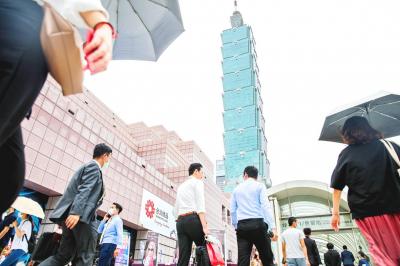
Japanese footwear brand Onitsuka Tiger today issued a public apology and said it has suspended an employee amid allegations that the staff member discriminated against a Vietnamese customer at its Taipei 101 store. Posting on the social media platform Threads yesterday, a user said that an employee at the store said that “those shoes are very expensive” when her friend, who is a migrant worker from Vietnam, asked for assistance. The employee then ignored her until she asked again, to which she replied: "We don't have a size 37." The post had amassed nearly 26,000 likes and 916 comments as of this

US President Donald Trump said "it’s up to" Chinese President Xi Jinping (習近平) what China does on Taiwan, but that he would be "very unhappy" with a change in the "status quo," the New York Times said in an interview published yesterday. Xi "considers it to be a part of China, and that’s up to him what he’s going to be doing," Trump told the newspaper on Wednesday. "But I’ve expressed to him that I would be very unhappy if he did that, and I don’t think he’ll do that," he added. "I hope he doesn’t do that." Trump made the comments in

Tourism in Kenting fell to a historic low for the second consecutive year last year, impacting hotels and other local businesses that rely on a steady stream of domestic tourists, the latest data showed. A total of 2.139 million tourists visited Kenting last year, down slightly from 2.14 million in 2024, the data showed. The number of tourists who visited the national park on the Hengchun Peninsula peaked in 2015 at 8.37 million people. That number has been below 2.2 million for two years, although there was a spike in October last year due to multiple long weekends. The occupancy rate for hotels
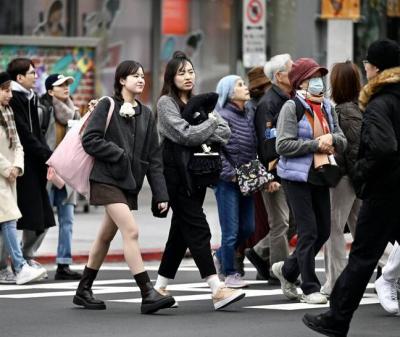
A cold surge advisory was today issued for 18 cities and counties across Taiwan, with temperatures of below 10°C forecast during the day and into tonight, the Central Weather Administration (CWA) said. New Taipei City, Taipei, Taoyuan and Hsinchu, Miaoli and Yilan counties are expected to experience sustained temperatures of 10°C or lower, the CWA said. Temperatures are likely to temporarily drop below 10°C in most other areas, except Taitung, Pingtung, Penghu and Lienchiang (Matsu) counties, CWA data showed. The cold weather is being caused by a strong continental cold air mass, combined with radiative cooling, a process in which heat escapes from


 RSS
RSS