


Chinese Nationalist Party (KMT) Chairman Wu Den-yih (吳敦義) yesterday pledged to mediate between KMT Taipei mayoral candidate Ting Shou-chung (丁守中) and the party’s Central Committee member Sean Lien (連勝文), whose relationship has been plagued by a years-long feud that could cost Ting the support of a prominent KMT family in the Nov. 24 nine-in-one elections.
Wu made the remarks when responding to media queries about whether Ting and Lien have yet to patch things up, given Lien’s refusal on Friday to campaign for the former lawmaker, who on May 9 secured the KMT’s nomination as its Taipei mayoral candidate after four failed attempts since 1994.
“[Lien’s refusal] was inevitable because he is only human. I think [Ting] should try making more visits [to Lien’s family] and let his sincerity change people’s minds,” Wu said on the sidelines of a party event in Taipei, which was also attended by Ting.
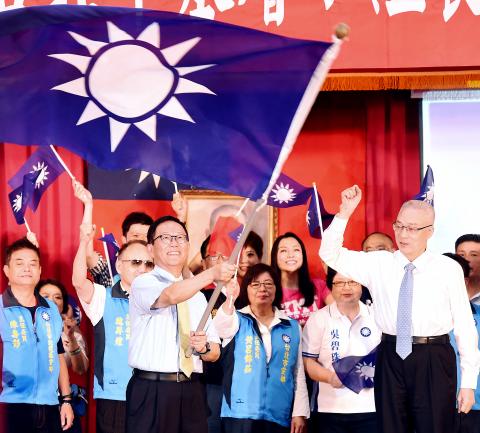
Photo: Chu Pei-hsiung, Taipei Times
Wu said Lien is an outstanding young talent and he believes Lien’s family’s support for Ting “can be expected,” adding that he is willing to mediate, as it is his job as KMT chairman to maintain solidarity within the party.
Lien and Ting’s rapport ran aground after Lien announced his bid for the KMT’s Taipei mayoral primary in February 2014, which prompted Ting, another candidate aspirant at the time, to run a full front-page newspaper ad criticizing Lien and saying he lacked the experience needed to govern the nation’s capital.
The two later exchanged harsh words until the KMT nominated Lien as its Taipei mayoral candidate for the 2014 local elections in April that year.
Although Ting is likely to benefit from a possible split in the pan-green camp after the Democratic Progressive Party (DPP) decided to field its own candidate in Taipei, rather than endorsing independent Taipei Mayor Ko Wen-je (柯文哲) for re-election, it is vital for Ting to win the support of Lien’s family given its influence among KMT supporters.
Lien is the grandson of Lien Chen-tung (連震東), who reportedly rose from a poor civil servant to the seventh-wealthiest man in Taipei within 11 years of the KMT’s retreat to Taiwan in 1949 and occupied several high-ranking positions under the former authoritarian KMT regime, including the position of premier from 1960 to 1966.
Sean Lien’s father, former vice president Lien Chan (連戰), has also filled several high-ranking posts in the government, as well as within the KMT.

The military has spotted two Chinese warships operating in waters near Penghu County in the Taiwan Strait and sent its own naval and air forces to monitor the vessels, the Ministry of National Defense (MND) said. Beijing sends warships and warplanes into the waters and skies around Taiwan on an almost daily basis, drawing condemnation from Taipei. While the ministry offers daily updates on the locations of Chinese military aircraft, it only rarely gives details of where Chinese warships are operating, generally only when it detects aircraft carriers, as happened last week. A Chinese destroyer and a frigate entered waters to the southwest

A magnitude 6.1 earthquake struck off the coast of Yilan County at 8:39pm tonight, the Central Weather Administration (CWA) said, with no immediate reports of damage or injuries. The epicenter was 38.7km east-northeast of Yilan County Hall at a focal depth of 98.3km, the CWA’s Seismological Center said. The quake’s maximum intensity, which gauges the actual physical effect of a seismic event, was a level 4 on Taiwan’s 7-tier intensity scale, the center said. That intensity level was recorded in Yilan County’s Nanao Township (南澳), Hsinchu County’s Guansi Township (關西), Nantou County’s Hehuanshan (合歡山) and Hualien County’s Yanliao (鹽寮). An intensity of 3 was

Japanese Prime Minister Sanae Takaichi’s comment last year on Tokyo’s potential reaction to a Taiwan-China conflict has forced Beijing to rewrite its invasion plans, a retired Japanese general said. Takaichi told the Diet on Nov. 7 last year that a Chinese naval blockade or military attack on Taiwan could constitute a “survival-threatening situation” for Japan, potentially allowing Tokyo to exercise its right to collective self-defense. Former Japan Ground Self-Defense Force general Kiyofumi Ogawa said in a recent speech that the remark has been interpreted as meaning Japan could intervene in the early stages of a Taiwan Strait conflict, undermining China’s previous assumptions
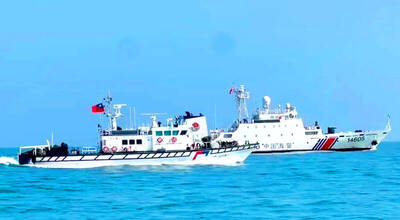
Instead of focusing solely on the threat of a full-scale military invasion, the US and its allies must prepare for a potential Chinese “quarantine” of Taiwan enforced through customs inspections, Stanford University Hoover fellow Eyck Freymann said in a Foreign Affairs article published on Wednesday. China could use various “gray zone” tactics in “reconfiguring the regional and ultimately the global economic order without a war,” said Freymann, who is also a nonresident research fellow at the US Naval War College. China might seize control of Taiwan’s links to the outside world by requiring all flights and ships entering or leaving Taiwan


 RSS
RSS