


To promote renewable energy installations in Aboriginal communities, the government should propose concrete plans to help them build a sustainable industry, instead of simply offering subsidies, Paiwan pastor Sakinu Tepiq said yesterday.
Sakinu Tepiq, who serves as chairman of an Aboriginal community reconstruction foundation, made the remark at a meeting about renewable energy development in Aboriginal communities and remote areas at the Legislative Yuan in Taipei yesterday, which was hosted by Democratic Progressive Party Legislator Chen Man-li (陳曼麗).
The Ministry of Economic Affairs in March released a set of guidelines governing subsidies for Aboriginal regions to install renewable power generation capacity.
Each installation proposal qualifies for a subsidy of up to NT$2 million (US$66,863) in the first stage, Bureau of Energy section head Chen Chung-hsien (陳崇憲) said at the meeting.
In the second stage, the bureau can cover up to 20 percent of a proposal’s total equipment cost up to a limit of NT$10 million, he added.
However, Sakinu Tepiq said that the government could do better than simply providing subsidies.
If the government wants to develop renewable energy generation and boost the economy in Aboriginal communities, it should promote it “as an industry,” as most people would remain passive if they could rely on government subsidies, he said.
Sakinu Tepiq, who has protested against nuclear power and nuclear waste since the 1990s, said he is encouraging people in the Lalauran community (拉勞蘭) in Taitung County’s Taimali Township (太麻里) to join the government program to install solar panels on household rooftops.
In addition to their existing agricultural and tourism industries, Aboriginal communities should break new ground to electrify their economy, so that young people leaving for cities would return to their homelands with hope, he said.
The exploration of other renewable sources, such as geothermal power on the east coast, might bear on the issue of land ownership, and the Council of Indigenous Peoples should more actively help Aborigines obtain the necessary resources, he added.
The council is less familiar with energy-related issues, but would protect Aborigines’ rights in line with the Indigenous Peoples Basic Act (原住民族基本法), council Economic Development Department Deputy Director Tsai Miao-ling (蔡妙凌) said.
While the council supports an industrial approach to renewable power development, it expects agencies in charge of energy policy to provide more assistance and resources, Tsai added.

The military has spotted two Chinese warships operating in waters near Penghu County in the Taiwan Strait and sent its own naval and air forces to monitor the vessels, the Ministry of National Defense (MND) said. Beijing sends warships and warplanes into the waters and skies around Taiwan on an almost daily basis, drawing condemnation from Taipei. While the ministry offers daily updates on the locations of Chinese military aircraft, it only rarely gives details of where Chinese warships are operating, generally only when it detects aircraft carriers, as happened last week. A Chinese destroyer and a frigate entered waters to the southwest

The eastern extension of the Taipei MRT Red Line could begin operations as early as late June, the Taipei Department of Rapid Transit Systems said yesterday. Taipei Rapid Transit Corp said it is considering offering one month of free rides on the new section to mark its opening. Construction progress on the 1.4km extension, which is to run from the current terminal Xiangshan Station to a new eastern terminal, Guangci/Fengtian Temple Station, was 90.6 percent complete by the end of last month, the department said in a report to the Taipei City Council's Transportation Committee. While construction began in October 2016 with an
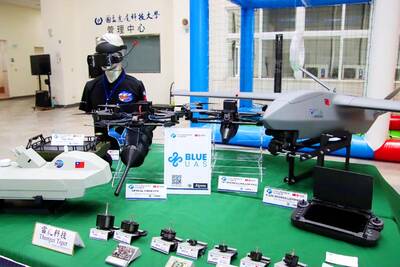
NON-RED SUPPLY: Boosting the nation’s drone industry is becoming increasingly urgent as China’s UAV dominance could become an issue in a crisis, an analyst said Taiwan’s drone exports to Europe grew 41.7-fold from 2024 to last year, with demand from Ukraine’s fight against Russian aggression the most likely driver of growth, a study showed. The Institute for Democracy, Society and Emerging Technology (DSET) in a statement on Wednesday said it found that many of Taiwan’s uncrewed aerial vehicle (UAV) sales were from Poland and the Czech Republic. These countries likely transferred the drones to Ukraine to aid it in its fight against the Russian invasion that started in 2022, it said. Despite the gains, Taiwan is not the dominant drone exporter to these markets, ranking second and fourth

Japanese Prime Minister Sanae Takaichi’s comment last year on Tokyo’s potential reaction to a Taiwan-China conflict has forced Beijing to rewrite its invasion plans, a retired Japanese general said. Takaichi told the Diet on Nov. 7 last year that a Chinese naval blockade or military attack on Taiwan could constitute a “survival-threatening situation” for Japan, potentially allowing Tokyo to exercise its right to collective self-defense. Former Japan Ground Self-Defense Force general Kiyofumi Ogawa said in a recent speech that the remark has been interpreted as meaning Japan could intervene in the early stages of a Taiwan Strait conflict, undermining China’s previous assumptions


 RSS
RSS