


The Legislative Yuan yesterday passed amendments to the Farmer Health Insurance Act (農民健康保險條例) on third reading, extending the coverage of the Occupational Injury Insurance to about 1.16 million farmers nationwide.
The Council of Agriculture (COA), which is responsible for the act, said that it would initiate a soft launch of the improved farmers’ insurance system in November.
Citing calculations by the council, COA Deputy Minister Chen Chi-chung (陳吉仲) said at a committee review of the amendments earlier this month that farmers covered by the Farmers’ Health Insurance system would have to pay just an additional NT$14 (US$0.47) per month to enjoy the benefits offered by the Occupational Injury Insurance system.
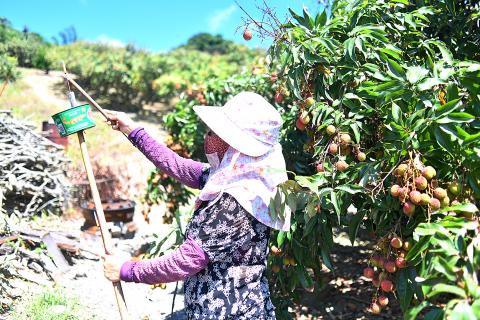
Photo: Tsai Tsung-hsien, Taipei Times
Under the amendments, the insured is to shoulder 60 percent of the premium if their household registration is in one of the six special municipalities, while their local governments and the council would each pay 20 percent of the fee.
If the insured lives in another city or county, their local governments would shoulder 30 percent of the premium, while the council would provide the remaining 10 percent.
Farmers can decide whether they want to be included in the new insurance scheme, which offers the same terms by which the insured can claim compensation as they would under the Occupational Injury Insurance system: If the insured is injured or hospitalized due to work, becomes disabled because of an occupational hazard, or dies at work, in which case their family or beneficiaries would receive compensation equivalent to 30 times their monthly premium, or NT$306,000 (US$10,230).
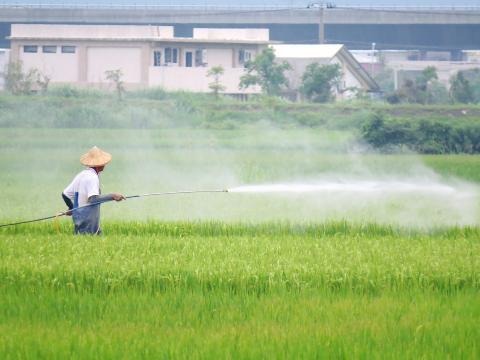
Photo courtesy of Tzeng Der-syh
Insured people who fraudulently claim compensation, such as by using falsified documentation or reports, are to be fined two times the compensation they have received and be credited for any ensuing legal liabilities, an amendment stipulates.
Democratic Progressive Party (DPP) Legislator Tsai Pei-hui (蔡培慧) said that farmers are exposed to a range of occupational hazards — such as heat stroke and injuries from the use of pesticides, herbicides or machinery — but for decades these hazards were overlooked by the government.
She lauded the legislation, saying that everyone toiling in the fields deserves the nation’s support and protection.
In a related development, an amendment to the Temporary Statute Regarding the Welfare Pension of Senior Farmers (老年農民福利津貼暫行條例) also passed its third reading yesterday.
The amendment eased the “luxury clause” targeting farmers aged 65 or older who own properties worth NT$5 million or more, who, according to the former rules, were not eligible to receive farmers’ pensions.
Farmers who own land that has been designated by the government as a reserved site for public infrastructure or had land that has been expropriated, but have not received reimbursements can deduct the value of their properties when their eligibility for receiving pension is reviewed.
Pensions are to be reinstated for farmers who have been excluded from the pension system due to increases in the assessed value of land or houses they own, provided that they have not bought or inherited any properties since Jan. 1 this year.
Additional reporting by Su Fang-ho
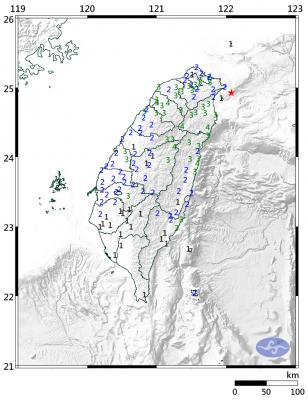
A magnitude 6.1 earthquake struck off the coast of Yilan County at 8:39pm tonight, the Central Weather Administration (CWA) said, with no immediate reports of damage or injuries. The epicenter was 38.7km east-northeast of Yilan County Hall at a focal depth of 98.3km, the CWA’s Seismological Center said. The quake’s maximum intensity, which gauges the actual physical effect of a seismic event, was a level 4 on Taiwan’s 7-tier intensity scale, the center said. That intensity level was recorded in Yilan County’s Nanao Township (南澳), Hsinchu County’s Guansi Township (關西), Nantou County’s Hehuanshan (合歡山) and Hualien County’s Yanliao (鹽寮). An intensity of 3 was
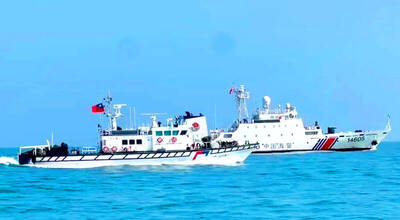
Instead of focusing solely on the threat of a full-scale military invasion, the US and its allies must prepare for a potential Chinese “quarantine” of Taiwan enforced through customs inspections, Stanford University Hoover fellow Eyck Freymann said in a Foreign Affairs article published on Wednesday. China could use various “gray zone” tactics in “reconfiguring the regional and ultimately the global economic order without a war,” said Freymann, who is also a nonresident research fellow at the US Naval War College. China might seize control of Taiwan’s links to the outside world by requiring all flights and ships entering or leaving Taiwan
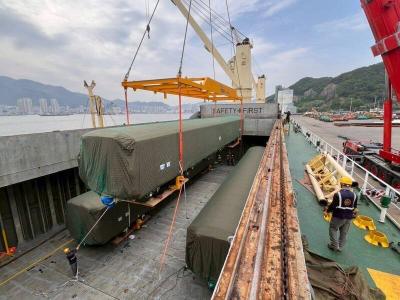
The first of 10 new high-capacity trains purchased from South Korea’s Hyundai Rotem arrived at the Port of Taipei yesterday to meet the demands of an expanding metro network, Taipei Rapid Transit Corp (TRTC) said yesterday. The train completed a three-day, 1,200km voyage from the Port of Masan in South Korea, the company said. Costing NT$590 million (US$18.79 million) each, the new six-carriage trains feature a redesigned interior based on "human-centric" transportation concepts, TRTC said. The design utilizes continuous longitudinal seating to widen the aisles and optimize passenger flow, while also upgrading passenger information displays and driving control systems for a more comfortable
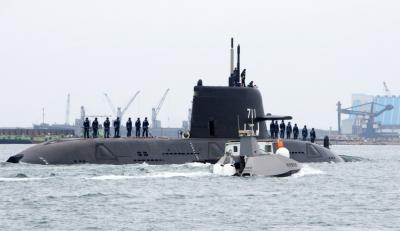
Taiwan's first indigenous defense submarine, the SS-711 Hai Kun (海鯤, or Narwhal), departed for its 13th sea trial at 7am today, marking its seventh submerged test, with delivery to the navy scheduled for July. The outing also marked its first sea deployment since President William Lai (賴清德) boarded the submarine for an inspection on March 19, drawing a crowd of military enthusiasts who gathered to show support. The submarine this morning departed port accompanied by CSBC Corp’s Endeavor Manta (奮進魔鬼魚號) uncrewed surface vessel and a navy M109 assault boat. Amid public interest in key milestones such as torpedo-launching operations and overnight submerged trials,


 RSS
RSS