


President Tsai Ing-wen (蔡英文) yesterday called for a rebuilding of basic mutual trust with China, and reiterated that she would like to meet Chinese President Xi Jinping (習近平), as long as such a meeting is based on reciprocity, with no political conditions.
“The two sides should rebuild basic mutual trust and sit down and talk given the overall international situation,” Tsai told political commentator Clara Chou (周玉蔻) during an interview on Hit FM radio. “Now that South and North Koreas have done so, I think Taiwan and mainland China should also engage in detailed communication.”
“Although there have been cross-strait exchanges in the private sector, I think there is a need for the two sides to advance and deepen two-way communication,” she said.
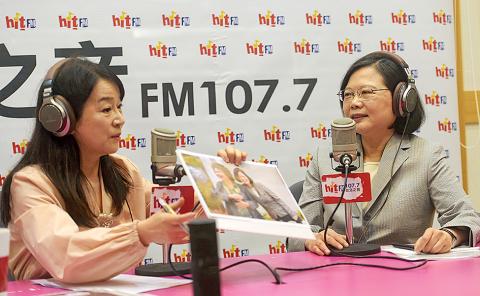
Photo: Chang Chia-ming, Taipei Times
Asked in the radio interview why she is unwilling to back the so-called “1992 consensus” while acknowledging that a cross-strait meeting took place in 1992, Tsai said: “We must explore the truth based on facts.”
“It is a fact that Taiwan and mainland China held a meeting that year, the results of which were interpreted differently by the two sides,” she said. “Maybe the ‘1992 consensus’ contains other explanations, but the question is whether the people of Taiwan can accept them or whether China can accept the KMT’s interpretation.”
“To me, it is an issue that could jeopardize our sovereignty and I will not compromise,” she said.
While Beijing sees the supposed consensus as the political foundation for cross-strait exchanges, the Democratic Progressive Party has refused to endorse it.
Representatives of the Straits Exchange Foundation and China’s Association for Relations Across the Taiwan Strait met in Hong Kong from Oct. 28 to Oct. 30, 1992. No statements were made by either side after the meeting, although each side did issue statements about the talks over the following two months.
Former Mainland Affairs Council chairman Su Chi (蘇起) said in 2006 that he had made up the term “1992 consensus” in 2000 to refer to a supposed tacit understanding between the Chinese Nationalist Party (KMT) and the Chinese government that both sides acknowledge there is “one China,” with each side having its own interpretation of what “China” means.
Asked if Premier William Lai’s (賴清德) description of himself as a “pragmatic worker for Taiwan independence” had prompted the Chinese People’s Liberation Army Air Force to send aircraft on missions circling Taiwan in recent months, Tsai told Chou that Lai is an “honest man.”
“The mainland should know that Taiwan is a democratic society, and it should understand that different opinions can be aired freely in an open society before a consensus could be forged,” she said.
Asked about her falling approval ratings, Tsai said opinion polls did not bother her, because “what counts is whether you have done your best to achieve your goal.”
A poll released yesterday by the Chinese-language United Daily News found that 56 percent of respondents disapproved of Tsai’s performance, up from 50 percent a year ago, while 29 percent approved, down from 30 percent a year ago.
On specific issues, 56 percent of respondents said they were not satisfied with her performance on cross-strait relations and 62 percent were unhappy with her performance on the economy.
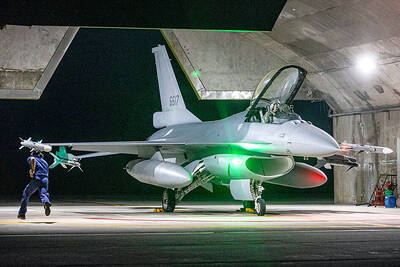
Taiwan has received more than US$70 million in royalties as of the end of last year from developing the F-16V jet as countries worldwide purchase or upgrade to this popular model, government and military officials said on Saturday. Taiwan funded the development of the F-16V jet and ended up the sole investor as other countries withdrew from the program. Now the F-16V is increasingly popular and countries must pay Taiwan a percentage in royalties when they purchase new F-16V aircraft or upgrade older F-16 models. The next five years are expected to be the peak for these royalties, with Taiwan potentially earning
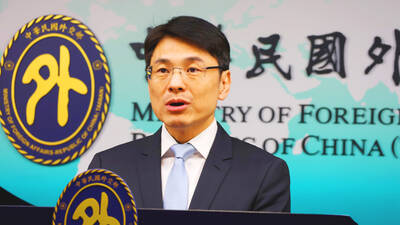
STAY IN YOUR LANE: As the US and Israel attack Iran, the ministry has warned China not to overstep by including Taiwanese citizens in its evacuation orders The Ministry of Foreign Affairs (MOFA) yesterday rebuked a statement by China’s embassy in Israel that it would evacuate Taiwanese holders of Chinese travel documents from Israel amid the latter’s escalating conflict with Iran. Tensions have risen across the Middle East in the wake of US and Israeli airstrikes on Iran beginning Saturday. China subsequently issued an evacuation notice for its citizens. In a news release, the Chinese embassy in Israel said holders of “Taiwan compatriot permits (台胞證)” issued to Taiwanese nationals by Chinese authorities for travel to China — could register for evacuation to Egypt. In Taipei, the ministry yesterday said Taiwan
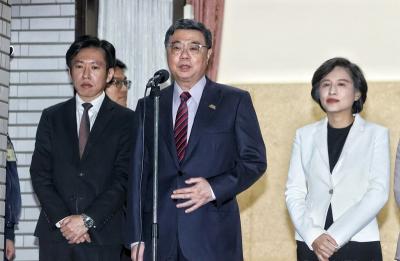
Taiwan is awaiting official notification from the US regarding the status of the Agreement on Reciprocal Trade (ART) after the US Supreme Court ruled US President Donald Trump's global tariffs unconstitutional. Speaking to reporters before a legislative hearing today, Premier Cho Jung-tai (卓榮泰) said that Taiwan's negotiation team remains focused on ensuring that the bilateral trade deal remains intact despite the legal challenge to Trump's tariff policy. "The US has pledged to notify its trade partners once the subsequent administrative and legal processes are finalized, and that certainly includes Taiwan," Cho said when asked about opposition parties’ doubts that the ART was
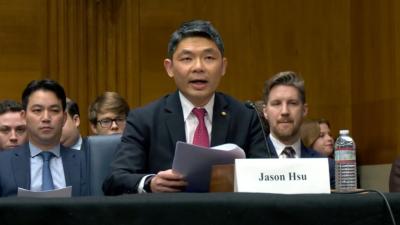
If China chose to invade Taiwan tomorrow, it would only have to sever three undersea fiber-optic cable clusters to cause a data blackout, Jason Hsu (許毓仁), a senior fellow at the Hudson Institute and former Chinese Nationalist Party (KMT) legislator, told a US security panel yesterday. In a Taiwan contingency, cable disruption would be one of the earliest preinvasion actions and the signal that escalation had begun, he said, adding that Taiwan’s current cable repair capabilities are insufficient. The US-China Economic and Security Review Commission (USCC) yesterday held a hearing on US-China Competition Under the Sea, with Hsu speaking on


 RSS
RSS