


Minister of Foreign Affairs Joseph Wu (吳釗燮) yesterday rejected allegations that the government has a list of potential new diplomatic allies, saying that the government has no plans to establish new diplomatic ties and would focus on the nation’s existing allies.
Wu made the remarks in Taipei at his first gathering with the media since taking the helm of the ministry in February, during which he was asked whether the ministry has a list as his predecessor, David Lee (李大維), had told a legislative session in December 2016.
“The foreign ministry does not have such a list. We should focus on strengthening ties with our existing diplomatic allies and let them see that the assistance we are offering them is substantial and vital to maintaining ties with us,” Wu said.
He also said that Taipei would not engage in a checkbook diplomacy war with Beijing, something that Taiwanese strongly oppose, according to opinion polls conducted by the ministry.
Asked if the ministry would adopt any new strategies to counter China’s reinforced attempts to poach the nation’s diplomatic allies, Wu said that relying on political and economic status alone to maintain the relationships would be challenging, so the government would also seek to win the recognition of major world powers through its democratic performance.
The minister also urged the public to refrain from speculating which of the nation’s diplomatic allies is next in line to sever ties, as “doing so would not be conducive to our efforts to maintain these relations.”
The Dominican Republic on Monday last week severed diplomatic ties with Taiwan, the third nation to do so in two years, reportedly to receive US$3.094 billion in investment from China.
Wu also announced the establishment of an Indo-Pacific section at the ministry’s Department of East Asian and Pacific Affairs, which is to become operational on Friday and would be tasked with handling affairs concerning Australia, New Zealand, India and other nations in the region.
The section was created by renaming one of the department’s existing sections and dividing its responsibilities, Wu said, adding that the department was assigned six additional employees in light of the expected increase in its workload due to the government’s New Southbound Policy.
“The change is in response to the current strategic situation,” Wu said.
The change is perceived to be a response to US President Donald Trump’s Indo-Pacific initiative. During a visit to Taiwan in late March, Alex Wong (黃之瀚), deputy assistant secretary at the US Department of State’s Bureau of East Asian and Pacific Affairs, praised Taiwan’s democracy and resulting development as an example for the Indo-Pacific region.
Regarding Taiwan-Japan ties, Wu dismissed concerns that the two nations’ friendship would be affected as China-Japan relations warm ahead of today’s scheduled meeting between Japanese Prime Minister Shinzo Abe and Chinese Premier Li Keqiang (李克強) in Tokyo.
There has also been speculation that Beijing is to lift its ban on Japanese food imports that was implemented following the 2011 Fukushima Dai-ichi nuclear crisis.
“The information we have gathered from our Japanese friends suggests that improvements in China-Japan ties would not influence Japan’s relations with us and that all bilateral interactions would continue,” Wu said.
The government has maintained a consistent stance on the import ban issue, which is to ensure public health and to bring Taiwan’s regulations more in line with international standards, Wu added.
While acknowledging that the ban has been a major hurdle in Taiwan-Japan relations, Wu said it could be lifted once the government’s screening system for imported food products earns the public’s trust.
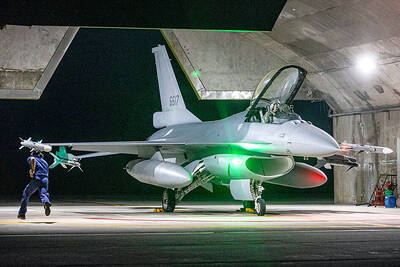
Taiwan has received more than US$70 million in royalties as of the end of last year from developing the F-16V jet as countries worldwide purchase or upgrade to this popular model, government and military officials said on Saturday. Taiwan funded the development of the F-16V jet and ended up the sole investor as other countries withdrew from the program. Now the F-16V is increasingly popular and countries must pay Taiwan a percentage in royalties when they purchase new F-16V aircraft or upgrade older F-16 models. The next five years are expected to be the peak for these royalties, with Taiwan potentially earning
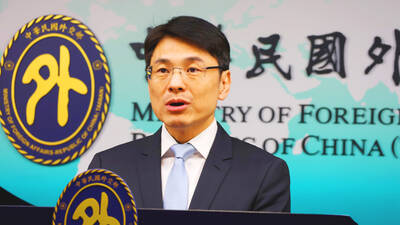
STAY IN YOUR LANE: As the US and Israel attack Iran, the ministry has warned China not to overstep by including Taiwanese citizens in its evacuation orders The Ministry of Foreign Affairs (MOFA) yesterday rebuked a statement by China’s embassy in Israel that it would evacuate Taiwanese holders of Chinese travel documents from Israel amid the latter’s escalating conflict with Iran. Tensions have risen across the Middle East in the wake of US and Israeli airstrikes on Iran beginning Saturday. China subsequently issued an evacuation notice for its citizens. In a news release, the Chinese embassy in Israel said holders of “Taiwan compatriot permits (台胞證)” issued to Taiwanese nationals by Chinese authorities for travel to China — could register for evacuation to Egypt. In Taipei, the ministry yesterday said Taiwan
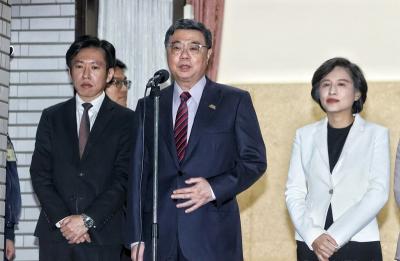
Taiwan is awaiting official notification from the US regarding the status of the Agreement on Reciprocal Trade (ART) after the US Supreme Court ruled US President Donald Trump's global tariffs unconstitutional. Speaking to reporters before a legislative hearing today, Premier Cho Jung-tai (卓榮泰) said that Taiwan's negotiation team remains focused on ensuring that the bilateral trade deal remains intact despite the legal challenge to Trump's tariff policy. "The US has pledged to notify its trade partners once the subsequent administrative and legal processes are finalized, and that certainly includes Taiwan," Cho said when asked about opposition parties’ doubts that the ART was
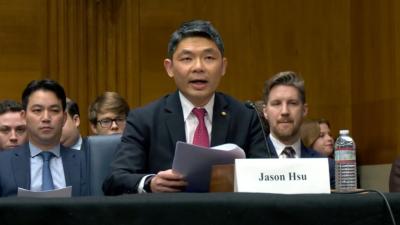
If China chose to invade Taiwan tomorrow, it would only have to sever three undersea fiber-optic cable clusters to cause a data blackout, Jason Hsu (許毓仁), a senior fellow at the Hudson Institute and former Chinese Nationalist Party (KMT) legislator, told a US security panel yesterday. In a Taiwan contingency, cable disruption would be one of the earliest preinvasion actions and the signal that escalation had begun, he said, adding that Taiwan’s current cable repair capabilities are insufficient. The US-China Economic and Security Review Commission (USCC) yesterday held a hearing on US-China Competition Under the Sea, with Hsu speaking on


 RSS
RSS