


A political neutrality requirement for members of the nation’s 15 irrigation associations means that the Chinese Nationalist Party (KMT) is to lose several of its Central Standing Committee members, a party source said yesterday.
An amendment to the Organic Regulations for Irrigation and Water Conservancy Associations (農田水利會組織通則) implemented in November returned control of the associations to the government. To facilitate the transition, the terms for leaders and members of the associations were extended to 2020, but all are required to follow the Civil Service Administrative Neutrality Act (公務人員行政中立法) during the interim.
One of the KMT’s most influential Central Standing Committee members, Lin Wen-jui (林文瑞) — who is also head of the Yunlin Irrigation Association — last month resigned from the party, the source said, adding that the party believes the resignation is unnecessary.
The KMT has protested the amendment, saying it would make the associations a tool for political manipulation, with one legislator calling it a scare tactic aimed at coercing farmers into voting for the Democratic Progressive Party. Giving control of the associations to the Executive Yuan would “bind the hands and feet” of association members, the KMT said.
Eleven association heads are also KMT members, such as Lin, who holds various party posts and also leads the Joint Irrigation Association, in addition to the Yunlin organization.
The KMT believes that association heads and members should not be required to resign from the party if their positions within the KMT are unpaid, the source said, citing Lin, whose serves on the Central Standing Committee as a volunteer.
“Otherwise, you may as well change the Constitution to say that no civil servant can be a member of a political party,” the source said, adding that people should be free to have political affiliations if it does not interfere with their work.
Lin should not abandon his party affiliation, KMT Central Standing Committee member Lee Te-wei (李德維) said, adding that his party-related roles are honorary and not salaried.
“Is it not the case that there are Democratic Progressive Party Central Standing Committee and Central Executive Committee members who are also paid government officials?” he added.

SECURITY: Starlink owner Elon Musk has taken pro-Beijing positions, and allowing pro-China companies to control Taiwan’s critical infrastructure is risky, a legislator said Starlink was reluctant to offer services in Taiwan because of the nation’s extremely high penetration rates in 4G and 5G services, the Ministry of Digital Affairs said yesterday. The ministry made the comments at a meeting of the legislature’s Transportation Committee, which reviewed amendments to Article 36 of the Telecommunications Management Act (電信管理法). Article 36 bans foreigners from holding more than 49 percent of shares in public telecommunications networks, while shares foreigners directly and indirectly hold are also capped at 60 percent of the total, unless specified otherwise by law. The amendments, sponsored by Chinese Nationalist Party (KMT) Legislator Ko
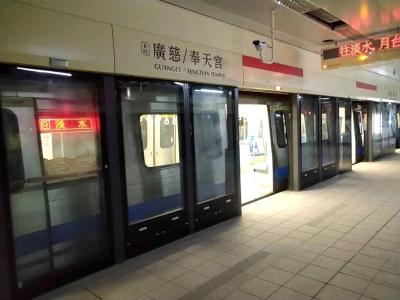
The eastern extension of the Taipei MRT Red Line could begin operations as early as late June, the Taipei Department of Rapid Transit Systems said yesterday. Taipei Rapid Transit Corp said it is considering offering one month of free rides on the new section to mark its opening. Construction progress on the 1.4km extension, which is to run from the current terminal Xiangshan Station to a new eastern terminal, Guangci/Fengtian Temple Station, was 90.6 percent complete by the end of last month, the department said in a report to the Taipei City Council's Transportation Committee. While construction began in October 2016 with an
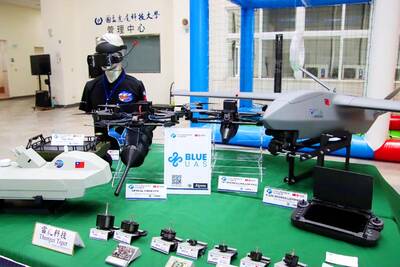
NON-RED SUPPLY: Boosting the nation’s drone industry is becoming increasingly urgent as China’s UAV dominance could become an issue in a crisis, an analyst said Taiwan’s drone exports to Europe grew 41.7-fold from 2024 to last year, with demand from Ukraine’s fight against Russian aggression the most likely driver of growth, a study showed. The Institute for Democracy, Society and Emerging Technology (DSET) in a statement on Wednesday said it found that many of Taiwan’s uncrewed aerial vehicle (UAV) sales were from Poland and the Czech Republic. These countries likely transferred the drones to Ukraine to aid it in its fight against the Russian invasion that started in 2022, it said. Despite the gains, Taiwan is not the dominant drone exporter to these markets, ranking second and fourth

Japanese Prime Minister Sanae Takaichi’s comment last year on Tokyo’s potential reaction to a Taiwan-China conflict has forced Beijing to rewrite its invasion plans, a retired Japanese general said. Takaichi told the Diet on Nov. 7 last year that a Chinese naval blockade or military attack on Taiwan could constitute a “survival-threatening situation” for Japan, potentially allowing Tokyo to exercise its right to collective self-defense. Former Japan Ground Self-Defense Force general Kiyofumi Ogawa said in a recent speech that the remark has been interpreted as meaning Japan could intervene in the early stages of a Taiwan Strait conflict, undermining China’s previous assumptions


 RSS
RSS