


The army has proposed a modernization program to replace or upgrade nine major types of weapons and equipment, including replacing aging battle tanks with US-made M1A2 Abrams, a Ministry of National Defense official said.
The budget plan, titled “The Follow-up Plan for the Procurement of Important New Combat Systems for the Army,” requests the ministry to obtain a substantial number of new weapons, the official said on condition of anonymity.
While the army has over the past decade obtained AH-64 attack and UH-60 utility helicopters and CM-32 wheeled armored personnel carriers, large quantities of other essential equipment still need modernization, the official said.
The nine items on the army’s wish list are tanks, anti-tank guided missiles, self-propelled air defense systems, mortars and 155mm howitzers, infantry fighting vehicles, tracked field recovery vehicles, fuel trucks and new rifles, the official said.
The equipment is to be obtained from US arms sales or developed by the Chungshan Institute of Science and Technology and manufactured domestically, he said.
All of the weapons and equipment tentatively slated for replacement or upgrades are those that have been in service for more than 25 years and are nearing obsolescence, he said.
Army generals, especially those from the armored branch, want to place an order for more than 500 M1A2 tanks to replace the M60A3 and CM-11 tanks, whereas the ministry considers their proposal excessive, because the army has more than 1,000 tanks in active service, he said.
Instead, the ministry is inclined to request to purchase about 100 M1A2 tanks from the US, which would be adequate for fully equipping two armored battalions, he said.
The army’s Avenger air defense missile system — essentially Stinger missile launchers mounted on Humvees — are armed with older munitions types and have a high incident rate for rollovers, he said.
As a result, the army is interested in either procuring an upgraded model from the US, or considering the option of replacing it with an indigenous self-propelled air defense system to be developed by the institute, the official said.
The remaining legacy tanks and artillery pieces would undergo servicing to extend their service life and maintenance until they could be replaced, he said.

SECURITY: Starlink owner Elon Musk has taken pro-Beijing positions, and allowing pro-China companies to control Taiwan’s critical infrastructure is risky, a legislator said Starlink was reluctant to offer services in Taiwan because of the nation’s extremely high penetration rates in 4G and 5G services, the Ministry of Digital Affairs said yesterday. The ministry made the comments at a meeting of the legislature’s Transportation Committee, which reviewed amendments to Article 36 of the Telecommunications Management Act (電信管理法). Article 36 bans foreigners from holding more than 49 percent of shares in public telecommunications networks, while shares foreigners directly and indirectly hold are also capped at 60 percent of the total, unless specified otherwise by law. The amendments, sponsored by Chinese Nationalist Party (KMT) Legislator Ko

The eastern extension of the Taipei MRT Red Line could begin operations as early as late June, the Taipei Department of Rapid Transit Systems said yesterday. Taipei Rapid Transit Corp said it is considering offering one month of free rides on the new section to mark its opening. Construction progress on the 1.4km extension, which is to run from the current terminal Xiangshan Station to a new eastern terminal, Guangci/Fengtian Temple Station, was 90.6 percent complete by the end of last month, the department said in a report to the Taipei City Council's Transportation Committee. While construction began in October 2016 with an
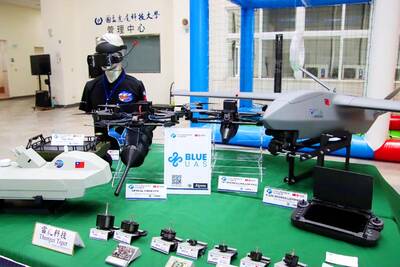
NON-RED SUPPLY: Boosting the nation’s drone industry is becoming increasingly urgent as China’s UAV dominance could become an issue in a crisis, an analyst said Taiwan’s drone exports to Europe grew 41.7-fold from 2024 to last year, with demand from Ukraine’s fight against Russian aggression the most likely driver of growth, a study showed. The Institute for Democracy, Society and Emerging Technology (DSET) in a statement on Wednesday said it found that many of Taiwan’s uncrewed aerial vehicle (UAV) sales were from Poland and the Czech Republic. These countries likely transferred the drones to Ukraine to aid it in its fight against the Russian invasion that started in 2022, it said. Despite the gains, Taiwan is not the dominant drone exporter to these markets, ranking second and fourth
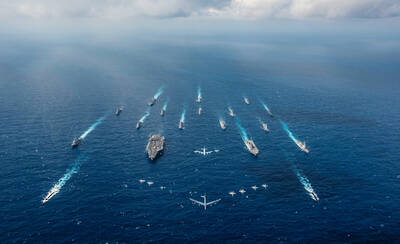
Japanese Prime Minister Sanae Takaichi’s comment last year on Tokyo’s potential reaction to a Taiwan-China conflict has forced Beijing to rewrite its invasion plans, a retired Japanese general said. Takaichi told the Diet on Nov. 7 last year that a Chinese naval blockade or military attack on Taiwan could constitute a “survival-threatening situation” for Japan, potentially allowing Tokyo to exercise its right to collective self-defense. Former Japan Ground Self-Defense Force general Kiyofumi Ogawa said in a recent speech that the remark has been interpreted as meaning Japan could intervene in the early stages of a Taiwan Strait conflict, undermining China’s previous assumptions


 RSS
RSS