


A group of public school teachers yesterday protested outside the Democratic Progressive Party’s (DPP) headquarters in Taipei against provisions in a law set to take effect in July that would allow public school teachers’ spouses without a pension plan to receive part of their pension after a divorce.
About 20 teachers called for the Act Governing Retirement, Severance, and Bereavement Compensation for the Teaching and Other Staff Members of Public Schools (公立學校教職員退休資遣撫卹條例) to be amended.
Until the law takes effect, pensions are not considered part of a married couple’s shared assets and do not have to be redistributed upon divorce.
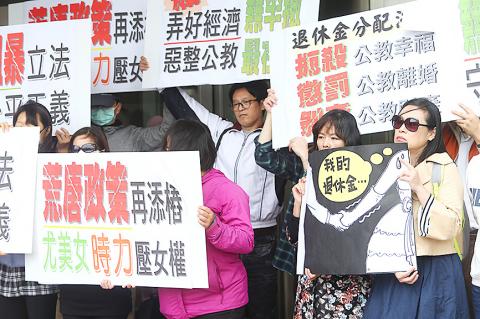
Photo: CNA
However, the act stipulates that teachers’ spouses of more than two years who are not on a pension plan can claim part of a teacher’s pension in case of a divorce.
According to the enforcement rules announced in November last year, the amount that a former spouse can receive is calculated by multiplying the pension by the percentage of time that the marriage overlapped with the public school teacher’s career and then dividing it by two.
DPP Legislator Yu Mei-nu (尤美女) and the New Power Party caucus strongly advocated the legislation and described it as a progressive step toward gender equality, New Taipei City Education Union secretary-general Lee Man-li (李曼麗) said.
They overlooked the fact that 61 percent of public school teachers in Taiwan are women and many of them are also responsible for most chores at home, she said.
“Wouldn’t it be very unfair if they had to give part of their pension to an ex-husband who contributed very little?” She asked.
Whether a spouse is on a pension plan says nothing about their financial situation, Lee said, adding that many business owners, freelancers and lawyers do not have official pensions, but own considerable assets.
The government has already reduced civil servants and public-school teachers’ pensions, and now it even wants to allow cheating spouses to take from what is left, Taipei School Education Union president Lee Hui-lan (李惠蘭) said.
“Yu said that teachers can file a lawsuit if they do not agree with the percentage of pension their spouse are eligible for, but lawsuits are complex and stressful,” she said.
“First you need to collect evidence for the court. Then you also need a lot of money,” she said. “Every court session requires at least NT$60,000.”
Anyone who is going through a divorce is already under great emotional stress, she said.
As the ruling party and an important champion of the legislation, the DPP should amend the act to better protect the rights of career women who are also the homemakers of their families, Lee Man-li said.
In addition to public school teachers, civil servants who divorce after June 30 would also be subject to the rule.
Yu has said that the rules are intended to protect spouses who stay at home to care for families, as they might not be able to find a job after a divorce.
Such rules also exist in Japan and Germany, and the DPP would promote similar regulations in other sectors, Yu said.

The Centers for Disease Control (CDC) yesterday reported the first case of a new COVID-19 subvariant — BA.3.2 — in a 10-year-old Singaporean girl who had a fever upon arrival in Taiwan and tested positive for the disease. The girl left Taiwan on March 20 and the case did not have a direct impact on the local community, it said. The WHO added the BA.3.2 strain to its list of Variants Under Monitoring in December last year, but this was the first imported case of the COVID-19 variant in Taiwan, CDC Deputy Director-General Lin Ming-cheng (林明誠) said. The girl arrived in Taiwan on

South Korea is planning to revise its controversial electronic arrival card, a step Taiwanese officials said prompted them to hold off on planned retaliatory measures, a South Korean media report said yesterday. A Yonhap News Agency report said that the South Korean Ministry of Foreign Affairs is planning to remove the “previous departure place” and “next destination” fields from its e-arrival card system. The plan, reached after interagency consultations, is under review and aims to simplify entry procedures and align the electronic form with the paper version, a South Korean ministry official said. The fields — which appeared only on the electronic form

The Ministry of Foreign Affairs (MOFA) is suspending retaliation measures against South Korea that were set to take effect tomorrow, after Seoul said it is updating its e-arrival system, MOFA said today. The measures were to be a new round of retaliation after Taiwan on March 1 changed South Korea's designation on government-issued alien resident certificates held by South Korean nationals to "South Korea” from the "Republic of Korea," the country’s official name. The move came after months of protests to Seoul over its listing of Taiwan as "China (Taiwan)" in dropdown menus on its new online immigration entry system. MOFA last week

A bipartisan group of US senators has introduced a bill to enhance cooperation with Taiwan on drone development and to reduce reliance on supply chains linked to China. The proposed Blue Skies for Taiwan Act of 2026 was introduced by Republican US senators Ted Cruz and John Curtis, and Democratic US senators Jeff Merkley and Andy Kim. The legislation seeks to ease constraints on Taiwan-US cooperation in uncrewed aerial systems (UAS), including dependence on China-sourced components, limited access to capital and regulatory barriers under US export controls, a news release issued by Cruz on Wednesday said. The bill would establish a "Blue UAS


 RSS
RSS