


Former US secretary of defense William Perry yesterday urged the Taiwanese government to “play it cool” ahead of the Chinese People’s Liberation Army’s (PLA) planned live-fire drill in the Taiwan Strait next week.
“My advice will be as long as the Chinese do not violate your boundary and sovereignty, play it cool. Don’t read something into [what] might or might not be there,” Perry told media in Taipei.
“They called it a drill, accept it as a drill,” he said, referring to the PLA’s scheduled exercise that is scheduled to take place from 8am to midnight on Wednesday next week in a zone 20km from the coast of Quanzhou Bay in Fujian Province.
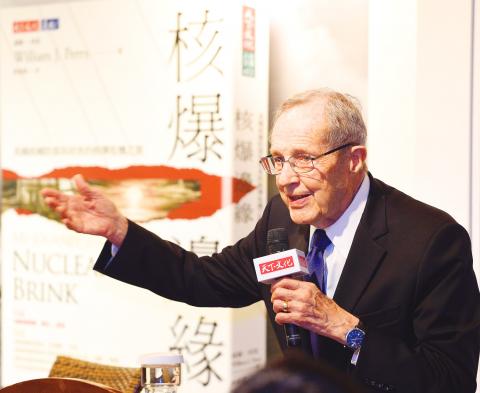
Photo: George Tsorng, Taipei Times
Perry, who served as US secretary of defense from 1994 to 1997 under then-US president Bill Clinton, was on a whirlwind 24-hour visit to Taiwan to promote the Mandarin version of his book, My Journey at the Nuclear Brink.
During the 1996 Third Taiwan Strait Crisis, Perry urged Clinton to dispatch two aircraft carriers to patrol waters close to the Strait.
Perry said the US chose to act strongly in 1996 was because “it was obviously more than a drill,” but rather an attempt at coercion by Beijing, which therefore justified Washington’s strong response.
“So my advice is don’t read something into a military drill and don’t interpret it,” he said.
The 90-year-old said he has more confidence in the security and safety of Taiwan today than he did in 1996, given that a lot has changed across the Taiwan Strait over the past two decades.
“Maybe most dramatically is the free travel between China and Taiwan. And also, the very robust commercial air traffic and the very robust economic interchange,” he said, adding that he did not see any basis for believing that Beijing is trying to stimulate military action against Taipei.
Asked whether Taiwan should seek to purchase Lockheed Martin F-35 jets from the US, Perry said he would not recommend such an acquisition, as it would be more effective for Taiwan to improve its air capability by spending resources on pilot training and air-to-air missiles than buying the latest aircraft.
“It [purchasing F-35 jets] is probably not necessary. The previous generation of fighter planes, some of which Taiwan already has, are very, very good,” Perry said, adding that the F-35 is also “very expensive.”
Turning to the US’ recently promulgated Taiwan Travel Act, which encourages high-level visits by US and Taiwanese officials, Perry said he holds a positive view of the new legislation.
“My own experience when I was in government is that the more visits, more dialogues and more discussions, the better,” he said.

Yangmingshan National Park authorities yesterday urged visitors to respect public spaces and obey the law after a couple was caught on a camera livestream having sex at the park’s Qingtiangang (擎天崗) earlier in the day. The Shilin Police Precinct in Taipei said it has identified a suspect and his vehicle registration number, and would summon him for questioning. The case would be handled in accordance with public indecency charges, it added. The couple entered the park at about 11pm on Thursday and began fooling around by 1am yesterday, the police said, adding that the two were unaware of the park’s all-day live
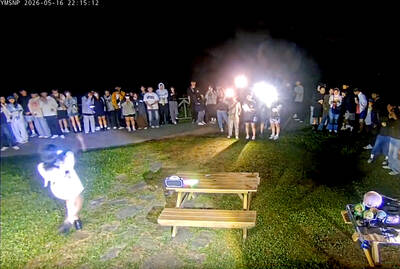
Yangmingshan National Park’s Qingtiangang (擎天崗) nature area has gone viral after a park livestream camera observed a couple in the throes of intimate congress, which was broadcast live on YouTube, drawing large late-night crowds and sparking a backlash over noise, bright lights and disruption to wildlife habitat. The area’s livestream footage appeared to show a couple engaging in sexual activity on a picnic table in the park on Friday last week, with the uncensored footage streamed publicly online. The footage quickly spread across social media, prompting a tide of visitors to travel to the site to “check in” and recreate the
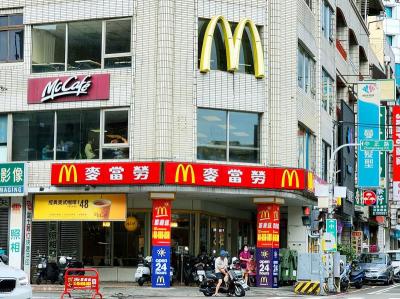
Fast food chain McDonald's is to raise prices by up to NT$5 on some products at its restaurants across Taiwan, starting on Wednesday next week, the company announced today. The prices of all extra value meals and sharing boxes are to increase by NT$5, while breakfast combos and creamy corn soup would go up by NT$3, the company said in a statement. The price of the main items of those meals, if ordered individually, would remain the same. Meanwhile, the price of a medium-sized lemon iced tea and hot cappuccino would rise by NT$3, extra dipping sauces for chicken nuggets would go up

Minister of Digital Affairs Lin Yi-ching (林宜敬) yesterday cited regulatory issues and national security concerns as an expert said that Taiwan is among the few Asian regions without Starlink. Lin made the remarks on Facebook after funP Innovation Group chief executive officer Nathan Chiu (邱繼弘) on Friday said Taiwan and four other countries in Asia — China, North Korea, Afghanistan and Syria — have no access to Starlink. Starlink has become available in 166 countries worldwide, including Ukraine, Malaysia, the Philippines and Vietnam, in the six years since it became commercial, he said. While China and North Korea block Starlink, Syria is not


 RSS
RSS