


Nearly 200 people wearing white T-shirts and caps yesterday afternoon protested in front of the Taipei City Council building and handed Taipei Mayor Ko Wen-je (柯文哲) a petition against fines the city government imposed on residents of 1,675 illegal residential units in a commercial zone in Neihu District (內湖).
The residential units were found by the city government last year in a 105 hectare area along Neihu’s Mingshui and Jingye roads near the MRT Jiannan Road Station, although the area was designated for commercial and recreational use in 2003.
From March to August last year, the Taipei Department of Urban Development informed residents that they would face fines under the Urban Planning Act (都市計畫法) for living in illegal residential units.
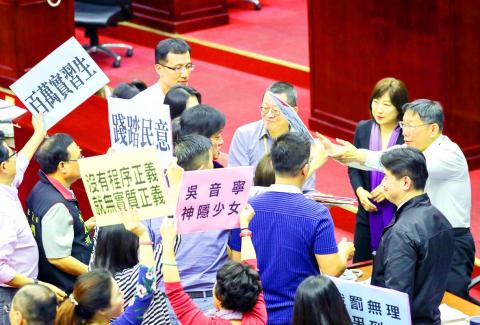
Photo: CNA
In October last year, the department announced five categories of fines according to unit size.
Despite several protests by the area’s residents, the department in December last year said that it would not change its decision to impose fines.
As Ko was asked to report to the city council during the first meeting of its new session yesterday, nearly 200 residents of the area gathered outside to protest against what they called unfair fines and handed their petition to the mayor.
Several Chinese Nationalist Party (KMT) and Democratic Progressive Party city councilors joined the protesters in support.
Ko accepted the written petition, but walked into the building without verbally responding to the demonstrators.
A few city councilors also attempted to stop Ko from delivering his administrative report at the beginning of the meeting, which mainly focused on the issue of illegal residential units in Neihu.
KMT Taipei City Councilor Chen Yi-chou (陳義洲) said that department Commissioner Lin Jou-min (林洲民) has defamed the residents as intentionally living in an area that is not zoned for residential use.
Citing a survey that showed the majority of city government department heads did not read urban planning documents before purchasing residential units, Chen said the government should not condemn the residents for not knowing the homes they purchased were illegally constructed in a commercial and recreational zone.
KMT Taipei City Councilor Yeh Lin-chuan (葉林傳) urged Ko to re-evaluate urban planning in Neihu.

Taiwanese paleontologists have discovered fossil evidence that pythons up to 4m long inhabited Taiwan during the Pleistocene epoch, reporting their findings in the international scientific journal Historical Biology. National Taiwan University (NTU) Institute of Ecology and Evolutionary Biology associate professor Tsai Cheng-hsiu (蔡政修) led the team that discovered the largest snake fossil ever found in Taiwan. The single trunk vertebra was discovered in Tainan at the Chiting Formation, dated to between 400,000 and 800,000 years ago in the Middle Pleistocene, the paper said. The area also produced Taiwan’s first avian fossil, as well as crocodile, mammoth, saber-toothed cat and rhinoceros fossils, it said. Discoveries

Taiwanese paleontologists have discovered fossil evidence that pythons up to 4m long inhabited Taiwan during the Pleistocene epoch, reporting their findings in the international scientific journal Historical Biology. National Taiwan University (NTU) Institute of Ecology and Evolutionary Biology associate professor Tsai Cheng-hsiu (蔡政修) led the team that discovered the largest snake fossil ever found in Taiwan. A single trunk vertebra was discovered in Tainan at the Chiting Formation, dated to between 800,000 to 400,000 years ago in the Middle Pleistocene, the paper said. The area also produced Taiwan’s first avian fossil, as well as crocodile, mammoth, sabre-toothed cat and rhinoceros fossils, it said. Discoveries
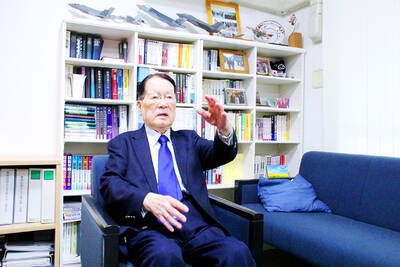
Whether Japan would help defend Taiwan in case of a cross-strait conflict would depend on the US and the extent to which Japan would be allowed to act under the US-Japan Security Treaty, former Japanese minister of defense Satoshi Morimoto said. As China has not given up on the idea of invading Taiwan by force, to what extent Japan could support US military action would hinge on Washington’s intention and its negotiation with Tokyo, Morimoto said in an interview with the Liberty Times (sister paper of the Taipei Times) yesterday. There has to be sufficient mutual recognition of how Japan could provide
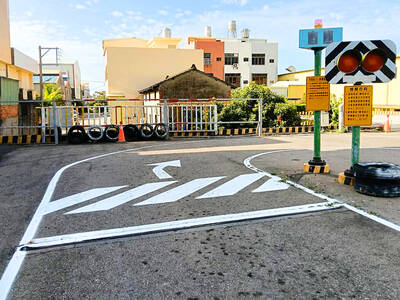
UPDATED TEST: The new rules aim to assess drivers’ awareness of risky behaviors and how they respond under certain circumstances, the Highway Bureau said Driver’s license applicants who fail to yield to pedestrians at intersections or to check blind spots, or omit pointing-and-calling procedures would fail the driving test, the Highway Bureau said yesterday. The change is set to be implemented at the end of the month, and is part of the bureau’s reform of the driving portion of the test, which has been criticized for failing to assess whether drivers can operate vehicles safely. Sedan drivers would be tested regarding yielding to pedestrians and turning their heads to check blind spots, while drivers of large vehicles would be tested on their familiarity with pointing-and-calling


 RSS
RSS