


A working holiday program is to be offered to young people from Southeast Asian nations to ease a labor shortage in the agricultural sector, the Council of Agriculture (COA) said.
Vietnam, Indonesia, the Philippines and Thailand would be the first nations targeted by the program, the council said, adding that as the Vietnamese government is optimistic about the program, it expects collaborations to begin later this year.
The council is next week to invite officials from the Ministry of Foreign Affairs, the Ministry of the Interior and the Ministry of Labor to discuss the plan, it said.
The foreign ministry has signed working holiday programs with 15 nations, including New Zealand, Australia, Singapore, Japan and South Korea, but people from developed countries are less likely to visit Taiwan on a working holiday, council Deputy Minister Chen Chi-chung (陳吉仲) said.
Given that there are many Southeast Asian people married to Taiwanese or who already work in Taiwan, the council wants to prioritize agreements with Vietnam, Indonesia, the Philippines and Thailand first, he added.
The working holiday program is to be open to applicants aged 20 to 45 for at least 180 days, which can be extended for one or two years, the council said.
Following the council’s preliminary planning, the foreign ministry will negotiate details with other nations, the council said.
However, visitors from Vietnam, Indonesia, the Philippines and Thailand are considered at higher risk of overstaying their visas, council Personnel Office Executive Secretary Tsai Pei-chun (蔡佩君) said.
The council is to consider granting visas to those who have family in Taiwan first and allow them to apply for visa extensions, she said.
Given that the majority of the nation’s foreign spouses are Vietnamese, the program would offer about 300 places to Vietnamese, the council said, adding that the program would allow a maximum of 1,000 people from Vietnam, Indonesia, the Philippines and Thailand.
The council hopes that negotiations with the countries will focus on job openings in the agricultural sector, she said, but added that applicants might be able to change jobs.
First-time visas are expected to be set at six months, and officials might ask those applying for visa extensions to present documentation showing that they have worked in the agricultural industry for at least three months, she said.
Agricultural businesses could consider retaining foreign workers who perform well while on their working holiday, and those with specialized skills are likely to earn up to NT$47,000 per month, she said.
The Nantou and Yunlin county governments have expressed an intention to open working holiday programs for family members of foreign spouses, Tsai said.

LOUD AND PROUD Taiwan might have taken a drubbing against Australia and Japan, but you might not know it from the enthusiasm and numbers of the fans Taiwan might not be expected to win the World Baseball Classic (WBC) but their fans are making their presence felt in Tokyo, with tens of thousands decked out in the team’s blue, blowing horns and singing songs. Taiwanese fans have packed out the Tokyo Dome for all three of their games so far and even threatened to drown out home team supporters when their team played Japan on Friday. They blew trumpets, chanted for their favorite players and had their own cheerleading squad who dance on a stage during the game. The team struggled to match that exuberance on the field, with
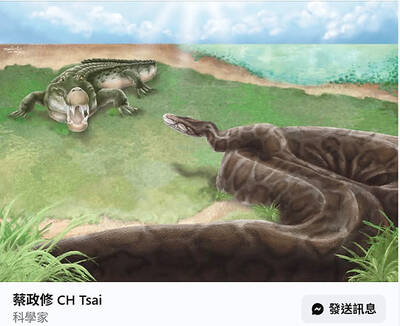
Taiwanese paleontologists have discovered fossil evidence that pythons up to 4m long inhabited Taiwan during the Pleistocene epoch, reporting their findings in the international scientific journal Historical Biology. National Taiwan University (NTU) Institute of Ecology and Evolutionary Biology associate professor Tsai Cheng-hsiu (蔡政修) led the team that discovered the largest snake fossil ever found in Taiwan. The single trunk vertebra was discovered in Tainan at the Chiting Formation, dated to between 400,000 and 800,000 years ago in the Middle Pleistocene, the paper said. The area also produced Taiwan’s first avian fossil, as well as crocodile, mammoth, saber-toothed cat and rhinoceros fossils, it said. Discoveries

Taiwanese paleontologists have discovered fossil evidence that pythons up to 4m long inhabited Taiwan during the Pleistocene epoch, reporting their findings in the international scientific journal Historical Biology. National Taiwan University (NTU) Institute of Ecology and Evolutionary Biology associate professor Tsai Cheng-hsiu (蔡政修) led the team that discovered the largest snake fossil ever found in Taiwan. A single trunk vertebra was discovered in Tainan at the Chiting Formation, dated to between 800,000 to 400,000 years ago in the Middle Pleistocene, the paper said. The area also produced Taiwan’s first avian fossil, as well as crocodile, mammoth, sabre-toothed cat and rhinoceros fossils, it said. Discoveries

Whether Japan would help defend Taiwan in case of a cross-strait conflict would depend on the US and the extent to which Japan would be allowed to act under the US-Japan Security Treaty, former Japanese minister of defense Satoshi Morimoto said. As China has not given up on the idea of invading Taiwan by force, to what extent Japan could support US military action would hinge on Washington’s intention and its negotiation with Tokyo, Morimoto said in an interview with the Liberty Times (sister paper of the Taipei Times) yesterday. There has to be sufficient mutual recognition of how Japan could provide


 RSS
RSS