


One of the main proponents of the US’ recently enacted Taiwan Travel Act yesterday vowed to continue efforts to strengthen Taiwan-US relations as he became the first US lawmaker to receive an honorary medal for diplomacy from the Legislative Yuan for his long-term dedication to promoting bilateral ties.
US Representative Ed Royce, chairman of the US House Committee on Foreign Affairs, received the Congressional Diplomacy Honorary Medal from Legislative Speaker Su Jia-chyuan (蘇嘉全) at a ceremony at the legislature in Taipei yesterday morning.
Praising Royce as the “strongest facilitator and defender” of Taiwan-US relations, Su said the US lawmaker has pushed his congressional colleagues and the US executive branch to engage in bilateral exchanges and pass Taiwan-friendly legislation.
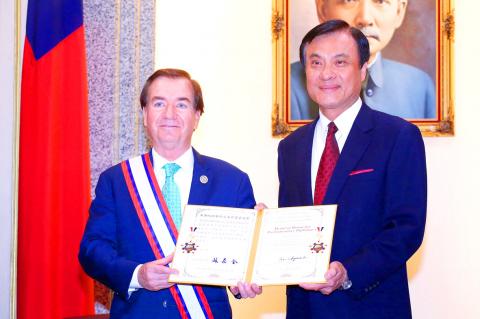
Photo: CNA
“[Such efforts] can be evidenced by the Taiwan Travel Act enacted recently, which has met with admiration from the people of Taiwan, as well as members of our legislature,” Su said.
Su said that thanks to genuine friends and foresighted statesmen such as Royce, the relationship between Taipei and Washington is expected to grow stronger, and continue to contribute to the maintenance of regional peace and stability.
In his acceptance speech, Royce said that 20 years ago he made his first visit to Taiwan, which was also the destination of his first trip abroad after becoming chairman of the committee six years ago.
“The reason [for the trip as new committee chairman] was in order to send a powerful message about the importance of the strong relationship between Taiwan and the US,” Royce said.
With that message in mind, Royce said he has over the years led many bipartisan delegations to Taiwan, helped pass initiatives important to the economic strength and security of the nation and worked to improve the US’ Taiwan Relations Act, which has served as the cornerstone of Taiwan-US ties since its passage in 1979.
Concrete results have also been yielded by efforts to facilitate travel by people of the two nations, Royce said, citing Taiwan’s inclusion into the US’ Visa Waiver and Global Entry programs in 2012 and late last year respectively.
The latest achievement in that area was the inauguration on Sunday of direct flights by China Airlines between Taiwan Taoyuan International Airport and Ontario International Airport in California, which he said could further promote travel between the two sides, as Ontario airport is close to areas where 55 percent of Taiwanese-Americans in California live.
The flight route could also make Taiwan a transfer hub for people traveling between the US and ASEAN nations, he added.
Thanking the nation for the honor, Royce concluded his speech by pledging to continue his efforts to strengthen ties between Taiwan and the US.
Royce is one of the sponsors of the Taiwan Travel Act, which encourages high-level visits by Taiwanese and US officials.
The legislation was signed into law by US President Donald Trump on March 16 after receiving the unanimous support of the US House of Representatives on Jan. 9 and the US Senate on Feb. 28.
The Ministry of Foreign Affairs said Royce is the first US lawmaker to receive the medal, which has been granted to individuals who help the legislature maintain relationships with lawmakers worldwide.

Considering that most countries issue more than five denominations of banknotes, the central bank has decided to redesign all five denominations, the bank said as it prepares for the first major overhaul of the banknotes in more than 24 years. Central bank Governor Yang Chin-lung (楊金龍) is expected to report to the Legislative Yuan today on the bank’s operations and the redesign’s progress. The bank in a report sent to the legislature ahead of today’s meeting said it had commissioned a survey on the public’s preferences. Survey results showed that NT$100 and NT$1,000 banknotes are the most commonly used, while NT$200 and NT$2,000

The Centers for Disease Control (CDC) yesterday reported the first case of a new COVID-19 subvariant — BA.3.2 — in a 10-year-old Singaporean girl who had a fever upon arrival in Taiwan and tested positive for the disease. The girl left Taiwan on March 20 and the case did not have a direct impact on the local community, it said. The WHO added the BA.3.2 strain to its list of Variants Under Monitoring in December last year, but this was the first imported case of the COVID-19 variant in Taiwan, CDC Deputy Director-General Lin Ming-cheng (林明誠) said. The girl arrived in Taiwan on

ANNUAL EVENT: Two massive Pokemon balloons are to be set up in Daan Park, with an event zone operating from 10am to 6pm This year’s Taipei Floral Picnic is to be held at Daan Park today and tomorrow, featuring an exclusive Pokemon Go event, a themed food market, a coffee rave picnic area and stage performances, the Taipei Department of Information and Tourism said yesterday. Two massive Pokemon balloons are to be set up in the park as attractions, with an exclusive event zone operating from 10am to 6pm, it said. Participants who complete designated tasks on-site would have a chance to receive limited-edition souvenirs, it added. People could also try the newly launched game Pokemon Pokopia in the trial area, the department said. Three PokeStops are

South Korea is planning to revise its controversial electronic arrival card, a step Taiwanese officials said prompted them to hold off on planned retaliatory measures, a South Korean media report said yesterday. A Yonhap News Agency report said that the South Korean Ministry of Foreign Affairs is planning to remove the “previous departure place” and “next destination” fields from its e-arrival card system. The plan, reached after interagency consultations, is under review and aims to simplify entry procedures and align the electronic form with the paper version, a South Korean ministry official said. The fields — which appeared only on the electronic form


 RSS
RSS