


China should prepare for military action over Taiwan following passage of the US’ Taiwan Travel Act, an editorial in China’s Global Times said yesterday.
China has to “strike back” against the US’ act, for example by pressuring the US in other areas of bilateral cooperation such as North Korea and Iran, said the paper, which is published by the Chinese Communist Party’s People’s Daily.
“The mainland must also prepare itself for a direct military clash in the Taiwan Strait. It needs to make clear that escalation of US-Taiwan official exchanges will bring serious consequences to Taiwan,” the editorial said. “This newspaper has suggested that the mainland can send military planes and warships across the Taiwan Straits middle line. This can be implemented gradually depending on the cross-straits [sic] situation.”
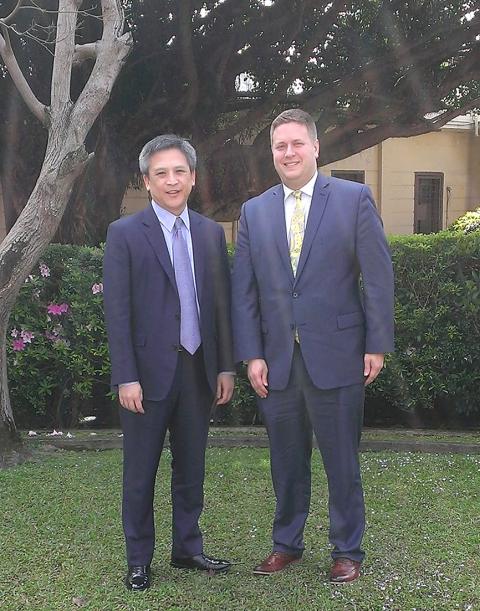
Photo: Screen grab from AIT’s Facebook page
Beijing was infuriated after US President Donald Trump on Friday last week signed the legislation that encourages the US to send senior US officials to Taiwan to meet their counterparts and vice versa.
Despite Beijing’s warnings, the American Institute in Taiwan (AIT) yesterday announced that US Deputy Assistant Secretary of Commerce for Manufacturing Ian Steff arrived yesterday for a six-day visit to strengthen bilateral trade, commercial and investment relations, his first as deputy assistant secretary.
He is one of the officials responsible for executing the Trump administration’s plans to foster growth in US manufacturing jobs and investments, the AIT said.
The first US official to visit Taipei following the act’s enactment, Alex Wong (黃之瀚), deputy assistant secretary at the US State Department’s Bureau of East Asian and Pacific Affairs, on Wednesday night told an American Chamber of Commerce in Taipei banquet that the US commitment to Taiwan has never been stronger and that Taiwan was an inspiration to the rest of the Indo-Pacific region.
In other developments, the US Department of State on Wednesday reiterated that the US opposes any unilateral action that alters the “status quo” in the Taiwan Strait.
The US has a “deep and abiding interest in cross-strait peace and stability, so it welcomes steps to reduce tension and improve cross-strait relations,” a department spokesperson said when asked about China’s aircraft carrier passing through the Taiwan Strait on a routine exercise.
The Chinese carrier entered the Strait on Tuesday and left at about noon on Wednesday, Minister of National Defense Yen Teh-fa (嚴德發) said.

The Centers for Disease Control (CDC) yesterday reported the first case of a new COVID-19 subvariant — BA.3.2 — in a 10-year-old Singaporean girl who had a fever upon arrival in Taiwan and tested positive for the disease. The girl left Taiwan on March 20 and the case did not have a direct impact on the local community, it said. The WHO added the BA.3.2 strain to its list of Variants Under Monitoring in December last year, but this was the first imported case of the COVID-19 variant in Taiwan, CDC Deputy Director-General Lin Ming-cheng (林明誠) said. The girl arrived in Taiwan on

South Korea is planning to revise its controversial electronic arrival card, a step Taiwanese officials said prompted them to hold off on planned retaliatory measures, a South Korean media report said yesterday. A Yonhap News Agency report said that the South Korean Ministry of Foreign Affairs is planning to remove the “previous departure place” and “next destination” fields from its e-arrival card system. The plan, reached after interagency consultations, is under review and aims to simplify entry procedures and align the electronic form with the paper version, a South Korean ministry official said. The fields — which appeared only on the electronic form

The Ministry of Foreign Affairs (MOFA) is suspending retaliation measures against South Korea that were set to take effect tomorrow, after Seoul said it is updating its e-arrival system, MOFA said today. The measures were to be a new round of retaliation after Taiwan on March 1 changed South Korea's designation on government-issued alien resident certificates held by South Korean nationals to "South Korea” from the "Republic of Korea," the country’s official name. The move came after months of protests to Seoul over its listing of Taiwan as "China (Taiwan)" in dropdown menus on its new online immigration entry system. MOFA last week

A bipartisan group of US senators has introduced a bill to enhance cooperation with Taiwan on drone development and to reduce reliance on supply chains linked to China. The proposed Blue Skies for Taiwan Act of 2026 was introduced by Republican US senators Ted Cruz and John Curtis, and Democratic US senators Jeff Merkley and Andy Kim. The legislation seeks to ease constraints on Taiwan-US cooperation in uncrewed aerial systems (UAS), including dependence on China-sourced components, limited access to capital and regulatory barriers under US export controls, a news release issued by Cruz on Wednesday said. The bill would establish a "Blue UAS


 RSS
RSS