


Academics yesterday called for calm amid concern that Beijing’s 31 incentives for Taiwanese could trigger a brain drain and industrial migration, saying the trend is global.
They made the remarks at a forum organized by the Friends of Hong Kong and Macau Association in Taipei yesterday morning, just hours before the Executive Yuan put forward eight countermeasures against the incentives designed to draw Taiwanese talent and corporations to China.
The association is the only civic group focused on Hong Kong and Macau affairs and exchanges, and has been deemed as blue-leaning.
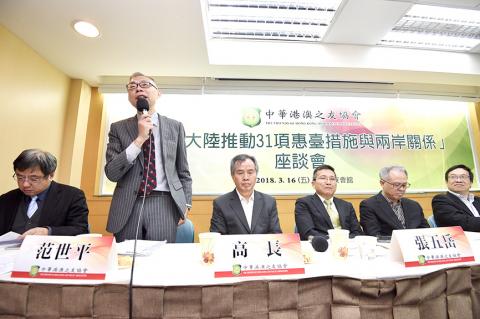
Photo: Peter Lo, Taipei Times
However, on Sunday, it elected Taoyuan Mayor Cheng Wen-tsan (鄭文燦) of the Democratic Progressive Party as its new chairman.
The 31 incentives should be put in a global context, as they are similar to other nations’ economic incentives to draw foreign investment, such as the US’ efforts to lure its enterprises back home as part of its reindustrialization plan, National Dong Hwa University Department of Public Administration professor Kao Charng (高長) said.
“Amid globalization, the migration of talent and industries is common. Just like people might also want to work in nations [targeted by the DPP administration’s] New Southbound Policy,” Kao said.
Beijing’s incentives might attract young Taiwanese, but they do not necessarily mean they would start to identify with the Chinese government or want to stay there permanently.
Taiwan’s talent exodus and Beijing’s attempt to attract Taiwanese by offering benefits did not just begin, Fo Guang University Department of Public Affairs assistant professor Jean Tseng (曾于蓁) said, adding that she does not expect the 31 incentives to lead to a dramatic brain drain.
Citing as an example the higher education industry, one of the sectors targeted by the 31 incentives, Tseng said that experienced Taiwanese professors might be deterred by the Chinese education system, in which promotion hinges more on subjective than objective factors.
“Besides, not all areas of studies can be exported to China. For instance, academic specialists in politics or cross-strait research might not be able to find a place in Beijing,” Tseng said.
The only sectors the government should keep a close eye on are the medical and high-tech industries, because they are the primary targets of the 31 incentives in terms of talent recruitment, National Taiwan Normal University political science professor Fan Shih-ping (范世平) said.
“That Foxconn Industrial Internet Co Ltd, an Internet-focused unit of Hon Hai Precision Industry Co, was able to obtain approval to launch an initial public offering in China [on Thursday last week] just 36 days after applying is a manifestation of this goal,” Fan said.
However, to avoid repercussions from the 31 incentives on Taiwan’s national and economic security, Chien Hsin University of Science and Technology Department of Business Administration professor Yen Chien-fa (顏建發) advised the government to use government resources as a leverage to keep China-based businesspeople at bay.
“If an enterprise or individual with an investment or business in China repeatedly makes comments that are in favor of Beijing, but detrimental to Taiwan’s national security, the government should bar them from public-sector projects as a countermeasure,” Yen said. “Otherwise, how is the government going to deal with future politically motivated economic incentives that might set support for the ‘one China’ principle as a precondition?”

The Centers for Disease Control (CDC) yesterday reported the first case of a new COVID-19 subvariant — BA.3.2 — in a 10-year-old Singaporean girl who had a fever upon arrival in Taiwan and tested positive for the disease. The girl left Taiwan on March 20 and the case did not have a direct impact on the local community, it said. The WHO added the BA.3.2 strain to its list of Variants Under Monitoring in December last year, but this was the first imported case of the COVID-19 variant in Taiwan, CDC Deputy Director-General Lin Ming-cheng (林明誠) said. The girl arrived in Taiwan on

South Korea is planning to revise its controversial electronic arrival card, a step Taiwanese officials said prompted them to hold off on planned retaliatory measures, a South Korean media report said yesterday. A Yonhap News Agency report said that the South Korean Ministry of Foreign Affairs is planning to remove the “previous departure place” and “next destination” fields from its e-arrival card system. The plan, reached after interagency consultations, is under review and aims to simplify entry procedures and align the electronic form with the paper version, a South Korean ministry official said. The fields — which appeared only on the electronic form

The Ministry of Foreign Affairs (MOFA) is suspending retaliation measures against South Korea that were set to take effect tomorrow, after Seoul said it is updating its e-arrival system, MOFA said today. The measures were to be a new round of retaliation after Taiwan on March 1 changed South Korea's designation on government-issued alien resident certificates held by South Korean nationals to "South Korea” from the "Republic of Korea," the country’s official name. The move came after months of protests to Seoul over its listing of Taiwan as "China (Taiwan)" in dropdown menus on its new online immigration entry system. MOFA last week

A bipartisan group of US senators has introduced a bill to enhance cooperation with Taiwan on drone development and to reduce reliance on supply chains linked to China. The proposed Blue Skies for Taiwan Act of 2026 was introduced by Republican US senators Ted Cruz and John Curtis, and Democratic US senators Jeff Merkley and Andy Kim. The legislation seeks to ease constraints on Taiwan-US cooperation in uncrewed aerial systems (UAS), including dependence on China-sourced components, limited access to capital and regulatory barriers under US export controls, a news release issued by Cruz on Wednesday said. The bill would establish a "Blue UAS


 RSS
RSS