


Taiwan would do its utmost to keep the nation’s diplomatic allies, Premier William Lai (賴清德) said yesterday, as Minister of Foreign Affairs Joseph Wu (吳釗燮) added that while China and the Vatican are expected to later this month finalize which side has the right to ordain bishops, the accord would not hamper diplomatic ties between Taiwan and the Holy See.
Wu made the remarks at the Legislative Yuan in Taipei when asked by Chinese Nationalist Party (KMT) Legislator Lu Shiow-yen (盧秀燕) whether he can guarantee that the Vatican would not switch diplomatic recognition from Taiwan to China.
The Vatican is allegedly on the verge of making a historic concession by asking two bishops to resign to make way for two Chinese bishops appointed by Beijing.
The intelligence that the ministry has gathered indicates that negotiations over the appointment of the bishops would not affect diplomatic ties between Taiwan and the Vatican, Wu said.
However, when pressed on whether he could ensure that the Holy See would not drop its diplomatic recognition, Wu did not give a definite answer, saying that he would do his utmost to prevent the scenario.
Saying that President Tsai Ing-wen’s (蔡英文) administration is “at its wits’ end” over China’s courting of Taiwan’s diplomatic allies, Lu asked Lai whether he could guarantee that Taiwan would not lose the Vatican as an ally.
“I believe that if China poaches our diplomatic allies, it will be the party that should be denounced,” Lai said.
There is “some distance” between Beijing and the Holy See signing an accord and the establishment of diplomatic ties, Lai said, adding that the government can only guarantee to do its utmost to consolidate ties with all 20 of its diplomatic allies.
Lu asked Lai whether China could siphon off Taiwan’s talent and capital with its “economic carrots” — such as the 31 incentives offered to Taiwanese businesses and the cultural and creative sector, and its approval of Foxconn Industrial Internet Co’s request to hold an initial public offering on the Shanghai Stock Exchange.
These policies would definitely have an impact on Taiwan’s business sector, Lai said.
However, the public should have faith in the robustness of local industries and their productivity, not see them as inferior, Lai said, adding that the concern Lu raised is exactly why the 31 policies “disguised as incentives” would actually benefit China more than Taiwan.
He and his team have formulated policies to address the “five shortages” in the industrial sector, while the passage of the Act Governing Recruitment and Employment of Foreign Professionals (外國專業人才延攬及雇用法) and the Act for Industrial Innovation (產業創新條例) last year made the environment for foreign professionals and innovative firms in Taiwan “friendlier,” Lai said.
If Taiwanese businesses could consolidate their foothold and grow capacity, they would be able to retain both talent and capital, he said.

SECURITY: Starlink owner Elon Musk has taken pro-Beijing positions, and allowing pro-China companies to control Taiwan’s critical infrastructure is risky, a legislator said Starlink was reluctant to offer services in Taiwan because of the nation’s extremely high penetration rates in 4G and 5G services, the Ministry of Digital Affairs said yesterday. The ministry made the comments at a meeting of the legislature’s Transportation Committee, which reviewed amendments to Article 36 of the Telecommunications Management Act (電信管理法). Article 36 bans foreigners from holding more than 49 percent of shares in public telecommunications networks, while shares foreigners directly and indirectly hold are also capped at 60 percent of the total, unless specified otherwise by law. The amendments, sponsored by Chinese Nationalist Party (KMT) Legislator Ko
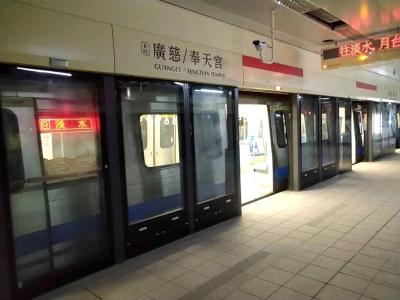
The eastern extension of the Taipei MRT Red Line could begin operations as early as late June, the Taipei Department of Rapid Transit Systems said yesterday. Taipei Rapid Transit Corp said it is considering offering one month of free rides on the new section to mark its opening. Construction progress on the 1.4km extension, which is to run from the current terminal Xiangshan Station to a new eastern terminal, Guangci/Fengtian Temple Station, was 90.6 percent complete by the end of last month, the department said in a report to the Taipei City Council's Transportation Committee. While construction began in October 2016 with an
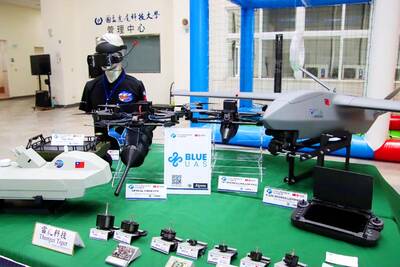
NON-RED SUPPLY: Boosting the nation’s drone industry is becoming increasingly urgent as China’s UAV dominance could become an issue in a crisis, an analyst said Taiwan’s drone exports to Europe grew 41.7-fold from 2024 to last year, with demand from Ukraine’s fight against Russian aggression the most likely driver of growth, a study showed. The Institute for Democracy, Society and Emerging Technology (DSET) in a statement on Wednesday said it found that many of Taiwan’s uncrewed aerial vehicle (UAV) sales were from Poland and the Czech Republic. These countries likely transferred the drones to Ukraine to aid it in its fight against the Russian invasion that started in 2022, it said. Despite the gains, Taiwan is not the dominant drone exporter to these markets, ranking second and fourth
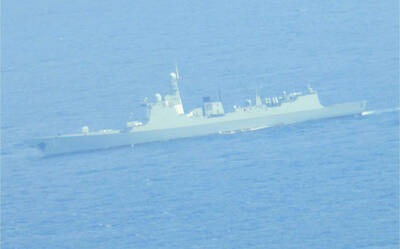
The military has spotted two Chinese warships operating in waters near Penghu County in the Taiwan Strait and sent its own naval and air forces to monitor the vessels, the Ministry of National Defense (MND) said. Beijing sends warships and warplanes into the waters and skies around Taiwan on an almost daily basis, drawing condemnation from Taipei. While the ministry offers daily updates on the locations of Chinese military aircraft, it only rarely gives details of where Chinese warships are operating, generally only when it detects aircraft carriers, as happened last week. A Chinese destroyer and a frigate entered waters to the southwest


 RSS
RSS