


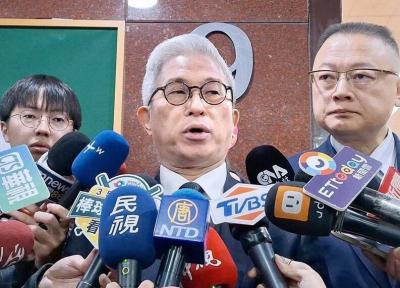
Chinese Nationalist Party (KMT) lawmakers yesterday demanded that the Ministry of Foreign Affairs seek an explanation from Japan over an assault on a Taiwanese fishing boat over the weekend, and recall Representative to Japan Frank Hsieh (謝長廷) if it does not receive a formal response.
With more Taiwan-Japan Fisheries Agreement talks set for Thursday and Friday next week, KMT caucus secretary-general Lee Yen-hsiu (李彥秀) said the water-cannon attack on Tung Pan Chiu No. 28 (東半球) could be a Japanese tactic to subjugate Taiwan.
Japan’s actions infringed on Taiwanese fishermen’s rights, and if Hsieh cannot obtain an adequate explanation from the Japanese government by the end of today, the Presidential Office should summon him back to Taipei as a protest against Japan’s actions, the lawmaker said.
The ministry announced on Monday that it had lodged a protest with Tokyo at noon that day, accusing the Japanese of using excessive force against the Suao Township (蘇澳)-registered vessel near Taiwan’s territorial waters.
A separate Fisheries Agency statement said that Japanese patrol boats chased off the Tung Pan Chiu No. 28 on Saturday when it was about 10 nautical miles (18.52km) outside the fishing zone specified in the 2013 Taiwan-Japan Fisheries Agreement.
On Sunday, Japan’s patrol boats water-cannoned the fishing boat and drove it away when it was inside the zone, the agency said yesterday.
The Tung Pan Chiu No. 28 incident was proof that the affinity President Tsai Ing-wen (蔡英文) has shown toward Japan in setting the nation’s diplomatic policy has failed to yield positive results, Lee said.
The incident undermined Taiwan’s sovereignty, and agencies in charge of the nation’s diplomatic policy should press Tokyo to promise that there would not be a repeat, KMT caucus deputy secretary-general William Tseng (曾銘宗) said.
With the dispute over fishing rights in the waters off Japan’s Okinotori atoll unresolved, the government should adopt a tougher stance in response to Japan’s water-cannoning the Taiwanese fishing boat, KMT Legislator Chiang Nai-hsin (蔣乃辛) said.
Coast Guard Administration vessels should shadow Taiwanese fishing boats to ensure that their activities in the maritime zone would not be hindered by others, Chiang said.
Minister of Foreign Affairs Joseph Wu (吳釗燮) told reporters yesterday that an interdepartmental investigation on Monday had determined that Japan’s actions constituted an excessive use of force.
The ministry would convey its stance on Taiwan’s fishing rights whenever it has the opportunity to do so, he added.
Despite the boat on Sunday crossing the limit set for recreational fishing activities — 30 nautical miles from the nation’s coasts — it did not reach a tentative red line being negotiated by the two sides, and in this context, Japan’s chasing the Taiwanese boat away was a violation of international laws, Wu said.
The ministry also said yesterday that a date and location for the next round of bilateral fishery talks has not been set.
The 2013 agreement covers the maritime zone south of 27° north latitude and north of Japan’s Yaeyama and Miyako islands, which are part of the overlapping area of exclusive economic zones claimed by Taiwan and Japan.
Additional reporting by staff writer
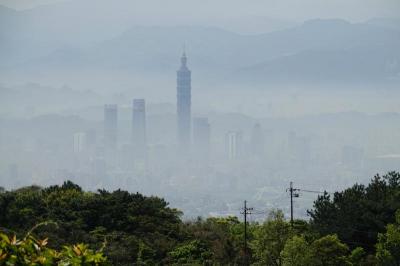
A strong continental cold air mass is to bring pollutants to Taiwan from tomorrow, the Ministry of Environment said today, as it issued an “orange” air quality alert for most of the country. All of Taiwan except for Hualien and Taitung counties is to be under an “orange” air quality alert tomorrow, indicating air quality that is unhealthy for sensitive groups. In China, areas from Shandong to Shanghai have been enveloped in haze since Saturday, the ministry said in a news release. Yesterday, hourly concentrations of PM2.5 in these areas ranged from 65 to 160 micrograms per cubic meter (mg/m³), and pollutants were
Taiwan’s armed forces have established response protocols for a wide range of sudden contingencies, including the “Wan Chun Plan” to protect the head of state, the Ministry of Defense (MND) said today. After US President Donald Trump on Saturday launched a series of airstrikes in Venezuela and kidnapped Venezuelan President Nicolas Maduro, concerns have been raised as to whether China would launch a similar “decapitation strike” on Taiwan. The armed forces regularly coordinate with relevant agencies and practice drills to ensure preparedness for a wide range of scenarios, Vice Minister of National Defense Hsu Szu-chien (徐斯儉) told reporters before a
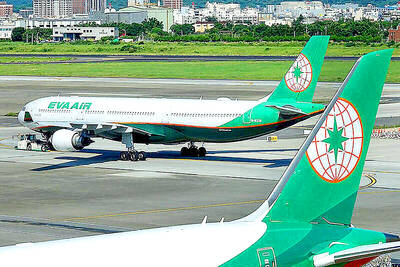
EVA Airways on Saturday said that it had suspended a pilot and opened an investigation after he allegedly lost his temper and punched the first officer several times as their plane was taxiing before takeoff at Los Angeles International Airport. According to a report published on Thursday by The Reporter, the incident occurred after the flight’s Malaysian first officer tried to warn the Taiwanese pilot, surnamed Wen (文), that he was taxiing faster than the speed limit of 30 knots (55.6kph). After alerting the pilot several times without response, the first officer manually applied the brakes in accordance with standard operating
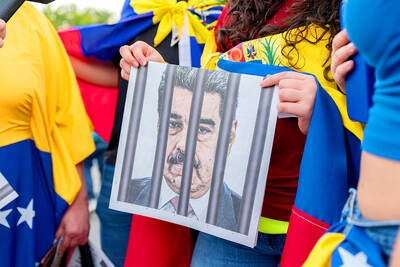
NOT AN OPENING: Trump’s violation of international law does not affect China’s consideration in attacking Taiwan; Beijing lacks capability, not precedent, an official said Taiwanese officials see the US’ capture of the president of Venezuela as a powerful deterrent to Beijing’s aggression and a timely reminder of the US’ ability to defeat militaries equipped with Chinese-made weapons. The strikes that toppled Venezuelan President Nicolas Maduro signaled to authoritarian leaders, including Chinese President Xi Jinping (習近平), US President Donald Trump’s willingness to use military might for international affairs core to US interests, one senior official in Taipei’s security circle said. That reassured Taiwan, the person said. Taipei has also dismissed the idea that Trump’s apparent violation of international law could embolden Beijing, said the official, who was not


 RSS
RSS