


Taipei Zoo hopes to work with schools and government agencies to increase public awareness of wildlife protection, spokesman Eric Tsao (曹先紹) said.
One of the nation’s most popular attractions, the zoo, established in 1914, draws about 3 million visitors every year, Tsao said.
Tsao recalled a statement made by former Wildlife Conservation Society president William Conway, who told the annual meeting of the World Association of Zoos and Aquariums in New York in 2005 that it is crucial for zoos around the world to transition from being “living museums” to being conservationist institutions.

Photo provided by Taipei Zoo
Tsao said he has long been hoping to promote such an idea, “because conservation is a value that zoos can provide.”
Tsao said he was initially unsure how zoos could promote conservation, although 15 percent of critically endangered animals worldwide could be found in zoos.
The value of zoos became apparent in Taiwan when the sika deer was facing extinction in the nation, he said.
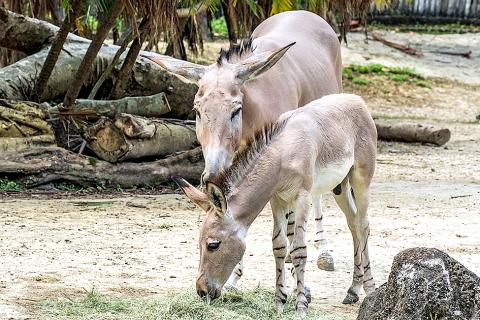
Photo provided by the Taipei Zoo
Former zoo director Chen Pao-chung (陳寶忠) sent the zoo’s deer to Tunghai University and breeders in Kenting’s Sheding Nature Park (社頂自然公園) to boost the population.
Tsao said many animals that are either injured or facing danger are brought to the zoo.
Animals like the Eurasian otter and the leopard cat, both endangered species, can benefit from the zoo’s extensive experience, he said.
“We must not let these animals become extinct because of human activity,” he said.
Tsao said conditions for wild animals are improving as the public becomes better informed, citing the Malayan night heron, which has been building its nests in the zoo for many years now, and the crested goshawk, which can be seen in Taipei’s Daan District (大安) every year.
This shows the birds are not afraid of people, which is a step forward, he said.
The zoo’s conservation efforts span cities, counties and even international borders, but seeing its plans through will take several years, he said.
One of the challenges facing conservationists is the need to find new bloodlines to prevent inbreeding when trying to save endangered animals, he said.
There is also a lack of experts in endangered animals, he said.
“Add this to the fact that these animals may have special characteristics that make it harder to transport them, especially across international borders,” he said.
African onagers brought to the country from France and the Czech Republic in 2015, as well as an orangutan from Poland in 2016, all required lengthy application processes lasting three to four years, he said.
“So far, we have had success breeding the onagers. It is a new page in history,” he said.
In 2000, former zoo director Jason Chin (金仕謙) rescued a black-faced spoonbill and sent it to Japan’s Tama Zoo, where a mate was found for it and it laid two eggs.
The zoo planned to send the bird back two years ago, but shelved the plan due to an avian flu outbreak at the time, he said.
Problems can also arise in transporting animals domestically, he said, citing a giraffe that died in transit in 2016 while on its way to Leofoo Village Theme Park in Hsinchu for breeding.
“Giraffes are really sensitive. They get nervous easily, and their height, age and demeanor must be considered when transporting them,” he said.
The failure with the first giraffe was a learning experience, he said, adding that a second attempt at transporting a giraffe from the zoo to the theme park last year was successful.
The zoo’s two pandas, Tuan Tuan (團團) and Yuan Yuan (圓圓), as well as pangolins, leopard cats and Eurasian otters rescued by the zoo are rising stars, he said.
Animals that are hairy, long-lived or “storybook-like” in nature tend to be the most popular with the public, he said.
“When we rescued the Eurasian otter siblings, Ta Chin (大金) and Hsiao Chin (小金), from Kinmen, images of them holding each other after birth with their eyes still closed were incredibly adorable. They became an instant hit,” he said.
Early stars at the zoo were the famous elephant Lin Wang (林旺), who was originally employed by Japanese troops invading Burma during World War II, the koala Patrick and the king penguin Hei Ma Shu (黑麻糬).
Conservationists at the zoo will continue to educate the public through the media and the Internet, sharing their experiences of caring for the animals and drawing the public’s attention to important conservation-related issues, he said.

FUKUOKA SITUATION: Japanese media reported that the pathogen is expected to be identified by the summer, while the CDC downplayed the idea that it was hMPV A “mysterious cold-like illness” reported in Japan’s Fukuoka Prefecture does not seem to be a new disease, but Japanese authorities have been asked about the situation, the Centers for Disease Control (CDC) said yesterday. The Fukuoka Prefectural Medical Association on Wednesday told a news conference that a “mystery cold” that has become a hot topic on social media is “highly likely to be caused by some kind of viral infection,” Japan’s KBC News reported. “Many people are experiencing symptoms starting with a sore throat, followed by a runny nose, phlegm and a severe cough,” KBC News reported, citing association officials. Health authorities are

Nvidia Corp CEO Jensen Huang (黃仁勳) arrived in Taiwan yesterday ahead of upcoming AI and technology events, saying he plans to meet with clients and Taiwan Semiconductor Manufacturing Co Chairman C.C. Wei (魏哲家) during his visit. After landing at Taipei Songshan Airport, Huang posed for photos with fans and handed out Yakult drinks to reporters and supporters waiting at the scene, saying he has “a lot to do” during the trip. Asked about reports that Nvidia’s planned headquarters site in Taipei’s Beitou Shilin Technology Park could break ground on May 27, Huang said that if the company holds an event, he would

The Ministry of Finance this afternoon announced the winning numbers for the March-April uniform invoice lottery. The winning number for the NT$10 million (US$318,060) special prize is 19531471, and the winning number for the NT$2 million grand prize is 85941329. Three numbers were drawn for the NT$200,000 first prize: 07225810, 20231230 and 83518781. Those with receipts matching the last seven digits of any of the first-prize numbers will win the NT$40,000 second prize, while those matching the last six digits will win the NT$10,000 third prize. Those whose receipts match the last five digits of the first-prize numbers can claim the NT$4,000 fourth prize,

SIX SUBSIDIES: The monthly allowance for older farmers is to increase to NT$10,000, and NT$5,000 is to be given to homemakers under the national pension system, Lai said The government is to implement major welfare policies for disadvantaged groups, including raising the monthly allowance for older farmers to NT$10,000 and providing homemakers with NT$5,000 per month, President William Lai (賴清德) said yesterday. Lai made the remarks during a visit to Wangling Temple in Chiayi County, saying that the planned increases were being introduced amid economic growth and an increase in tax revenue. Touting a policy, in which the government plans to provide a monthly allowance of NT$5,000 for every child under the age of 18 in a bid to address Taiwan’s low birthrate, Lai said that if received for the


 RSS
RSS