


While many look forward to the Lunar New Year holiday as a time for feasting and gift-giving, philatelists welcome its advent as a chance to collect Chunghwa Post’s annual Chinese zodiac stamp collection, with this year’s issue celebrating the Year of the Dog.
“It has become a trend for countries around the world to roll out stamps featuring the year’s Chinese zodiac sign,” Chunghwa Post stamp collection division director Chien Liang-lin (簡良璘) said.
Aside from Singapore, South Korea, Japan and Vietnam, where the Chinese zodiac signs are deeply rooted in their culture, culturally diverse nations like the US, Canada and France have also printed stamps depicting the animal signs, Chien said.
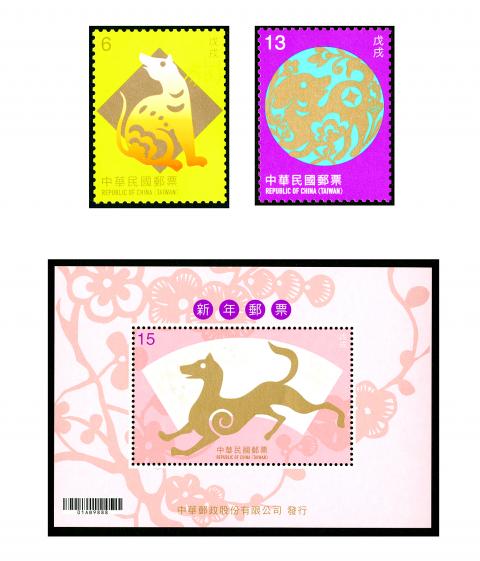
Photo courtesy of Chunghwa Post
In Taiwan, the first Chinese zodiac-themed stamp set was issued in 1968, which was the Year of the Rooster.
Since then, Chunghwa Post has been launching an annual stamp collection based on the Chinese zodiac sign of the year. As the same sign appears only once every 12 years, the products quickly sparked a collection craze.
The Chinese zodiac-themed stamps are very popular because people like to use them to send out Lunar New Year greeting cards, Chien said, adding that they usually achieve a sales rate of 90 percent.
This year was the fifth time the postal company has issued a dog-themed stamp set, she said, but it was the first time it has collaborated with its French counterpart to also print the collection overseas.
This year’s stamp collection was designed by National Taiwan Normal University’s College of Arts dean Lin Chun-liang (林俊良), featuring different designs for NT$6, NT$13 and NT$15 stamps.
The NT$6 stamp depicts a golden dog to symbolize the departure of the old and the arrival of good fortune, while the NT$13 stamp features a dog and a peony, both of which symbolize prosperity or wealth.
The NT$15 stamp features a high-spirited golden dog against a light pink background to showcase the traditional holiday’s festive spirit.
Chien said the first dog-themed stamp collection was issued in 1969 and designed by Yan Chi-shih (顏奇石).
It featured a popular purebred to symbolize loyalty, a quality usually associated with dogs.
The second dog-themed collection was printed in 1981. The designer, Chuang Chu-mei (莊珠妹), combined a stylized illustration of a dog with the Mandarin character quan (dog, 犬) written in seal script.
The design was meant to convey traditional Chinese ideals of reunion and harmony, Chien said.
In 1993, Tsao Chun-yan (曹俊彥) was tasked with designing the third dog-themed stamp collection. His geometric-shaped dog illustrations conveyed a childlike naivete.
The fourth version was published in 2005, with Wu Jen-feng (巫仁鳳) and Ko Hung-tu (柯鴻圖) jointly designing a collection of stamps that featured a pack of dogs and Lunar New Year couplets to signify harmony and get people into the holiday spirit.
In an effort to increase the appeal of this year’s stamp collection, Chien said it contains 20 stamps each for the NT$6 and NT$13 stamps, as well as nine NT$15 stamps, which are stored in a specially designed cylinder.
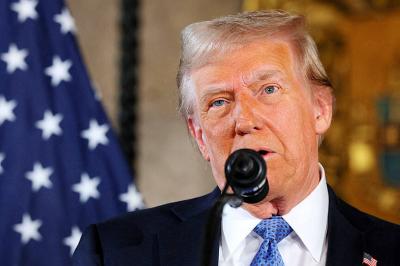
US President Donald Trump said "it’s up to" Chinese President Xi Jinping (習近平) what China does on Taiwan, but that he would be "very unhappy" with a change in the "status quo," the New York Times said in an interview published yesterday. Xi "considers it to be a part of China, and that’s up to him what he’s going to be doing," Trump told the newspaper on Wednesday. "But I’ve expressed to him that I would be very unhappy if he did that, and I don’t think he’ll do that," he added. "I hope he doesn’t do that." Trump made the comments in

NOT AN OPENING: Trump’s violation of international law does not affect China’s consideration in attacking Taiwan; Beijing lacks capability, not precedent, an official said Taiwanese officials see the US’ capture of the president of Venezuela as a powerful deterrent to Beijing’s aggression and a timely reminder of the US’ ability to defeat militaries equipped with Chinese-made weapons. The strikes that toppled Venezuelan President Nicolas Maduro signaled to authoritarian leaders, including Chinese President Xi Jinping (習近平), US President Donald Trump’s willingness to use military might for international affairs core to US interests, one senior official in Taipei’s security circle said. That reassured Taiwan, the person said. Taipei has also dismissed the idea that Trump’s apparent violation of international law could embolden Beijing, said the official, who was not
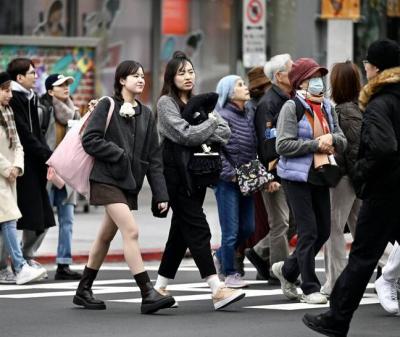
A cold surge advisory was today issued for 18 cities and counties across Taiwan, with temperatures of below 10°C forecast during the day and into tonight, the Central Weather Administration (CWA) said. New Taipei City, Taipei, Taoyuan and Hsinchu, Miaoli and Yilan counties are expected to experience sustained temperatures of 10°C or lower, the CWA said. Temperatures are likely to temporarily drop below 10°C in most other areas, except Taitung, Pingtung, Penghu and Lienchiang (Matsu) counties, CWA data showed. The cold weather is being caused by a strong continental cold air mass, combined with radiative cooling, a process in which heat escapes from
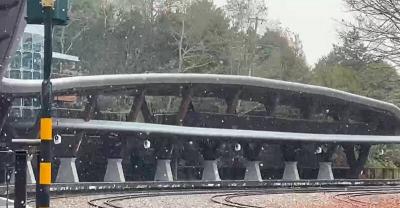
Snow this morning fell on Alishan for the first time in seven years, as a strong continental cold air mass sent temperatures plunging across Taiwan, the Central Weather Administration (CWA) said. The Alishan weather station, located at an elevation of about 2,200m in central Taiwan, recorded snowfall from 8:55am to 9:15am, when the temperature dropped to about 1°C, the CWA said. With increased moisture and low temperatures in the high-altitude Alishan area, the conditions were favorable for snow, CWA forecaster Tsai Yi-chi (蔡伊其) said. The last time snow fell at the Alishan weather station was on Jan. 10, 2018, while graupel fell there


 RSS
RSS