


A group of Taiwanese students studying in China yesterday protested in front of the Ministry of Transportation and Communications and the Presidential Office Building in Taipei over canceled cross-strait flights during the Lunar New Year holiday, which they said have made returning home difficult.
XiamenAir and China Eastern Airlines last month canceled plans for additional flights between Taiwan and China during the holiday after the Civil Aeronautics Administration put their applications on hold due to their planned use of the northbound M503 flight route, which was unilaterally launched by China.
The students blamed the ministry for sacrificing their rights for political reasons and demanded that Minister of Transportation and Communications Hochen Tan (賀陳旦) step down.
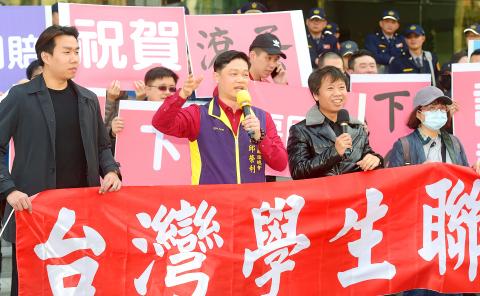
Photo: Huang Yao-cheng, Taipei Times
Several hours before the protest, the China-based Taiwan Students Solidarity Headquarters invited the protesters to lunch.
The organization’s chairman, Chiu Jung-li (邱榮利), said the lunch was paid for by him and Taiwanese businesspeople working in China.
About two weeks ago, the group found that more than 1,000 students could not return to Taiwan for the holiday because of the canceled flights, he said.
With the group’s help, more than 900 students had returned home as of yesterday, Chiu said, but added that many had to make transit stops or travel by boat, as direct flights cost about 4,000 yuan (US$630.48) — while they used to cost about 2,500 yuan.
He refused to provide the Straits Exchange Foundation with a list of the students stranded in China, saying that there is no reason to work with the foundation, because it cannot provide any assistance that the students do not already have.
Although most of the students have returned to Taiwan, they still hoped to protest and file claims for compensation from the government, because “it is upsetting that 2,500 yuan tickets are no longer available,” Chiu said.
The Civil Aeronautics Administration has said there are seats available on all flights between Taiwan and China.
A friend had to fly business class on a red-eye flight to return to Taiwan, Chiu said.
One student surnamed Teng (鄧) said he paid 4,000 yuan for his flight on Tuesday, but added that last year he only paid 2,500 yuan.
The protesters also submitted a petition to the Presidential Office.
“Our understanding is that Taiwanese students studying in China began their winter break in the middle of last month and have all safely returned to Taiwan,” Presidential Office spokesman Sidney Lin (林鶴明) said.
China’s decision to unilaterally launch the M503 flight route is a challenge to the “status quo” and a threat to the security of East Asia and flight safety, he said.
Lin called on Beijing to compensate for the effect of the route’s launch on regional stability, aviation safety and cross-strait ties, and to resolve the issue with Taipei as soon as possible.
Additional reporting by Ann Maxon

A magnitude 6.1 earthquake struck off the coast of Yilan County at 8:39pm tonight, the Central Weather Administration (CWA) said, with no immediate reports of damage or injuries. The epicenter was 38.7km east-northeast of Yilan County Hall at a focal depth of 98.3km, the CWA’s Seismological Center said. The quake’s maximum intensity, which gauges the actual physical effect of a seismic event, was a level 4 on Taiwan’s 7-tier intensity scale, the center said. That intensity level was recorded in Yilan County’s Nanao Township (南澳), Hsinchu County’s Guansi Township (關西), Nantou County’s Hehuanshan (合歡山) and Hualien County’s Yanliao (鹽寮). An intensity of 3 was
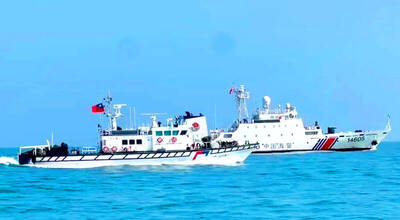
Instead of focusing solely on the threat of a full-scale military invasion, the US and its allies must prepare for a potential Chinese “quarantine” of Taiwan enforced through customs inspections, Stanford University Hoover fellow Eyck Freymann said in a Foreign Affairs article published on Wednesday. China could use various “gray zone” tactics in “reconfiguring the regional and ultimately the global economic order without a war,” said Freymann, who is also a nonresident research fellow at the US Naval War College. China might seize control of Taiwan’s links to the outside world by requiring all flights and ships entering or leaving Taiwan
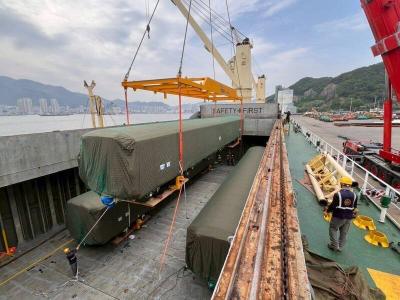
The first of 10 new high-capacity trains purchased from South Korea’s Hyundai Rotem arrived at the Port of Taipei yesterday to meet the demands of an expanding metro network, Taipei Rapid Transit Corp (TRTC) said yesterday. The train completed a three-day, 1,200km voyage from the Port of Masan in South Korea, the company said. Costing NT$590 million (US$18.79 million) each, the new six-carriage trains feature a redesigned interior based on "human-centric" transportation concepts, TRTC said. The design utilizes continuous longitudinal seating to widen the aisles and optimize passenger flow, while also upgrading passenger information displays and driving control systems for a more comfortable
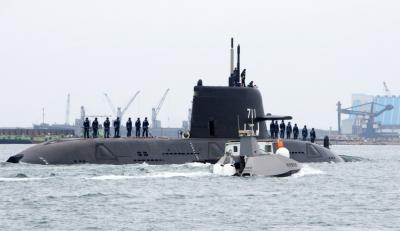
Taiwan's first indigenous defense submarine, the SS-711 Hai Kun (海鯤, or Narwhal), departed for its 13th sea trial at 7am today, marking its seventh submerged test, with delivery to the navy scheduled for July. The outing also marked its first sea deployment since President William Lai (賴清德) boarded the submarine for an inspection on March 19, drawing a crowd of military enthusiasts who gathered to show support. The submarine this morning departed port accompanied by CSBC Corp’s Endeavor Manta (奮進魔鬼魚號) uncrewed surface vessel and a navy M109 assault boat. Amid public interest in key milestones such as torpedo-launching operations and overnight submerged trials,


 RSS
RSS