


An outdated article in the National Security Act (國家安全法) that designates mountains as restricted areas should be abolished, Democratic Progressive Party (DPP) Legislator Huang Kuo-shu (黃國書) said yesterday, citing an incident in January last year in which nine mountaineers were convicted of climbing a mountain because they had not applied for entry passes.
One of the mountaineers, Aucat Gemaduan of the Paiwan community, told a news conference in Taipei that they were given a written warning and told to go back when passing through a checkpoint on Lioushunshan (六順山) in Nantou County.
“What we cannot get through our heads is why this group of well-behaved citizens should be charged with violating the act,” he said, adding that the case was likely the only one in the nation’s history that saw mountaineers convicted for this reason.
Lioushunshan, which is accessible through the Danda Forest Trail (丹大林道), is in one of the nation’s most breathtaking mountain areas, so many people climb the mountain without applying for an entry pass, because they do not know it is restricted under Article 5 of the act, he said.
Some mountains were off-limits to the public to prevent spies from hiding there during the Period of National Mobilization for Suppression of the Communist Rebellion (動員戡亂時期) that ended in 1991, Huang said.
However, the rule is outdated and only hurts people’s right to enjoy mountain climbing, as it is unlikely that spies nowadays will set up their headquarters in the mountains, he said.
The incident was also problematic, because Gemaduan, as an Aborigine, should have been allowed access to the restricted mountain after presenting his national ID card under enforcement guideline No. 32 of the act, he said.
He called on the Forestry Bureau to introduce appropriate rules to regulate mountaineers so that the nation can attract more tourists to its mountains, adding that this should be done with the prerequisite of enforcing forest preservation.
On the sidelines of the news conference, mountain climbing enthusiast Tsai Chi-wen (蔡及文) told the Taipei Times that many of his foreign friends have expressed incredulity that Taiwan imposes so many restrictions on its mountains and that climbers must go through such complicated procedures before being granted access.
“If foreign mountaineers are convicted of violating the act, how can they return home or travel to other countries with a criminal record?” Tsai asked.
The bureau has since late last year stopped handing out written warnings to tourists, opting only to control traffic at certain checkpoints, such as near the damaged Sun Hai Bridge (孫海橋), bureau section head Wu Hsueh-ping (吳學平) said.
Bureau Director-General Lin Hua-ching (林華慶) has put much effort into promoting tourism in the hope of striking a balance between forest protection and mountaineers’ rights, he added.
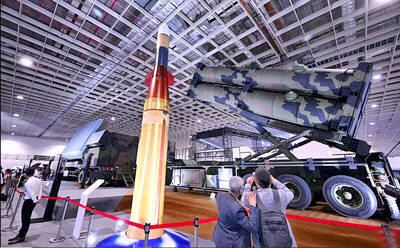
Taiwan is to commence mass production of the Tien Kung (天弓, “Sky Bow”) III, IV and V missiles by the second quarter of this year if the legislature approves the government’s NT$1.25 trillion (US$39.78 billion) special defense budget, an official said yesterday. Commenting on condition of anonymity, a defense official with knowledge of the matter said that the advanced systems are expected to provide crucial capabilities against ballistic and cruise missiles for the proposed “T-Dome,” an advanced, multi-layered air defense network. The Tien Kung III is an air defense missile with a maximum interception altitude of 35km. The Tien Kung IV and V
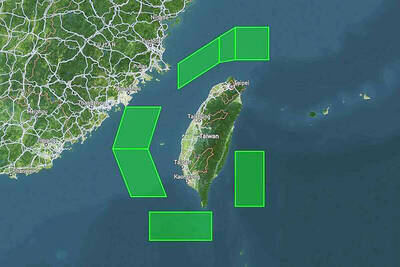
The disruption of 941 flights in and out of Taiwan due to China’s large-scale military exercises was no accident, but rather the result of a “quasi-blockade” used to simulate creating the air and sea routes needed for an amphibious landing, a military expert said. The disruptions occurred on Tuesday and lasted about 10 hours as China conducted live-fire drills in the Taiwan Strait. The Civil Aviation Administration (CAA) said the exercises affected 857 international flights and 84 domestic flights, affecting more than 100,000 travelers. Su Tzu-yun (蘇紫雲), a research fellow at the government-sponsored Institute for National Defense and Security Research, said the air
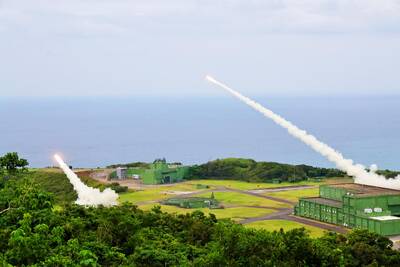
Taiwan lacks effective and cost-efficient armaments to intercept rockets, making the planned “T-Dome” interception system necessary, two experts said on Tuesday. The concerns were raised after China’s military fired two waves of rockets during live-fire drills around Taiwan on Tuesday, part of two-day exercises code-named “Justice Mission 2025.” The first wave involved 17 rockets launched at 9am from Pingtan in China’s Fujian Province, according to Lieutenant General Hsieh Jih-sheng (謝日升) of the Office of the Deputy Chief of the General Staff for Intelligence at the Ministry of National Defense. Those rockets landed 70 nautical miles (129.6km) northeast of Keelung without flying over Taiwan,
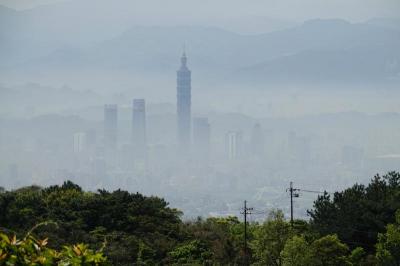
A strong continental cold air mass is to bring pollutants to Taiwan from tomorrow, the Ministry of Environment said today, as it issued an “orange” air quality alert for most of the country. All of Taiwan except for Hualien and Taitung counties is to be under an “orange” air quality alert tomorrow, indicating air quality that is unhealthy for sensitive groups. In China, areas from Shandong to Shanghai have been enveloped in haze since Saturday, the ministry said in a news release. Yesterday, hourly concentrations of PM2.5 in these areas ranged from 65 to 160 micrograms per cubic meter (mg/m³), and pollutants were


 RSS
RSS