


More than 80 percent of the public approved of the government’s emergency response and disaster relief measures following the Feb. 6 earthquake in Hualien, with President Tsai Ing-wen’s (蔡英文) approval rating passing 50 percent, the results of a poll conducted by the Taiwan NextGen Foundation (formerly known as the Taiwan Style Foundation) showed yesterday.
The government’s emergency response following the earthquake that caused the deaths of 16 people, with one missing and presumed dead, was swift, according to 80.3 percent of the respondents, with only 9.6 percent saying that the response was slow.
An overwhelming 82.9 percent of the respondents were satisfied with the government’s search-and-rescue and disaster relief measures, while only 9.1 percent were dissatisfied.
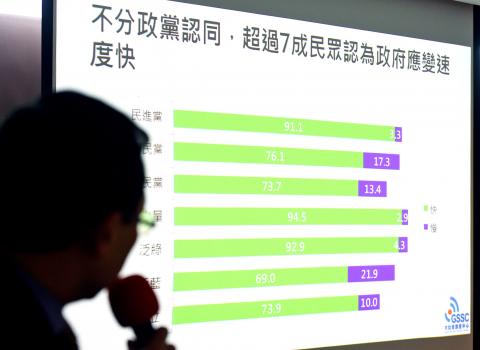
Photo: Liao Chen-hui, Taipei Times
Respondents were first asked about their perception of Tsai’s performance before being asked about their impression of the government’s emergency response, the foundation said.
Tsai’s performance was satisfying to 51.2 percent of the respondents, but dissatisfying to 39.4 percent. More than 65 percent of pan-green respondents approved of Tsai, while more than 67 percent of pan-blue respondents disapproved of her.
While 57.2 percent of the respondents said they supported Tsai, 32.7 percent said they did not. More than 77 percent of pan-green respondents supported the president, while more than 57 percent of pan-blue respondents did not.
Photo: CNA
The poll showed that Tsai’s approval rating has risen to 54 percent overall and 51 percent in eastern Taiwan.
While 73.4 percent of the respondents approved of Tsai’s response to the disaster, 17.1 percent disapproved. Although pan-blue respondents were less satisfied with the president’s performance, more than 55 percent still approved.
Tsai’s pledge to build social housing units to accommodate people displaced by the earthquake was approved by 85.7 percent, and only 7.3 percent disapproved.
The rally in Tsai’s approval rating was due to the public’s overall approval of the government’s response to the disaster, Cross-Strait Policy Association president Stephen Tan (譚耀南) said.
“As long as the government contributes and performs well, the public gives it the recognition,” Tan said.
The overwhelming approval shown by the public for the government’s response to the disaster matches the feelings of foundation members involved in the search and rescue, with Premier William Lai (賴清德) asking them to help build an emergency support system to prevent the tilted Yun Men Tsui Ti (雲門翠堤) commercial and residential complex from fully collapsing, Taiwan Professional Civil Engineers Association member Lai Chien-hung (賴建宏) said.
Asked which country showed the most support to Taiwan following the earthquake, 75.8 percent of respondents chose Japan, followed by China with 1.8 percent, Singapore with 0.8 percent, the US with 0.6 percent and South Korea with 0.3 percent.
China skirting Tsai’s administration and directly contacting the Hualien County Government to provide disaster relief was clearly politically motivated, DPP Legislator Pasuya Yao (姚文智) said.
“The public is very discerning. They knew what [China] had in mind,” Yao said. “The Chinese government keeps boasting of its ‘cross-strait family’ idea, but it failed to offer any tangible support.”
The survey was conducted on Friday and Saturday last week and collected 1,076 valid samples with a margin of error of 2.99 percentage points.


South Korea is planning to revise its controversial electronic arrival card, a step Taiwanese officials said prompted them to hold off on planned retaliatory measures, a South Korean media report said yesterday. A Yonhap News Agency report said that the South Korean Ministry of Foreign Affairs is planning to remove the “previous departure place” and “next destination” fields from its e-arrival card system. The plan, reached after interagency consultations, is under review and aims to simplify entry procedures and align the electronic form with the paper version, a South Korean ministry official said. The fields — which appeared only on the electronic form

China has reserved offshore airspace in the Yellow Sea and East China Sea from March 27 to May 6, issuing alerts usually used to warn of military exercises, although no such exercises have been announced, the Wall Street Journal (WSJ) reported yesterday. Reserving such a large area for 40 days without explanation is an “unusual step,” as military exercises normally only last a few days, the paper said. These alerts, known as Notice to Air Missions (Notams), “are intended to inform pilots and aviation authorities of temporary airspace hazards or restrictions,” the article said. The airspace reserved in the alert is

A bipartisan group of US senators has introduced a bill to enhance cooperation with Taiwan on drone development and to reduce reliance on supply chains linked to China. The proposed Blue Skies for Taiwan Act of 2026 was introduced by Republican US senators Ted Cruz and John Curtis, and Democratic US senators Jeff Merkley and Andy Kim. The legislation seeks to ease constraints on Taiwan-US cooperation in uncrewed aerial systems (UAS), including dependence on China-sourced components, limited access to capital and regulatory barriers under US export controls, a news release issued by Cruz on Wednesday said. The bill would establish a "Blue UAS

More than 6,000 Taiwanese students have participated in exchange programs in China over the past two years, despite the Mainland Affairs Council’s (MAC) “orange light” travel advisory, government records showed. The MAC’s publicly available registry showed that Taiwanese college and university students who went on exchange programs across the Strait numbered 3,592 and 2,966 people respectively. The National Immigration Agency data revealed that 2,296 and 2,551 Chinese students visited Taiwan for study in the same two years. A review of the Web sites of publicly-run universities and colleges showed that Taiwanese higher education institutions continued to recruit students for Chinese educational programs without


 RSS
RSS