


The Executive Yuan on Friday submitted an administrative report to the Legislative Yuan that touched on issues such as balancing urban-rural development, the disposition of ill-gotten political party assets, cracking down on telecom fraud committed by Taiwanese and recruiting foreign talent.
The Cabinet, in a bid to bridge the developmental gap between large cities and rural areas, would deliberate on rezoning the administrative regions and formulate measures to address the “brain drain” problem in areas outside the six special municipalities, which is rooted in unequal pay grade systems that often see civil servants assigned the same work for less money in smaller towns, the report said.
The Cabinet has also allocated NT$1.8 billion (US$61.6 million) to push forward development in Hualien and Taitung counties by helping residents establish community agricultural cooperatives and microeconomies. The budget is also available to the outlying islands to develop low-carbon “green” energy generation facilities, tourism and sustainable fisheries.
Regarding the disposition of political parties’ illicit assets, the Administrative Enforcement Agency is sequestering the Chinese Nationalist Party’s (KMT) assets after it failed to pay a NT$864.8 million fine imposed by the Ill-gotten Party Assets Settlement Committee over properties the KMT forced people into underselling or expropriated after the Japanese colonial era, the report said.
The committee is also readying penal measures for the Chinese New Socialist Party and five other political parties that failed to declare their assets in the second half of last year as required, it said.
As part of the government’s efforts to promote transitional justice, the Cabinet is soliciting and archiving political files to be made public, and has commissioned academics to research keywords on political events, it said, adding that a consultation committee for gathering political files has been established to visit sources and sift through documents.
Authorities from July to December last year cracked 204 fraud cases and arrested 1,948 suspected members of fraud rings, in addition to 2,275 people who allegedly worked as their drivers, the report said.
To crack down on cross-border fraud perpetrated by Taiwanese, responsible agencies are to continue compiling a watch list of suspected fraud ring members, offices and financiers, in addition to deploying liaison officers abroad and establishing contact with foreign law enforcement bodies, the report said.
To increase foreign professionals’ willingness to settle in Taiwan, the Cabinet from November to last month held four meetings on policies covering foreigners with young children, including parental subsidies and the ability to sign up at community daycare centers for foreigners with children under two years old, as well as ongoing efforts to transform private kindergartens into more affordable public kindergartens, it added.
The Cabinet is learning about the problems and needs of new immigrants in its efforts to draft an immigration act in the hope of meeting challenges presented by the nation’s changing demographics, the report said.
The passage of the Act Governing Recruitment and Employment of Foreign Professionals (外國專業人才延攬及雇用法), which relaxed restrictions on foreigners seeking jobs or working in Taiwan, and amendments to the Act for Industrial Innovation (產業創新條例), which eased tax burdens on angel investors and innovative firms, were also part of the government’s efforts to retain foreign talent, it said.
Regarding international trade, the nation has signed the Agreement on Economic Cooperation between the Republic of China and the Republic of Paraguay, which took effect this year, and has initiated talks with Canada over the possibility of signing the Foreign Investment Promotion and Protection Agreement, it added.
The government is to continue to monitor developments within the Comprehensive and Progressive Agreement for Trans-Pacific Partnership — the Japan-led Trans-Pacific Partnership after the US’ withdrawal last year — and would continue to lobby for signatories’ support for the nation’s membership, the Cabinet said.
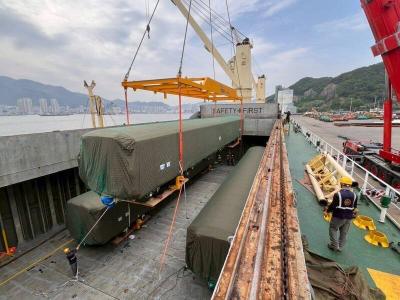
The first of 10 new high-capacity trains purchased from South Korea’s Hyundai Rotem arrived at the Port of Taipei yesterday to meet the demands of an expanding metro network, Taipei Rapid Transit Corp (TRTC) said yesterday. The train completed a three-day, 1,200km voyage from the Port of Masan in South Korea, the company said. Costing NT$590 million (US$18.79 million) each, the new six-carriage trains feature a redesigned interior based on "human-centric" transportation concepts, TRTC said. The design utilizes continuous longitudinal seating to widen the aisles and optimize passenger flow, while also upgrading passenger information displays and driving control systems for a more comfortable
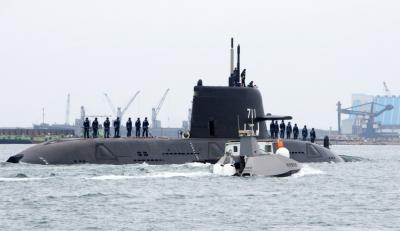
Taiwan's first indigenous defense submarine, the SS-711 Hai Kun (海鯤, or Narwhal), departed for its 13th sea trial at 7am today, marking its seventh submerged test, with delivery to the navy scheduled for July. The outing also marked its first sea deployment since President William Lai (賴清德) boarded the submarine for an inspection on March 19, drawing a crowd of military enthusiasts who gathered to show support. The submarine this morning departed port accompanied by CSBC Corp’s Endeavor Manta (奮進魔鬼魚號) uncrewed surface vessel and a navy M109 assault boat. Amid public interest in key milestones such as torpedo-launching operations and overnight submerged trials,
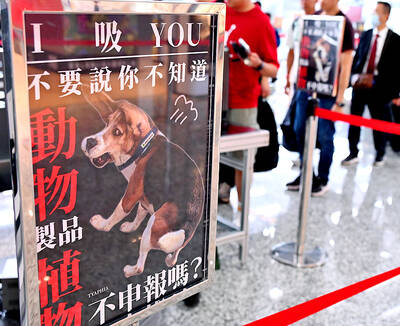
Quarantine awareness posters at Taiwan Taoyuan International Airport have gone viral for their use of wordplay. Issued by the airport branch of the Animal and Plant Health Inspection Agency, the posters feature sniffer dogs making a range of facial expressions, paired with advisory messages built around homophones. “We update the messages for holidays and campaign needs, periodically refreshing materials to attract people’s attention,” quarantine officials said. “The aim is to use the dogs’ appeal to draw focus to quarantine regulations.” A Japanese traveler visiting Taiwan has posted a photo on X of a poster showing a quarantine dog with a

Taiwan’s coffee community has launched a “one-person-one-e-mail” campaign, calling for people to send a protest-e-mail to the World Coffee Championships (WCC) urging it to redesignate Taiwanese competitors as from “Taiwan,” rather than “Chinese Taipei.” The call followed sudden action last week after the WCC changed all references to Taiwanese competitors from “Taiwan” to “Chinese Taipei,” including recent World Latte Art champion Bala (林紹興), who won the World Latte Art Championship in San Diego earlier this month. When Bala received the trophy, he was referred to as representing Taiwan, as well as in the announcement on the WCC’s Web site, until it


 RSS
RSS