


The Ministry of Science and Technology yesterday celebrated the launch of its Joint Center for Artificial Intelligence and Automated Healthcare at National Taiwan University, which it hopes will help carry over research results into the industrial and business sectors.
“AI [artificial intelligence] research began in the 1950s, and by the 1980s and 1990s, significant AI developments had been achieved in industrial control systems,” university acting president Kuo Tei-wei (郭大維) said.
By 2010, AI research on deep learning had branched out to linguistics, item recognition and medical imagery recognition, Kuo said.
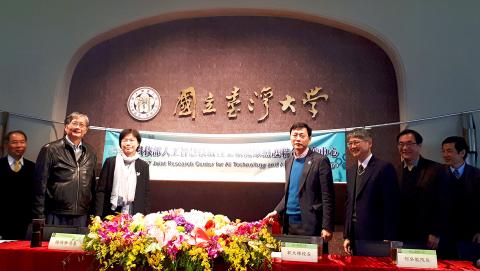
Photo: CNA
Only three universities in Asia have made it into the top 50 in terms of AI research, and NTU ranks No. 37, the best in Asia, Kuo said.
“With the ministry’s center set up at the university, we hope to promote biomedical research using our medical and health data archives, as well as increase the competitiveness of Taiwan’s AI industry,” Kuo said.
AI research is a globally trending topic and has been a primary focus of Minister of Science and Technology Chen Liang-gee (陳良基) since he was appointed to the position on Feb. 15 last year, Department of Foresight and Innovation Policies Director-General Yang Hsiu-ya (楊琇雅) said.
The ministry plans to launch AI-related projects based on a five-year cycle, with an allotted funding of NT$1 billion (US$34.24 million) per year, she said.
The center would offer core support to developing technology and applications from the nation’s AI research, she added.
The ministry plans to establish a total of four centers, with the center at NTU being the only one to support both research and applications, Yang said, adding that it would have an AI technology department and an automated healthcare department.
The other three centers would depend on technical assistance from the one at NTU, Yang said.
The ministry expects the resources injected into the centers to boost cooperation across universities and departments, hopefully spilling over into the industrial and business sectors, as well as foreign research centers, Yang said.
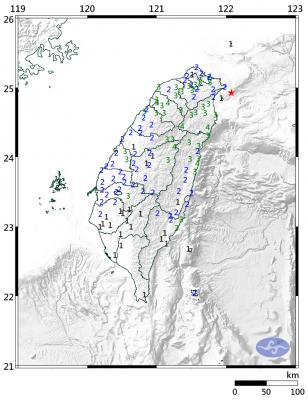
A magnitude 6.1 earthquake struck off the coast of Yilan County at 8:39pm tonight, the Central Weather Administration (CWA) said, with no immediate reports of damage or injuries. The epicenter was 38.7km east-northeast of Yilan County Hall at a focal depth of 98.3km, the CWA’s Seismological Center said. The quake’s maximum intensity, which gauges the actual physical effect of a seismic event, was a level 4 on Taiwan’s 7-tier intensity scale, the center said. That intensity level was recorded in Yilan County’s Nanao Township (南澳), Hsinchu County’s Guansi Township (關西), Nantou County’s Hehuanshan (合歡山) and Hualien County’s Yanliao (鹽寮). An intensity of 3 was
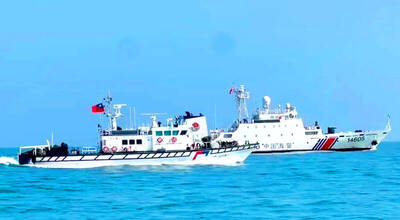
Instead of focusing solely on the threat of a full-scale military invasion, the US and its allies must prepare for a potential Chinese “quarantine” of Taiwan enforced through customs inspections, Stanford University Hoover fellow Eyck Freymann said in a Foreign Affairs article published on Wednesday. China could use various “gray zone” tactics in “reconfiguring the regional and ultimately the global economic order without a war,” said Freymann, who is also a nonresident research fellow at the US Naval War College. China might seize control of Taiwan’s links to the outside world by requiring all flights and ships entering or leaving Taiwan
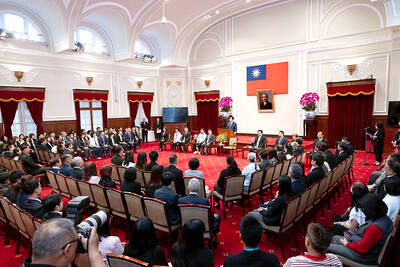
The next minimum wage hike is expected to exceed NT$30,000, President William Lai (賴清德) said yesterday during an award ceremony honoring “model workers,” including migrant workers, at the Presidential Office ahead of Workers’ Day today. Lai said he wished to thank the awardees on behalf of the nation and extend his most sincere respect for their hard work, on which Taiwan’s prosperity has been built. Lai specifically thanked 10 migrant workers selected for the award, saying that although they left their home countries to further their own goals, their efforts have benefited Taiwan as well. The nation’s industrial sector and small businesses lay
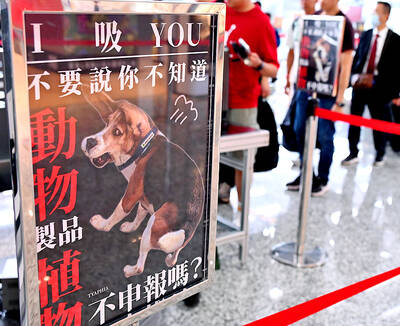
Quarantine awareness posters at Taiwan Taoyuan International Airport have gone viral for their use of wordplay. Issued by the airport branch of the Animal and Plant Health Inspection Agency, the posters feature sniffer dogs making a range of facial expressions, paired with advisory messages built around homophones. “We update the messages for holidays and campaign needs, periodically refreshing materials to attract people’s attention,” quarantine officials said. “The aim is to use the dogs’ appeal to draw focus to quarantine regulations.” A Japanese traveler visiting Taiwan has posted a photo on X of a poster showing a quarantine dog with a


 RSS
RSS