


Academics have urged President Tsai Ing-wen’s (蔡英文) government to follow other countries’ examples, preventing Chinese infiltration and establishing a self-defense mechanism for the nation’s democracy as soon as possible.
Chinese infiltration in the international community has affected the national interest of different countries, Cross-Strait Policy Association secretary-general Wang Chih-sheng (王智盛) said.
However, for Taiwan, Chinese infiltration touches on national survival, Wang said, adding that the government should review what other countries have done as soon as possible, assess national security laws and ensure Taiwan’s safety.
According to Wang, Jamestown Foundation fellow Peter Mattis has said that former president Ma Ying-jeou’s (馬英九) term was a “dark decade,” during which Chinese spies were most active in Taiwan.
Mattis, a former US government analyst, said that in the past, as Taiwan opened up, order was not enforced, allowing deep Chinese infiltration, Wang continued.
Such activities are no longer limited to photography and fishing for military intelligence like in the past, Wang said, adding that infiltrators are developing organizations, absorbing members and sowing seeds in Taiwan through pro-China political parties or groups.
Australia and other countries have already noticed Chinese infiltration and interference, and have drawn up laws to prevent it, Wang said.
However, disagreement about identity, with the pan-blue camp not viewing China as an enemy, has made drafting legislation difficult in Taiwan, Wang added.
China uses Confucius Institutes around the world as spy agencies that infiltrate academic and cultural institutions to limit academic freedom, Tamkang University Center of Advanced Technology executive director Su Tzu-yun (蘇紫雲) said, adding that many countries are already on alert.
China has replicated this mode in Taiwan, infiltrating Taiwanese academia and targeting graduate students to develop groups, Su said, adding that these actions are still happening in the shadows, but could spark the next national security crisis.
To recruit Chinese students, schools have cooperated with the country and lost their independence, he said, adding that China has also used academics in science and technology to execute its plans for technological research.
On the surface, these plans are commercial or technological in nature, but they actually have military aims, Su said.
In the fields of law and politics, by hosting forums, cross-strait academic exchanges and other platforms, China gives people a stage to influence Taiwanese public opinion and defend China, Su said.
Because of academic freedom, it might be legally difficult to intervene, but the government should strengthen education and psychological defense, Su said, adding that the nation should develop a defense mechanism for its democracy similar to that of Germany.
This means amending the Political Party Act (政黨法) or the Civil Associations Act (人民團體法) to forbid the use of democratic means to reject the democratic system and forbidding organizations that reject the democratic system, among others, Su said.
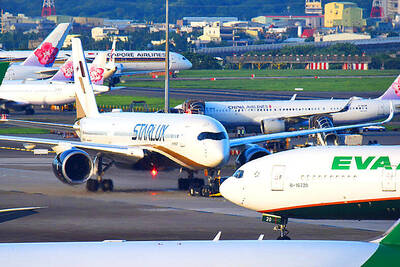
Trips for more than 100,000 international and domestic air travelers could be disrupted as China launches a military exercise around Taiwan today, Taiwan’s Civil Aviation Administration (CAA) said yesterday. The exercise could affect nearly 900 flights scheduled to enter the Taipei Flight Information Region (FIR) during the exercise window, it added. A notice issued by the Chinese Civil Aviation Administration showed there would be seven temporary zones around the Taiwan Strait which would be used for live-fire exercises, lasting from 8am to 6pm today. All aircraft are prohibited from entering during exercise, it says. Taipei FIR has 14 international air routes and
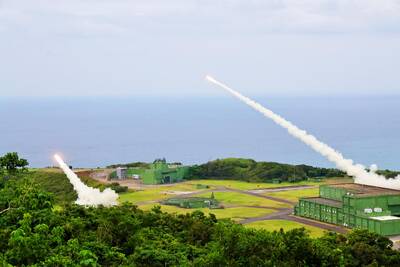
Taiwan lacks effective and cost-efficient armaments to intercept rockets, making the planned “T-Dome” interception system necessary, two experts said on Tuesday. The concerns were raised after China’s military fired two waves of rockets during live-fire drills around Taiwan on Tuesday, part of two-day exercises code-named “Justice Mission 2025.” The first wave involved 17 rockets launched at 9am from Pingtan in China’s Fujian Province, according to Lieutenant General Hsieh Jih-sheng (謝日升) of the Office of the Deputy Chief of the General Staff for Intelligence at the Ministry of National Defense. Those rockets landed 70 nautical miles (129.6km) northeast of Keelung without flying over Taiwan,
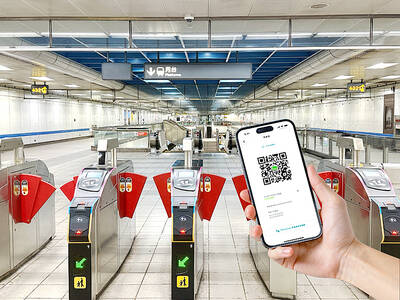
City buses in Taipei and New Taipei City, as well as the Taipei MRT, would on Saturday begin accepting QR code payments from five electronic payment providers, the Taipei Department of Transportation said yesterday. The new option would allow passengers to use the “transportation QR code” feature from EasyWallet, iPass Money, iCash Pay, Jkopay or PXPay Plus. Passengers should open their preferred electronic payment app, select the “transportation code” — not the regular payment code — unlock it, and scan the code at ticket readers or gates, General Planning Division Director-General Liu Kuo-chu (劉國著) said. People should move through the
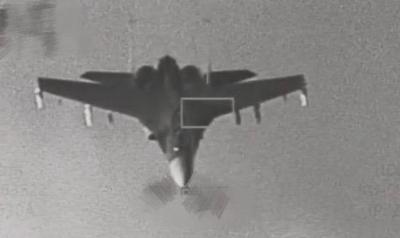
The Ministry of National Defense (MND) today released images of the military tracking China’s People's Liberation Army (PLA) movements during the latest round of Chinese drills around Taiwan. The PLA began "Justice Mission 2025" drills today, carrying out live-fire drills, simulated strikes on land and maritime targets, and exercises to blockade the nation's main ports. The exercises are to continue tomorrow, with the PLA announcing sea and air space restrictions for five zones around Taiwan for 10 hours starting from 8:30am. The ministry today released images showing a Chinese J-16 fighter jet tracked by a F-16V Block 20 jet and the


 RSS
RSS