


Chinese Nationalist Party (KMT) Chairman Wu Den-yih (吳敦義) yesterday vowed to restore the nation to its former glory under late president Chiang Ching-kuo (蔣經國) by leading the KMT to victory in the local elections in November and to win back executive power in 2020.
Wu made the remarks at an event held by the KMT at the Taipei Hero House to commemorate the 30th anniversary of Chiang’s death.
The event was attended by all KMT chairpersons after former president Lee Teng-hui (李登輝) — former president Ma Ying-jeou (馬英九), former vice president Lien Chan (連戰), New Taipei Mayor Eric Chu (朱立倫), Wu and Hung Hsiu-chu (洪秀柱).
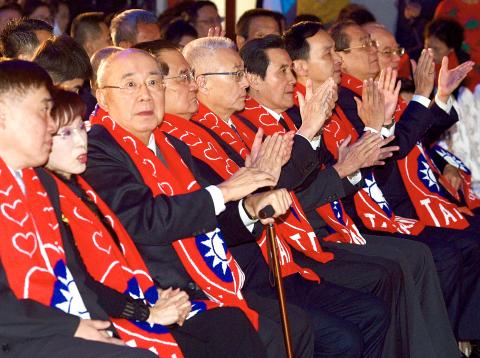
Photo: Peter Lo, Taipei Times
“Chiang was a man with eyes like torches, a heart as big as the ocean and shoulders stronger than iron,” Wu said during his speech about his experience working under Chiang.
Chiang’s four major contributions to the nation were pushing the 10 Reforms (十項革新), the 10 Major Construction Projects, lifting martial law and allowing veterans who had retreated from China to Taiwan with the KMT in 1949 to visit their families in China.
While carrying out the 10 Reforms Chiang led by example, adopting a frugal lifestyle, while he also punished officials found to have been involved in graft, which greatly reduced corruption in the government, Wu said.
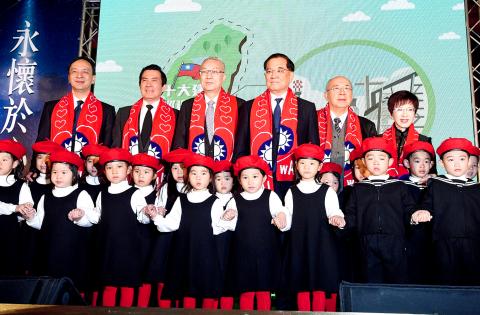
Photo: Peter Lo, Taipei Times
The 10 Major Construction Projects jump-started the nation’s industries and propelled the nation to the No. 1 spot among the four “Asian tigers” in terms of economic growth, he said.
The lifting of martial law enabled people to form political parties and laid the foundation for the nation’s transformation to a free and democratic nation built upon the rule of law, while allowing veterans to visit their families in China ushered in an era of peaceful exchanges across the Taiwan Strait, he said.
“As we commemorate the 30th anniversary of Sir Chiang’s passing, we feel that the responsibility on our shoulders is more important than ever, and the fire in our hearts is burning more fiercely than ever,” Wu said.
The KMT is more steadfast than ever in its resolve to regain political power — especially when it is faced with a ruling party that deviates from the ways of the past — so that it can bring back prosperity and wealth to all people; promote harmony in the legislature; build a society where young people’s talents can be seen and where elders are treated with respect; and resume steady and peaceful cross-strait developments through the bond between Zhonghua minzu (中華民族, “Chinese ethnic group”) on both sides of the Taiwan Strait, Wu said.
The party will nominate whoever has the necessary capabilities, loyalty, experience, achievements and chance of winning in the lead-up to this year’s local elections, and the 2020 presidential and legislative elections, he said.
Ma reminisced about his 76 months working as Chiang’s aide, sharing anecdotes and doing impersonations of the former president, with which he drew laughter and applause from the audience.
“When he received then-Washington Post publisher Katharine Graham, and told her that he was going to lift martial law and allow people to found political parties, I translated his every word into English, while telling myself that he was creating history,” Ma said.
He lauded Chiang for bringing about peaceful cross-strait developments and criticized the Democratic Progressive Party for allowing cross-strait exchanges to cease.
“When did cross-strait relations become as icy as they were before I took office?” Ma said.
While Chiang ended the nation’s authoritarian era and laid the groundwork for Taiwan’s democracy, a new authoritarian regime has formed, waiting for its moment, Ma said, without clarifying his remarks.
“We should all be alert and not allow the hard-fought democratic and constitutional system to be destroyed,” he said.
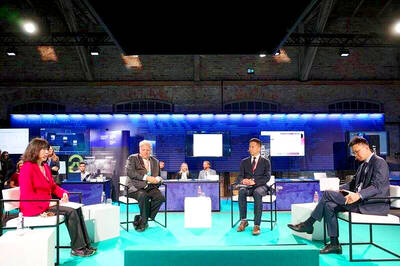
In a historic first, Taiwanese officials participated in this year’s Riga Strategic Communications Dialogue in Latvia from Wednesday to Friday last week, which debuted a breakout session focused on Taiwan The event organizer, the NATO Strategic Communications Center of Excellence, displayed Taiwan’s national flag and the officials’ formal titles on their Web site. Taiwanese attendees included National Security Council (NSC) Deputy Secretary-General Lin Fei-fan (林飛帆) and deputy head of the Taipei Representative Office in the UK, Chiang Ya-chi (江雅綺). In addition to the session discussing Taiwan titled “Taiwan: Navigating Strategic Communication in a Tense Environment,” the dialogue also included sessions
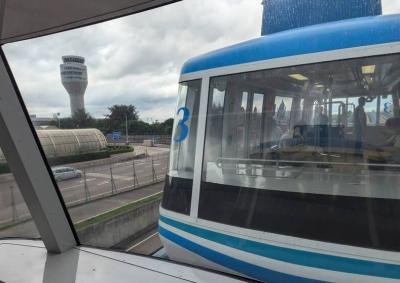
Taiwan Taoyuan International Airport is to suspend its automated Skytrain service connecting Terminal 1 and Terminal 2 starting on July 1 to facilitate connection works for the upcoming Terminal 3, the airport operator said today. Passengers and staff who need to travel between the two terminals after the suspension can instead use the Taoyuan MRT or the airport's 24-hour shuttle bus service, Taoyuan International Airport Corp said. The Taoyuan MRT Airport Line directly links the two terminals, while the shuttle buses are to operate around the clock, the company added. The Skytrain provides free transportation between the airport’s two terminals for travelers and
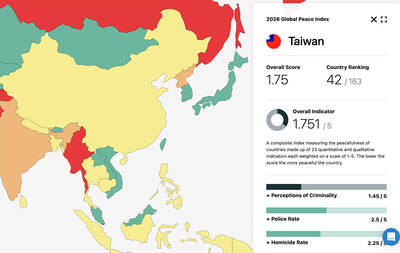
Taiwan ranked 42nd in terms of peacefulness among 163 countries, down five places from last year, according to this year’s Global Peace Index. With an overall score of 1.751, Taiwan dropped from 37th last year, the report published by the global Institute for Economics and Peace showed. The overall score measures a country’s level of peacefulness using 23 quantitative and qualitative indicators across three domains — ongoing domestic and international conflict, societal safety and security, and militarization. While Taiwan ranked 42nd worldwide, it was listed in ninth place among the 19 Asian-Pacific countries in the report, after New Zealand, Singapore, Japan, Malaysia,
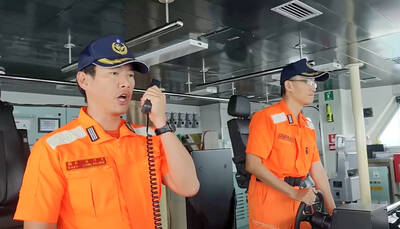
TOKYO-MANILA DELIMITATION TALKS: Beijing is attempting to use this opportunity to normalize patrols and law enforcement in the waters east of Taiwan, MOFA said China has no law enforcement authority over the waters east of Taiwan, the Ministry of Foreign Affairs (MOFA) said yesterday, accusing China of undermining regional peace and stability. The Chinese Ministry of Transport on Saturday evening announced that it had launched a “special maritime law enforcement operation” in the waters east of Taiwan, dispatching coast guard vessels to engage in illegal enforcement activities, the ministry said. State-run Xinhua news agency said the operation was “a necessary action taken in response to Japan and the Philippines unilaterally announcing the initiation of maritime boundary delimitation negotiations in the waters east of China’s Taiwan island,


 RSS
RSS