


The New Power Party (NPP) yesterday put forward six referendum topics regarding sovereignty and labor rights, including sensitive proposals dealing with the nation’s territory and official name, and said it would conduct an online poll to decide which two of the six topics the party should advocate to propose for a referendum.
Four of the topics fall within the category of sovereignty: whether the president should convene a “citizens’ constitutional convention” to draft a new constitution, which would need to be approved by referendum; whether Taiwan should seek to compete in the 2020 Tokyo Olympics under the name “Taiwan”; whether the government should define the country’s territory as “Taiwan, Penghu, Kinmen, Matsu and other islets”; and whether the English name “Republic of China” should be removed from Taiwanese passports.
In the labor rights category, the party proposed two questions: whether the Legislative Yuan should pass a “national holiday act” to ensure a minimum of 19 national holidays each year for public and private employees and whether it should pass a “minimum wage act” that guarantees the minimum income needed to sustain the basic living needs of employees and their families.
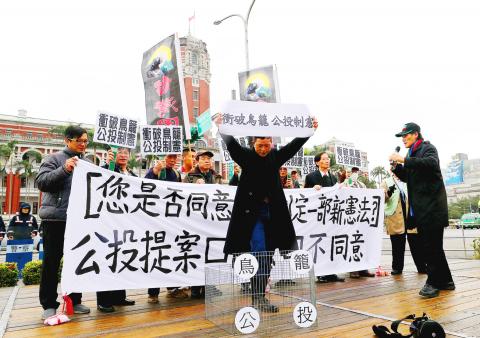
Photo: CNA
The NPP invited the public to vote on the six proposals on its Web site from yesterday to Thursday, saying it would initiate the referendum process for the most favored topic in each of the two categories and expects to submit the two referendum proposals to the Central Election Commission next month at the earliest.
The NPP’s proposals followed the passage of an amendment to the Referendum Act (公民投票法) that lowers the thresholds for initiating, seconding and passing referendums.
“[The proposal] to establish a ‘citizens’ constitutional convention’ is in line with the essence of Sunflower movement, which called for a convention to draft a constitution appropriate to Taiwan through a bottom-up decisionmaking process,” NPP Executive Chairman Huang Kuo-chang (黃國昌) said
Redefining the nation’s territory is crucial to help Taiwan assert its sovereignty and would have a positive effect on policymaking and budgeting, Huang said.
The NPP’s proposals have been criticized as being in conflict with the amendment, which rules out territorial changes and constitutional amendments as viable referendum topics.
Huang said that even though the party would touch on the issue of the nation’s territory and official name, none of the issues would require any changes to the Constitution.
The Democratic Progressive Party described the act as a procedural bill regulating how referendum processes should be carried out, not what topics the public can vote on, Huang said, adding that the NPP believes the public has the right to vote on the six topics.
“How could a purely procedural bill deprive citizens of the power to vote on those issues?” NPP Legislator Hsu Yung-ming (徐永明) said, calling on the commission to uphold the values of democracy when the NPP initiates the referendum processes.
While same-sex marriage opponents have reportedly planned to launch a referendum on the issue, Huang said that basic human rights cannot be put to vote and a referendum could not override the constitutional interpretation in May that found the statutory ban on same-sex marriage to be unconstitutional, Huang said.

The military has spotted two Chinese warships operating in waters near Penghu County in the Taiwan Strait and sent its own naval and air forces to monitor the vessels, the Ministry of National Defense (MND) said. Beijing sends warships and warplanes into the waters and skies around Taiwan on an almost daily basis, drawing condemnation from Taipei. While the ministry offers daily updates on the locations of Chinese military aircraft, it only rarely gives details of where Chinese warships are operating, generally only when it detects aircraft carriers, as happened last week. A Chinese destroyer and a frigate entered waters to the southwest

The eastern extension of the Taipei MRT Red Line could begin operations as early as late June, the Taipei Department of Rapid Transit Systems said yesterday. Taipei Rapid Transit Corp said it is considering offering one month of free rides on the new section to mark its opening. Construction progress on the 1.4km extension, which is to run from the current terminal Xiangshan Station to a new eastern terminal, Guangci/Fengtian Temple Station, was 90.6 percent complete by the end of last month, the department said in a report to the Taipei City Council's Transportation Committee. While construction began in October 2016 with an

NON-RED SUPPLY: Boosting the nation’s drone industry is becoming increasingly urgent as China’s UAV dominance could become an issue in a crisis, an analyst said Taiwan’s drone exports to Europe grew 41.7-fold from 2024 to last year, with demand from Ukraine’s fight against Russian aggression the most likely driver of growth, a study showed. The Institute for Democracy, Society and Emerging Technology (DSET) in a statement on Wednesday said it found that many of Taiwan’s uncrewed aerial vehicle (UAV) sales were from Poland and the Czech Republic. These countries likely transferred the drones to Ukraine to aid it in its fight against the Russian invasion that started in 2022, it said. Despite the gains, Taiwan is not the dominant drone exporter to these markets, ranking second and fourth

Japanese Prime Minister Sanae Takaichi’s comment last year on Tokyo’s potential reaction to a Taiwan-China conflict has forced Beijing to rewrite its invasion plans, a retired Japanese general said. Takaichi told the Diet on Nov. 7 last year that a Chinese naval blockade or military attack on Taiwan could constitute a “survival-threatening situation” for Japan, potentially allowing Tokyo to exercise its right to collective self-defense. Former Japan Ground Self-Defense Force general Kiyofumi Ogawa said in a recent speech that the remark has been interpreted as meaning Japan could intervene in the early stages of a Taiwan Strait conflict, undermining China’s previous assumptions


 RSS
RSS