


Makatao villages in Pingtung County concluded their annual Night Festival yesterday, as local government officials joined the Makatao Aboriginal community to review cultural revitalization policies and other government programs outlined for the community over the coming years.
The festival, which took place this weekend at Laopi Village (老埤) in Pingtung County’s Neipu Township (內埔), is one of the three main annual cultural events of the county’s Makatao people, who are one of 10 Pingpu, or lowlands, Aboriginal groups in Taiwan still not officially recognized by the government.
“We had over 300 Pingpu clan relatives and friends, mostly from southern Taiwan, coming in to attend this festival,” Laopi Village Elder Pan An-chuan (潘安全) said. “It is an important occasion for us to get together, to thank the deities who provided guidance, protection and a good harvest this year, and also to celebrate our cultural heritage.”
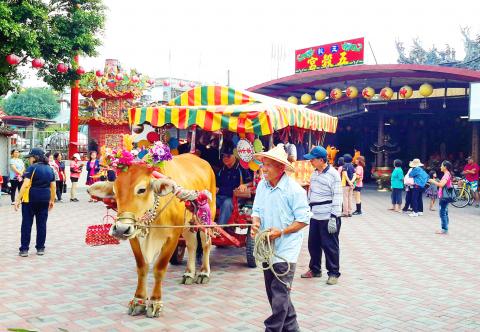
Photo: CNA
Pan said the traditional worship rituals and activities were centered on the village’s Laotsu Temple, where gatherers pay respects to Makatao deities through offerings of pork, grains, rice wine, betel nuts and fruits, as well as by performing a special dance known as Tioh-hi.
The dance is performed by women from the Makatao community and led by female shamans.
A key supporter of the revitalization of Makatao traditional festivals is Pingtung County Cultural Affairs Department Director Wu Chin-fa (吳錦發), who has pushed for financial backing for such programs.
“Household registration data from 1909, during the Japanese colonial era, show that Laopi Village had 1,186 residents listed as ‘plains Aborigines,’” Wu said in a speech at the festival.
“This was a vibrant Makatao community and a cultural center in the county,” he said. “It has remained so up to this day, but work is needed to preserve and pass on the heritage of the community by Makatao elders, community leaders and cultural researchers.”
Wu said that since Pingtung County Commissioner Pan Men-an (潘孟安) took office in 2014, programs for Makatao cultural revitalization have been among the county’s priorities, along with funding for local schools to teach students about the history and heritage of Makatao people.
Pan Yen-pao (潘燕寶), who heads local Makatao culture working groups, said that this year’s event included an exhibition of old photographs and documents about the Makatao community that showed people’s activities through the generations, along with a presentation of traditional local arts and crafts.
“The event is a good way to educate young people about the traditions and customs of the Makatao community. It is important for people to recognize their own cultural heritage and identify themselves as Makatao people,” he said.
Wu and community elders at the event also invited people to participate in two other upcoming Makatao festivals in Pingtung, the Ganabo Night Festival in Gaoshu Township (高樹), which will be held overnight from Jan. 1 to Jan. 2, and the Gabulong Night Festival in Wanluan Township (萬巒), which is scheduled for March 2.

NATIONAL SECURITY: Authorities are working to confirm the identities of the military personnel involved and investigating possible illegal conduct and regulatory violations Authorities are probing possible national security implications after Kinmen police and immigration officers on Sunday found a Chinese woman allegedly posing as a tourist while engaging in prostitution involving more than 10 military personnel. The woman, surnamed Chen (陳), has since been deported, authorities said, adding that investigators are still working to confirm the identities of those implicated, as the records only listed code names and aliases. The case stemmed from a report received by the Kinmen District Prosecutors’ Office on Friday last week from the Jinhu Precinct of the Kinmen County Police Bureau. On Sunday, police, along with the National Immigration

GLOBALGIVING: ‘ Caving to external pressure is not acceptable for an organization that has cultivated justice reform and human rights for 30 years,’ one NGO said A slew of non-government organizations (NGOs) have withdrawn from the GlobalGiving fundraising platform after it announced it would use “Chinese Taipei” instead of “Taiwan” from next month. The Taiwan Good Rice Association wrote on Facebook on Friday that it was informed on April 28 via a teleconference call of the change, which was made because the platform wanted to operate in China. Taiwan Good Rice is to terminate all cooperative relationships with GlobalGiving in response to the platform’s “unilateral and non-negotiable” decision to remove references to Taiwan, the NGO said. “Taiwan is in the official name of Taiwan Good Rice Association and the

HEAVY WEATHER: Typhoon Jangmi is due to crash straight into the Ryukyus as airlines look to shift flights to larger aircraft or cancel flights to Okinawa entirely Taiwan’s international air carriers announced flight adjustments over the weekend as Typhoon Jangmi is forecast to hit the Ryukyu Islands today and tomorrow. The Central Weather Administration (CWA) upgraded Jangmi from a tropical storm to a typhoon at 8am yesterday, with the eye located 580km south of Naha city. It was moving north at 19kph. Today, China Airlines’ CI-120, CI-121, CI-122 and CI-123 flights between Taoyuan and Naha, Okinawa, have been canceled as well as CI-132 and CI-133 between Kaohsiung and Naha. EVA Air’s BR-112, BR-113, BR-186 and BR-185 flights between Taoyuan and Naha are also canceled. Low-cost carrier Tigerair Taiwan canceled IT-230,

MULTIPRONGED APPROACH: China has sought to pressure Palau across a number of fronts, but the island nation has staunchly resisted overtures to ditch Taiwan Palau has been firm in backing Taiwan despite Chinese pressure that uses tourism economics, cyberattacks and criminal infiltration as tools to threaten the Pacific ally into renouncing its recognition of Taiwan as a sovereign state. The Presidential Office yesterday announced that Vice President Hsiao Bi-khim (蕭美琴) would visit Palau from Saturday to Wednesday next week at the invitation of Palauan President Surangel Whipps Jr. Whipps in April said in an interview that China had outspokenly asked Palau to “denounce Taiwan.” “And we have said: ‘We have no enemies, but nobody tells us who our friends are,’” he said. Whipps has told reporters multiple times


 RSS
RSS