


Civic groups and Democratic Progressive Party (DPP) lawmakers yesterday called on the government to step up efforts to fight air pollution after Taiwan placed seventh in the 2018 Global Climate Risk Index published by the non-profit organization Germanwatch.
Taiwan ranked 51st out of 182 countries worldwide last year in the index, which was presented at the 23rd Conference of Parties of the UN Framework Convention on Climate Change in Bonn, Germany, this week.
Environmental Protection Administration Minister Lee Ying-yuan (李應元) and the legislators accompanying him on the trip to the conference were blocked from attending the conference due to pressure from China, DPP Legislator Liu Chien-kuo (劉建國) said, calling on participating nations at the conference to support Taiwanese engagement on the issue of global climate change.
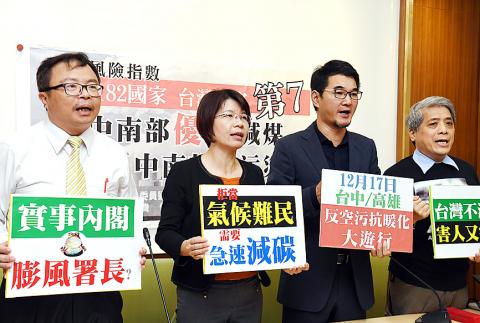
Photo: CNA
Liu also urged Premier William Lai (賴清德) to follow through on the government’s plan to cut back on coal production, citing the importance of reducing energy consumption domestically and transitioning to alternative sources of energy.
DPP Legislator Huang Hsiu-fang (黃秀芳) agreed, pointing to the worsening air quality in Changhua County in recent years and drawing attention to the potential health risks associated with air pollution.
DPP Legislator Hung Tsung-yi (洪宗熠) also called for more concrete steps to reduce coal production, saying he hoped the central government would not leave local government leaders alone in the battle to prevent air pollution.
Air Clean Taiwan director Yeh Guang-perng (葉光芃) questioned the productivity of the Executive Yuan’s Office of Energy and Carbon Reduction, saying that even China — known as a big producer of carbon emissions — ranked lower than Taiwan in the Global Climate Risk Index.
The government should not just plan actions, but also execute them, Yeh said.
Office of Energy and Carbon Reduction official Huang Ching-ming (黃錦明) rebutted allegations that the office has done nothing.
“There have been many meetings on key measures [to fight pollution] and the office has assisted related departments on reducing energy consumption and coal production,” Huang said.
It takes time for some plans to demonstrate their impact, he said.

Yangmingshan National Park authorities yesterday urged visitors to respect public spaces and obey the law after a couple was caught on a camera livestream having sex at the park’s Qingtiangang (擎天崗) earlier in the day. The Shilin Police Precinct in Taipei said it has identified a suspect and his vehicle registration number, and would summon him for questioning. The case would be handled in accordance with public indecency charges, it added. The couple entered the park at about 11pm on Thursday and began fooling around by 1am yesterday, the police said, adding that the two were unaware of the park’s all-day live

Yangmingshan National Park’s Qingtiangang (擎天崗) nature area has gone viral after a park livestream camera observed a couple in the throes of intimate congress, which was broadcast live on YouTube, drawing large late-night crowds and sparking a backlash over noise, bright lights and disruption to wildlife habitat. The area’s livestream footage appeared to show a couple engaging in sexual activity on a picnic table in the park on Friday last week, with the uncensored footage streamed publicly online. The footage quickly spread across social media, prompting a tide of visitors to travel to the site to “check in” and recreate the
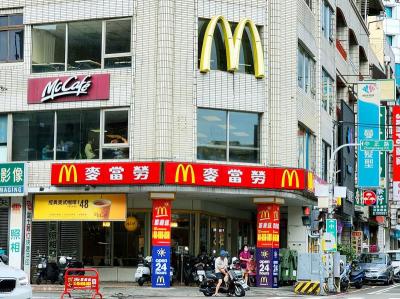
Fast food chain McDonald's is to raise prices by up to NT$5 on some products at its restaurants across Taiwan, starting on Wednesday next week, the company announced today. The prices of all extra value meals and sharing boxes are to increase by NT$5, while breakfast combos and creamy corn soup would go up by NT$3, the company said in a statement. The price of the main items of those meals, if ordered individually, would remain the same. Meanwhile, the price of a medium-sized lemon iced tea and hot cappuccino would rise by NT$3, extra dipping sauces for chicken nuggets would go up

Minister of Digital Affairs Lin Yi-ching (林宜敬) yesterday cited regulatory issues and national security concerns as an expert said that Taiwan is among the few Asian regions without Starlink. Lin made the remarks on Facebook after funP Innovation Group chief executive officer Nathan Chiu (邱繼弘) on Friday said Taiwan and four other countries in Asia — China, North Korea, Afghanistan and Syria — have no access to Starlink. Starlink has become available in 166 countries worldwide, including Ukraine, Malaysia, the Philippines and Vietnam, in the six years since it became commercial, he said. While China and North Korea block Starlink, Syria is not


 RSS
RSS