


Despite China’s military buildup, a war between the two sides of the Taiwan Strait could be prevented if the US helped beef up Taiwan’s defense capabilities, a visiting US academic said yesterday.
China’s “People’s Liberation Army [PLA] is thinking very hard of this mission, which is their principal one,” US think tank Project 2049 Institute analyst Ian Easton said at a forum in Taipei.
It is therefore important that Americans and Taiwanese see China’s growing military prowess as a serious threat and realize that there is no easy solution, he said.
There is no way to change Beijing’s desire to invade Taiwan, especially since Chinese President Xi Jinping (習近平) came to power, Easton said.
Xi is much more hawkish than his predecessors and is reforming the PLA by adopting new and innovative tactics and plans, he said.
However, if the US and Taiwan can work together to boost the latter’s defense capabilities, a cross-strait war can be prevented, Easton said.
“What we can do is to make sure we are prepared,” he said. “If we prepare sufficiently we can protect the safety and stability in the region.”
He added that there are two major myths about a potential cross-strait war, which were created largely through China’s successful psychological warfare.
“One of the myths is that Taiwan is hopeless [against a Chinese invasion] and it is inevitable, so you should give up now,” he said.
But, in fact, the Chinese military is very respectful toward Taiwan’s military, he said, citing internal Chinese documents that he had obtained.
“It is a myth that Taiwan is a hopeless place or unification is inevitable,” Easton said. “Taiwan controls its own future.”
The other myth is that the US would not help Taiwan if a cross-strait war broke out, he said.
“If you read China’s own assessment, however, they take it for granted that the US will help defend Taiwan,” he said.
There is a “100 percent chance” that Washington will help defend Taipei in the event of a war, Easton said, adding that the only two questions would be when the US would arrive and how exactly it would help.
One major reason for the US to help is that Taiwan is a democracy and an old ally, he said.
Another reason is Taiwan’s geostrategic location in East Asia and the West Pacific at the center of the First Island Chain, Easton said.
However, if the PLA did decide to invade, the troops most likely would land in Taoyuan, so they could seize the Port of Taipei and Taiwan Taoyuan International Airport, before taking the capital, he said.
Taiwan knows this and has those areas properly defended, said Easton, author of The Chinese Invasion Threat: Taiwan’s Defense and American Strategy in Asia.
See EDITORIAL on page 8
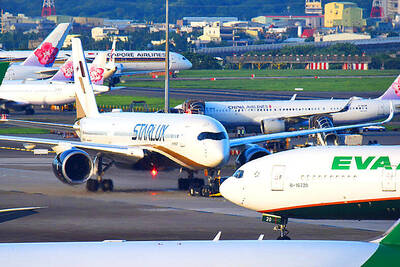
Trips for more than 100,000 international and domestic air travelers could be disrupted as China launches a military exercise around Taiwan today, Taiwan’s Civil Aviation Administration (CAA) said yesterday. The exercise could affect nearly 900 flights scheduled to enter the Taipei Flight Information Region (FIR) during the exercise window, it added. A notice issued by the Chinese Civil Aviation Administration showed there would be seven temporary zones around the Taiwan Strait which would be used for live-fire exercises, lasting from 8am to 6pm today. All aircraft are prohibited from entering during exercise, it says. Taipei FIR has 14 international air routes and
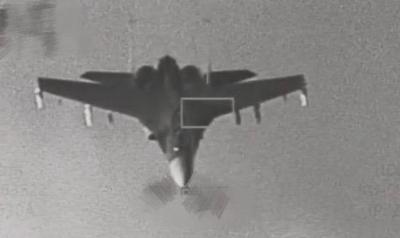
The Ministry of National Defense (MND) today released images of the military tracking China’s People's Liberation Army (PLA) movements during the latest round of Chinese drills around Taiwan. The PLA began "Justice Mission 2025" drills today, carrying out live-fire drills, simulated strikes on land and maritime targets, and exercises to blockade the nation's main ports. The exercises are to continue tomorrow, with the PLA announcing sea and air space restrictions for five zones around Taiwan for 10 hours starting from 8:30am. The ministry today released images showing a Chinese J-16 fighter jet tracked by a F-16V Block 20 jet and the
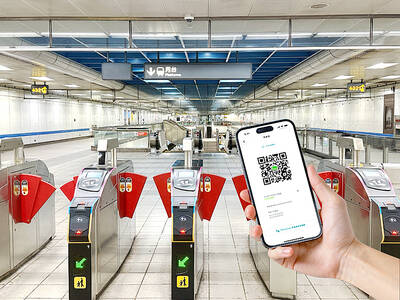
City buses in Taipei and New Taipei City, as well as the Taipei MRT, would on Saturday begin accepting QR code payments from five electronic payment providers, the Taipei Department of Transportation said yesterday. The new option would allow passengers to use the “transportation QR code” feature from EasyWallet, iPass Money, iCash Pay, Jkopay or PXPay Plus. Passengers should open their preferred electronic payment app, select the “transportation code” — not the regular payment code — unlock it, and scan the code at ticket readers or gates, General Planning Division Director-General Liu Kuo-chu (劉國著) said. People should move through the

Snow fell on Yushan (Jade Mountain, 玉山) yesterday morning as a continental cold air mass sent temperatures below freezing on Taiwan’s tallest peak, the Central Weather Administration (CWA) said. Snowflakes were seen on Yushan’s north peak from 6:28am to 6:38am, but they did not fully cover the ground and no accumulation was recorded, the CWA said. As of 7:42am, the lowest temperature recorded across Taiwan was minus-5.5°C at Yushan’s Fengkou observatory and minus-4.7°C at the Yushan observatory, CWA data showed. On Hehuanshan (合歡山) in Nantou County, a low of 1.3°C was recorded at 6:39pm, when ice pellets fell at Songsyue Lodge (松雪樓), a


 RSS
RSS