


Members of the People Rule Foundation yesterday began a hunger strike outside the Democratic Progressive Party’s (DPP) headquarters in Taipei, urging the DPP caucus to swiftly pass draft amendments to the Referendum Act (公民投票法), a move they say is crucial for the nation to attain direct democracy.
Foundation members gathered in a park facing DPP headquarters before circling the building three times in what foundation chief executive Liu Ming-hsin (劉明新) described as the foundation’s brand of “nonviolent protest.”
Liu urged lawmakers to pass draft amendments to the act that have passed their first reading.

Photo: CNA
Although some like-minded civic groups have voiced objections to Article 2 of the draft amendment, which prohibits changes to be made to the nation’s territory, official title, national flag and anthem, the foundation believes that solutions to these issues would manifest themselves after the proposed changes are enacted.
The DPP caucus believes that those issues should be addressed later through constitutional reforms, which is “understandable,” Liu said.
“We can achieve many things through referendums. Referendums should be made a habit and a part of people’s everyday life,” he said. “They will serve to revitalize Taiwanese democracy, encourage Taiwanese to take an active interest and participate in public affairs. That way, the restrictions imposed by Article 2 would disappear after two or three years.”
Asked if foundation founder Lin I-hsiung (林義雄), a veteran civil rights advocate, would join the hunger strike, Liu said that Lin would “take part [in the event] in due time and in his own way.”
Foundation president Chen Lih-kuei (陳麗貴) said that people being unable to exercise their constitutional rights through referendums is a flaw in the nation’s democratic system, which has prevented people from having direct democracy.
The act, passed in 2003, stipulates an unreasonably high threshold for a referendum to be adopted, which has caused the topics for all the referendums held in the past 14 years to be rejected, Chen said.
Democracy was the DPP’s core value when it was founded, but after gaining total control of the legislature more than 20 months ago, it has for the most part shelved draft amendments to the act, causing the legislation to drag on to this day, he said.
The hunger strike is a reminder to the DPP to fulfill its promise to finish amending the act before the end of this year, he added.
The hunger strike is scheduled to last until Nov. 23, with foundation members fasting in shifts.

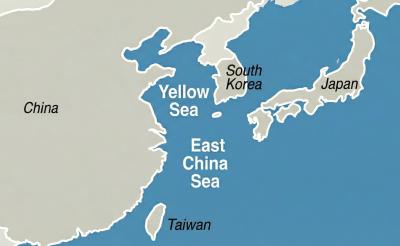
China has reserved offshore airspace in the Yellow Sea and East China Sea from March 27 to May 6, issuing alerts usually used to warn of military exercises, although no such exercises have been announced, the Wall Street Journal (WSJ) reported yesterday. Reserving such a large area for 40 days without explanation is an “unusual step,” as military exercises normally only last a few days, the paper said. These alerts, known as Notice to Air Missions (Notams), “are intended to inform pilots and aviation authorities of temporary airspace hazards or restrictions,” the article said. The airspace reserved in the alert is

NAMING SPAT: The foreign ministry called on Denmark to propose an acceptable solution to the erroneous nationality used for Taiwanese on residence permits Taiwan has revoked some privileges for Danish diplomatic staff over a Danish permit that lists “Taiwan” as “China,” Eric Huang (黃鈞耀), head of the Ministry of Foreign Affairs’ Department of European Affairs, told a news conference in Taipei yesterday. Reporters asked Huang whether the Danish government had responded to the ministry’s request that it correct the nationality on Danish residence permits of Taiwanese, which has been listed as “China” since 2024. Taiwan’s representative office in Denmark continues to communicate with the Danish government, and the ministry has revoked some privileges previously granted to Danish representatives in Taiwan and would continue to review

More than 6,000 Taiwanese students have participated in exchange programs in China over the past two years, despite the Mainland Affairs Council’s (MAC) “orange light” travel advisory, government records showed. The MAC’s publicly available registry showed that Taiwanese college and university students who went on exchange programs across the Strait numbered 3,592 and 2,966 people respectively. The National Immigration Agency data revealed that 2,296 and 2,551 Chinese students visited Taiwan for study in the same two years. A review of the Web sites of publicly-run universities and colleges showed that Taiwanese higher education institutions continued to recruit students for Chinese educational programs without
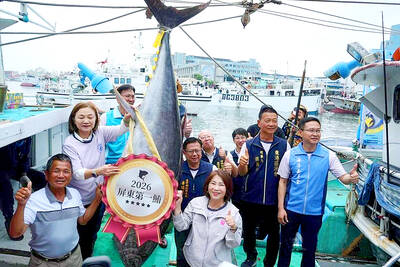
The first bluefin tuna of the season, brought to shore in Pingtung County and weighing 190kg, was yesterday auctioned for NT$10,600 (US$333.5) per kilogram, setting a record high for the local market. The auction was held at the fish market in Donggang Fishing Harbor, where the Siaoliouciou Island-registered fishing vessel Fu Yu Ching No. 2 delivered the “Pingtung First Tuna” it had caught for bidding. Bidding was intense, and the tuna was ultimately jointly purchased by a local restaurant and a local company for NT$10,600 per kilogram — NT$300 ,more than last year — for a total of NT$2.014 million. The 67-year-old skipper


 RSS
RSS