


The Cabinet yesterday announced measures to alleviate a shortage of industrial water, assuring the industry that they would not be hit by water shortages from 2031 onward.
The Cabinet is to improve reservoir capacity and water conservation efficiency while connecting the nation’s water supply systems to transport water to drought-affected areas and developing reserve supply systems, Premier William Lai (賴清德) said.
The measures are to create an additional 1.9 billion tonnes of water every year by 2031, which would ensure uninterrupted industrial water supply, Lai said.
They are part of measures to alleviate the nation’s five industrial shortages of land, power, water, workers and skilled labor.
“Solving the five industrial shortages is the fundamental means to develop the economy, which is a priority of the Cabinet,” Lai said.
As industrial water consumption is expected to grow, construction projects have been planned to boost supply capacity by dredging and expanding reservoirs and developing water recycling plants, Deputy Minister of Economic Affairs Kung Ming-hsin (龔明鑫) said.
Water conservation projects are also under way to reduce pipeline leakage and irrigation use, while improving industrial wastewater recycling capacity.
About 16 percent of potable water is lost due to pipe leakage, and the government plans to reduce that to 10 percent by 2031. The deadline of leakage improvement is to be 2022 in southern Taiwan, where water consumption has increased rapidly.
The government is to improve the efficiency of aging irrigation systems and introduce a subsidy program to encourage farmers to plant dry crops or leave fields fallow during dry seasons, which could conserve about 800 million tonnes of water every year. The agricultural sector uses 12.6 billion tonnes of water per year, Kung said.
While there is an uneven distribution of water resources in the nation, local water supply systems are to be connected to ensure stable supply in different regions.
The completion of a supply system connecting New Taipei City’s Banciao (板橋) and Sinjhuang (新莊) districts’ Feitsui Reservoir supply system — which supplies Taipei — with Taoyuan and Hsinchu counties, would free the Shihmen Reservoir for use by Hsinchu County.
“The water supply north of Hsinchu will be stable following the completion of the two supply systems,” Lai said, adding that a similar connecting system would be built for Chiayi County’s Tsengwen Reservoir.
The government is also to establish nationwide reserve supply systems by tapping into subterranean rivers and underground water to reduce the risk of water shortage during dry seasons.
By 2031, all of northern, central and southern Taiwan is to have a stable industrial supply, with Taoyuan and Hsinchu having access to 2.07 million tonnes of water every day (with 1.94 million tonnes in demand daily); Miaoli, Taichung and Changhua counties receiving 2.54 million tonnes per day (with 2.22 million tonnes in demand daily); and Tainan and Kaohsiung receiving 3.41 million tonnes per day (with 3.33 million tonnes in demand daily), the Cabinet said.

The military has spotted two Chinese warships operating in waters near Penghu County in the Taiwan Strait and sent its own naval and air forces to monitor the vessels, the Ministry of National Defense (MND) said. Beijing sends warships and warplanes into the waters and skies around Taiwan on an almost daily basis, drawing condemnation from Taipei. While the ministry offers daily updates on the locations of Chinese military aircraft, it only rarely gives details of where Chinese warships are operating, generally only when it detects aircraft carriers, as happened last week. A Chinese destroyer and a frigate entered waters to the southwest
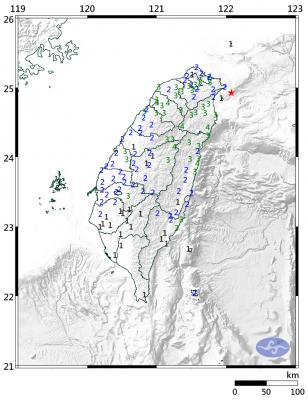
A magnitude 6.1 earthquake struck off the coast of Yilan County at 8:39pm tonight, the Central Weather Administration (CWA) said, with no immediate reports of damage or injuries. The epicenter was 38.7km east-northeast of Yilan County Hall at a focal depth of 98.3km, the CWA’s Seismological Center said. The quake’s maximum intensity, which gauges the actual physical effect of a seismic event, was a level 4 on Taiwan’s 7-tier intensity scale, the center said. That intensity level was recorded in Yilan County’s Nanao Township (南澳), Hsinchu County’s Guansi Township (關西), Nantou County’s Hehuanshan (合歡山) and Hualien County’s Yanliao (鹽寮). An intensity of 3 was

Japanese Prime Minister Sanae Takaichi’s comment last year on Tokyo’s potential reaction to a Taiwan-China conflict has forced Beijing to rewrite its invasion plans, a retired Japanese general said. Takaichi told the Diet on Nov. 7 last year that a Chinese naval blockade or military attack on Taiwan could constitute a “survival-threatening situation” for Japan, potentially allowing Tokyo to exercise its right to collective self-defense. Former Japan Ground Self-Defense Force general Kiyofumi Ogawa said in a recent speech that the remark has been interpreted as meaning Japan could intervene in the early stages of a Taiwan Strait conflict, undermining China’s previous assumptions
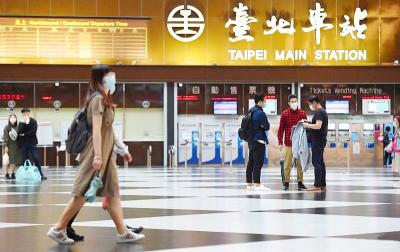
Taiwan Railways Corp (TRC) today announced that Shin Kong Mitsukoshi has been selected as the preferred bidder to operate the Taipei Railway Station shopping mall, replacing the current operator, Breeze Development Co Ltd. Among eight qualified firms that delivered presentations and were evaluated by a review committee, Shin Kong Mitsukoshi was ranked first, while Breeze was named the runner-up, the rail company said in a statement. Contract negotiations are to proceed in accordance with regulations, it said, adding that if negotiations with the top bidder fail, it could invite the second-ranked applicant to enter talks. Breeze in a statement today expressed doubts over


 RSS
RSS