


Democratic Progressive Party (DPP) Legislator Liu Chien-kuo (劉建國) yesterday urged the Cabinet to send an amendment to the Air Pollution Control Act (空氣污染防制法) proposed by the Environmental Protection Administration (EPA) to the legislature for review soon.
Even though the EPA’s amendment is not listed as one of the 72 priority bills for this legislative session, it should be reviewed as soon as possible, Liu said during a public hearing at the Legislative Yuan, which was also attended by DPP legislators Chung Kung-chao (鍾孔炤), Chen Man-li (陳曼麗) and Hung Tsung-yi (洪宗熠).
The proposal was sent to the Executive Yuan at the end of last month, but the Ministry of Economic Affairs expressed disagreement with some points, EPA Department of Air Quality Protection and Noise Control Director-General Tsai Hung-teh (蔡鴻德) said.
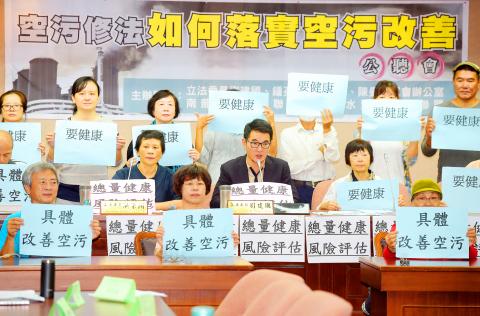
Photo: Huang Yao-cheng, Taipei Times
The EPA proposed that it would only “notify” the ministry when it is to impose regulations on industrial emissions, while the ministry insisted the agency should still obtain its approval, he said, adding that the EPA would insist on its position.
Lawmakers and groups concerned about air pollution are to visit Premier William Lai (賴清德) in coming days, asking him to come up with a concrete response to the issue, Liu said.
Air pollution has led to “environmental injustice,” as people in the center and south breathe dirtier air, National Taiwan University College of Public Health dean Chan Chang-chuan (詹長權) said.
The EPA’s regulations are only superficial and it should introduce policies such as phasing out petroleum cokes in power generation by 2020 and raw coal by 2030, he added.
Scientific studies have confirmed the correlation between exposure to fine particulate matter (PM2.5) and chronic obstructive pulmonary disease, reduced kidney functioning and other respiratory problems, National Institute of Environmental Health Sciences Director Guo Yue-liang (郭育良) said.
While government hopes to keep the yearly average PM2.5 concentration below 15 micrometers per cubic meter and 24-hour average below 35 micrometers per cubic meter, it should follow the WHO’s stricter standards, setting the yearly average at 10 micrometers per cubic meter and the 24-hour average at 25 micrometers per cubic meter, he said.
The nation last year did not meet the govenment’s target, as the average PM2.5 concentration last year was 20 micrometers per cubic meter, EPA data released last month showed.
The EPA should use part of its air pollution fund to undertake studies on the health of residents in or near industrial areas, the Southern Taiwan Anti-Air Pollution Alliance and other groups said in a statement after the meeting.


China has reserved offshore airspace in the Yellow Sea and East China Sea from March 27 to May 6, issuing alerts usually used to warn of military exercises, although no such exercises have been announced, the Wall Street Journal (WSJ) reported yesterday. Reserving such a large area for 40 days without explanation is an “unusual step,” as military exercises normally only last a few days, the paper said. These alerts, known as Notice to Air Missions (Notams), “are intended to inform pilots and aviation authorities of temporary airspace hazards or restrictions,” the article said. The airspace reserved in the alert is
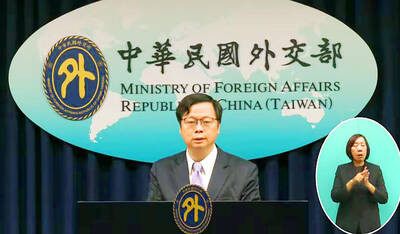
NAMING SPAT: The foreign ministry called on Denmark to propose an acceptable solution to the erroneous nationality used for Taiwanese on residence permits Taiwan has revoked some privileges for Danish diplomatic staff over a Danish permit that lists “Taiwan” as “China,” Eric Huang (黃鈞耀), head of the Ministry of Foreign Affairs’ Department of European Affairs, told a news conference in Taipei yesterday. Reporters asked Huang whether the Danish government had responded to the ministry’s request that it correct the nationality on Danish residence permits of Taiwanese, which has been listed as “China” since 2024. Taiwan’s representative office in Denmark continues to communicate with the Danish government, and the ministry has revoked some privileges previously granted to Danish representatives in Taiwan and would continue to review

More than 6,000 Taiwanese students have participated in exchange programs in China over the past two years, despite the Mainland Affairs Council’s (MAC) “orange light” travel advisory, government records showed. The MAC’s publicly available registry showed that Taiwanese college and university students who went on exchange programs across the Strait numbered 3,592 and 2,966 people respectively. The National Immigration Agency data revealed that 2,296 and 2,551 Chinese students visited Taiwan for study in the same two years. A review of the Web sites of publicly-run universities and colleges showed that Taiwanese higher education institutions continued to recruit students for Chinese educational programs without

A bipartisan group of US senators has introduced a bill to enhance cooperation with Taiwan on drone development and to reduce reliance on supply chains linked to China. The proposed Blue Skies for Taiwan Act of 2026 was introduced by Republican US senators Ted Cruz and John Curtis, and Democratic US senators Jeff Merkley and Andy Kim. The legislation seeks to ease constraints on Taiwan-US cooperation in uncrewed aerial systems (UAS), including dependence on China-sourced components, limited access to capital and regulatory barriers under US export controls, a news release issued by Cruz on Wednesday said. The bill would establish a "Blue UAS


 RSS
RSS