


Liberty Times (LT): What sorts of “united front” tactics have China employed in the overseas compatriot community since President Tsai Ing-wen (蔡英文) assumed office more than a year ago? How have the strategies evolved? How has the OCAC responded?
Wu Hsin-hsing (吳新興): China has always used united front tactics in the overseas compatriot community, but during Chinese Nationalist Party (KMT) administrations, the two sides did not seem as adversarial, so China was targeting these communities less intensely.
After May 20 last year, the new Democratic Progressive Party (DPP) government posited its own views on cross-strait issues, which apparently was not to Beijing’s liking, so it began to blockade Taiwan’s economic and diplomatic efforts. Those policies expanded to include attempts to suppress Taiwanese independence and promote unification in overseas communities.
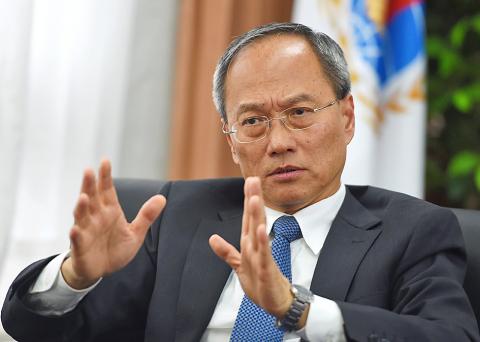
Photo: Liu Hsin-de, Taipei Times
Since then, China has been trying various tactics against Taiwan on all fronts with the apparent objective of compelling the DPP government to concede to Beijing’s views.
However, our aim is to be a good neighbor, and we do not wish to see this kind of pressuring behavior.
China has aggressively pursued its agenda of opposing independence and promoting unification in major cities all over the world. It is alarming that it has shown such initiative in trying to convince overseas Taiwanese and their community leaders to participate in such activities, and some of the more traditional overseas communities and pan-blue camp supporters have done so.
China has also been using dispersed elements to conduct such activities in Taiwan.
For example, in mid-August, the Committee to Promote the Reunification of China came to Taiwan under the pretext of conducting economic and cultural exchanges. It organized conferences with certain groups and political parties [such as the KMT and the Chinese Unity Promotion Party]. The topics of those conferences were invariably political.
China’s goal is to cultivate people in Taiwan who will support its anti-independence and pro-unification agenda. For this purpose, it has been using cross-strait exchanges as a cover for its operations to divide the nation and deploy its united front tactics on all kinds of groups.
Regardless of political affiliation, all Taiwanese should come together to oppose these activities.
LT: What united front tactics is China using against overseas Taiwanese organizations and compatriots? What countermeasures does the government have in place?
Wu: Many of the older overseas social organizations have members whose families trace back to China. It is unavoidable that they would want to visit China to see them. Some might even have business interests there.
Chinese embassies can impose visa restrictions to prevent them from supporting Taiwan.
Recently, a member of an organization in San Francisco told us that he has been blacklisted for supporting Taiwan and cannot go to China to see relatives, which made him quite angry. These organizations are a small battlefront in the large environment of cross-strait relations.
We need to change our way of thinking; there is no need to confront China. I believe that people with Taiwanese roots will not change recognition of their home nation, regardless of China’s tactics.
I do not think we should return to our old strategy of using money to resist China and hindering each other. Our work with overseas compatriots involves positive marketing [of the nation] to let them understand things clearly, for example [letting them know that] there will be no reduction in our services for them. We are not going to blindly chase NT$40 million [US$1.32 million], claiming it is for overseas compatriots — that way of thinking is over with.
Regarding united front tactics, China waves a big flag promoting unification and opposing Taiwanese independence, but a lot of Chinese immigrants join the activities held by Taiwanese overseas compatriot organizations. This is a competition in which people choose a superior [political] system.
Taiwan’s advantage is in its soft power, culture, philosophy, beliefs and free democratic system. This is the most important advantage it has in its countermeasures against the united front.
An overseas compatriot asked me: “Should we let Chinese join the activities we hold?”
I told them, if those Chinese recognize the ideas we value, why should we obstruct them? Why can we not fight back? We have shown goodwill toward China, but we are resolute in our standpoint; we will not yield when we should not.
LT: The government has been vigorously promoting its New Southbound Policy — is there anything specific that the OCAC can do to further the policy’s aims?
Wu: The OCAC’s rule in regard to the policy is to act as a coordinator between contacts, because we are the best-connected agency in those nations.
There are 179 Chamber of Commerce offices worldwide, several of which are in Southeast Asian nations at the national and international levels.
Additionally, there have been about 60,000 ethnic Chinese Malaysian who have come to study in Taiwan and have formed an alumni group. These alumni are important connections for us.
Over the past year or so, people from every government department have come to speak with us before embarking for Southeast Asia, asking: “Who should I look for when I get there?”
Throughout Southeast Asia there are more than 1,000 schools for overseas Taiwanese. These schools use textbooks from Taiwan written in traditional Chinese characters. Every year we provide more than 800,000 textbooks to Taiwanese schools all over the world. At some schools we even provide training for teachers.
These efforts have resulted in close relationships with Taiwanese schools in Southeast Asia.
However, China has also brought abundant resources and teachers to Southeast Asia. They are also recruiting overseas Chinese students by paying for a full four years of university, as just one example.
Taiwan cannot do this, it is not in the budget, so our work with overseas compatriots in Southeast Asia has encountered serious challenges from China.
However, we have seen some results in student recruitment in the region over the past year.
Last year, there were 754 new Southeast Asian students in technical and vocational studies programs, and this year there were 1,034 — an increase of 37 percent, while the Overseas Youth Skills Training Program took in 1,179 students last year, and this year accepted 1,380 students — a growth of about 17 percent.
However, can we maintain this rate of growth in enrollment? This is something we have to work on.
LT: What are the council’s policies for attracting investors from overseas communities and what are the results?
Wu: We have achieved much in attracting overseas Taiwanese businesspeople to check out investment opportunities in Taiwan.
We have carried out investors’ tours for infrastructure development in Southeast Asia, new agriculture and overseas youth groups. We anticipate investments of up to NT$2.6 billion, and US$600 million has already been invested.
The New Southbound Policy Office has established metrics that quantify targets for events, the number of visitors and investment sums for applicable ministries and departments. The council has met all of its assigned targets.
Translated by staff writers Jonathan Chin and William Hetherington
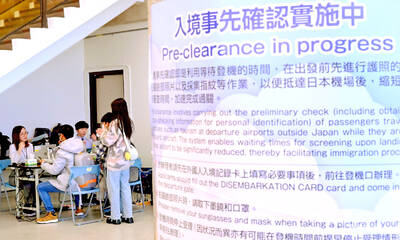
A preclearance service to facilitate entry for people traveling to select airports in Japan would be available from Thursday next week to Feb. 25 at Taiwan Taoyuan International Airport, Taoyuan International Airport Corp (TIAC) said on Tuesday. The service was first made available to Taiwanese travelers throughout the winter vacation of 2024 and during the Lunar New Year holiday. In addition to flights to the Japanese cities of Hakodate, Asahikawa, Akita, Sendai, Niigata, Okayama, Takamatsu, Kumamoto and Kagoshima, the service would be available to travelers to Kobe and Oita. The service can be accessed by passengers of 15 flight routes operated by
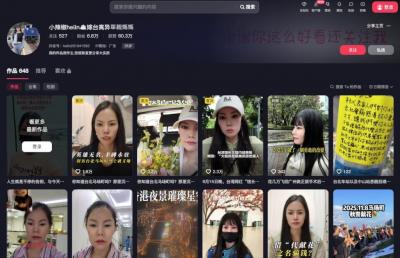
Chinese spouse and influencer Guan Guan’s (關關) residency permit has been revoked for repeatedly posting pro-China videos that threaten national security, the National Immigration Agency confirmed today. Guan Guan has said many controversial statements in her videos posted to Douyin (抖音), including “the red flag will soon be painted all over Taiwan” and “Taiwan is an inseparable part of China,” and expressing hope for expedited reunification. The agency last year received multiple reports alleging that Guan Guan had advocated for armed reunification. After verifying the reports, the agency last month issued a notice requiring her to appear and explain her actions. Guan

GIVE AND TAKE: Blood demand continues to rise each year, while fewer young donors are available due to the nation’s falling birthrate, a doctor said Blood donors can redeem points earned from donations to obtain limited edition Formosan black bear travel mugs, the Kaohsiung Blood Center said yesterday, as it announced a goal of stocking 20,000 units of blood prior to the Lunar New Year. The last month of the lunar year is National Blood Donation Month, when local centers seek to stockpile blood for use during the Lunar New Year holiday. The blood demand in southern Taiwan — including Tainan and Kaohsiung, as well as Chiayi, Pingtung, Penghu and Taitung counties — is about 2,000 units per day, the center said. The donation campaign aims to boost
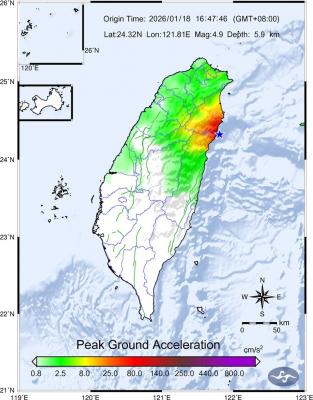
The Central Weather Administration (CWA) said a magnitude 4.9 earthquake that struck off the coast of eastern Taiwan yesterday was an independent event and part of a stress-adjustment process. The earthquake occurred at 4:47pm, with its epicenter at sea about 45.4km south of Yilan County Hall at a depth of 5.9km, the CWA said. The quake's intensity, which gauges the actual effects of a temblor, was highest in several townships in Yilan and neighboring Hualien County, where it measured 4 on Taiwan's seven-tier intensity scale, the CWA said. Lin Po-yu (林柏佑), a division chief at the CWA's Seismological Center, told a news conference


 RSS
RSS