


Due to the high cost of property in Taipei, there are particular transferable development rights issues that are limited to the capital, so the Taipei City Government is to urge the Executive Yuan to establish an ad hoc committee to discuss and resolve the problems, Taipei Mayor Ko Wen-je (柯文哲) said yesterday.
The city government yesterday afternoon held its sixth Living Justice Forum at the Regent Taipei hotel, and urban environments and transferable development rights were high on the agenda.
In his opening speech, Ko said the living justice forums were held so that Taipei residents’ problems can be discussed, adding that he believes the first step to solving problems is to first identify and face them.
The two main problems that need to be discussed are the transferable development rights of river areas and historic sites, he said, adding that the lack of clear regulations can cause problems in urban planning and management.
“It is strange that the land prices of adjoining areas are used when calculating the land prices of river areas,” Ko said. “It is strange and unbelievable how the price of the land in adjoining areas is the same as the price of river banks.”
He said the city government is trying to protect as many historic sites in the capital as possible, but that idealistic views cannot solve realistic problems, as evidenced by the more than 400 cultural heritage sites that have been designated in the city, which overburden those in the city government trying to protect them.
In addition, Ko said many transferable development rights issues are limited to Taipei because of the high cost of property in the city and using the same regulations to handle the issues as those used in other areas might not be suitable.
“I find it hard to believe that the same construction regulations used in Matsu are used for handling similar problems in Taipei,” he said, adding that he did not expect to find suitable solutions at the forum, but hoped to hear experts’ ideas on the issue.
Ko has asked Deputy Mayor Chen Chin-jun (陳景峻) to raise the problems at the next Cabinet meeting on Thursday, and to urge the Cabinet to establish an ad hoc committee to discuss and provide solutions to the problems, he said.
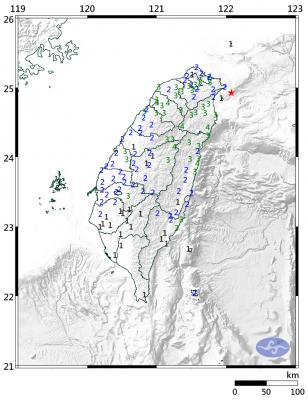
A magnitude 6.1 earthquake struck off the coast of Yilan County at 8:39pm tonight, the Central Weather Administration (CWA) said, with no immediate reports of damage or injuries. The epicenter was 38.7km east-northeast of Yilan County Hall at a focal depth of 98.3km, the CWA’s Seismological Center said. The quake’s maximum intensity, which gauges the actual physical effect of a seismic event, was a level 4 on Taiwan’s 7-tier intensity scale, the center said. That intensity level was recorded in Yilan County’s Nanao Township (南澳), Hsinchu County’s Guansi Township (關西), Nantou County’s Hehuanshan (合歡山) and Hualien County’s Yanliao (鹽寮). An intensity of 3 was
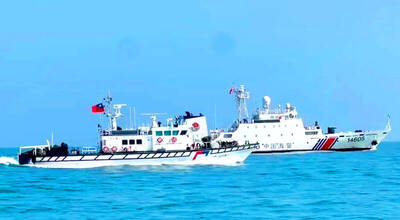
Instead of focusing solely on the threat of a full-scale military invasion, the US and its allies must prepare for a potential Chinese “quarantine” of Taiwan enforced through customs inspections, Stanford University Hoover fellow Eyck Freymann said in a Foreign Affairs article published on Wednesday. China could use various “gray zone” tactics in “reconfiguring the regional and ultimately the global economic order without a war,” said Freymann, who is also a nonresident research fellow at the US Naval War College. China might seize control of Taiwan’s links to the outside world by requiring all flights and ships entering or leaving Taiwan
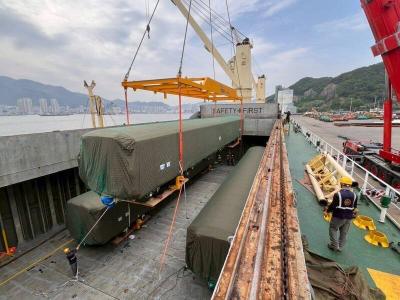
The first of 10 new high-capacity trains purchased from South Korea’s Hyundai Rotem arrived at the Port of Taipei yesterday to meet the demands of an expanding metro network, Taipei Rapid Transit Corp (TRTC) said yesterday. The train completed a three-day, 1,200km voyage from the Port of Masan in South Korea, the company said. Costing NT$590 million (US$18.79 million) each, the new six-carriage trains feature a redesigned interior based on "human-centric" transportation concepts, TRTC said. The design utilizes continuous longitudinal seating to widen the aisles and optimize passenger flow, while also upgrading passenger information displays and driving control systems for a more comfortable
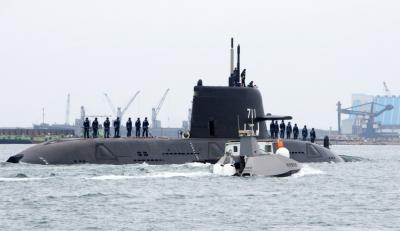
Taiwan's first indigenous defense submarine, the SS-711 Hai Kun (海鯤, or Narwhal), departed for its 13th sea trial at 7am today, marking its seventh submerged test, with delivery to the navy scheduled for July. The outing also marked its first sea deployment since President William Lai (賴清德) boarded the submarine for an inspection on March 19, drawing a crowd of military enthusiasts who gathered to show support. The submarine this morning departed port accompanied by CSBC Corp’s Endeavor Manta (奮進魔鬼魚號) uncrewed surface vessel and a navy M109 assault boat. Amid public interest in key milestones such as torpedo-launching operations and overnight submerged trials,


 RSS
RSS