

A netizen’s petition to change Taiwan’s time zone from the same as China’s to that of Japan and South Korea has gathered enough signatures on an official Web site to prompt an official response, the National Development Council said on Thursday.
When petitions receive more than 5,000 signatures within 60 days on the online public policy participation platform, which the council created in 2015, a government agency must be designated to issue a public response via the platform within two months.
Council Director of Information Management Chuang Ming-fen (莊明芬) said an agency would be appointed to the petition within seven days and would have to respond by Dec. 19.
“The netizen’s proposal touches upon the jurisdiction of several ministries. The council is coordinating with the Ministry of Transportation and Communications, the Ministry of the Interior and others,” Chuang said.
The netizen who launched the petition said that the country should leave the GMT+8 time zone, which it shares with Malaysia, China and parts of Indonesia and Australia, to the GMT+9 time zone, which covers Japan and South Korea.
The petition had garnered 7,879 signatures at press time last night.
“In the past, Taiwan belonged to GMT+9. North and South Korea, which are at similar latitudes with Taiwan, are also in the GMT+9 timezone. Switching time zone from GMT+8 to GMT+9 symbolically removes Taiwan from China and will serve as a subconscious reminder to Chinese and other foreign tourists in Taiwan that the country is not subordinated to China,” the petition said.
Moving the clock forward one hour would also save sunlight, the petition said.
A change of time zone would compel airports and airlines to change flight schedules, and systems for ticketing and sales, Civil Aeronautics Administration Air Transport Division Director Han Chen-hua (韓振華) said.
“The cost would be substantial and it would affect domestic airlines as well as foreign airlines that operate in Taiwan,” Han said.
Changing flight schedules would likely be troublesome because doing so would affect domestic and foreign airports, travel agencies, as well as hotels at the origin, destination and layover points for all of the country’s inbound and outgoing flights, an airline manager said on condition of anonymity.
Taiwan Taoyuan International Airport Co spokesman Lee Chien-kuo (李建國) said changing the country’s time zone would confuse travelers and disrupt the way of calculating time they are familiar with.
“This will cause difficulties, particularly with layover flights,” Lee said.
The airport handles 600 flights per day to and from 157 destinations and is used by 86 airlines, Lee said.
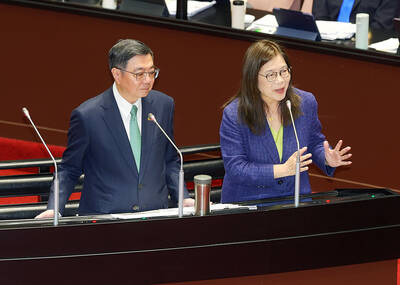
The donation of offshore patrol vessel Kinmen to the Philippines includes provisions that protect Taiwanese fishers and facilitate security cooperation across the First Island Chain, officials said yesterday. The comment was made during the Cabinet’s comprehensive administrative report at the legislature after Chinese Nationalist Party (KMT) Legislator Hsu Yu-chen (許宇甄) expressed concerns about the decision to give a ship to a country whose coast guard had in 2013 fired on a Taiwanese trawler and killed its captain without provocation. The Cabinet should lay out the safeguards that have been established to prevent the Philippine government from using the Kinmen to harass, expel
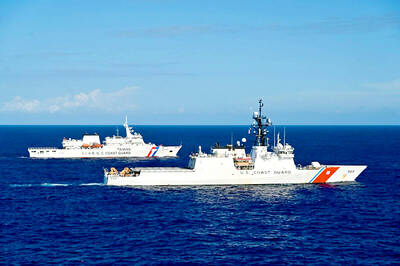
GROWING TIES: The CGA is planning a goodwill mission to the Philippines, in what would be the first time since 1975 a Taiwanese paramilitary vessel has visited the country The Coast Guard Administration (CGA) plans to significantly expand its participation in international security cooperative frameworks and its operational capabilities, a budget proposal for next year showed. The budget indicates a transformation of the CGA from a maritime law enforcement arm into a national defense and intelligence gathering entity capable of tackling larger regional security matters. The proposal showed that personnel from the coast guard’s Intelligence Division and Special Action Support Center are to participate in high-level national security talks with the US. As the CGA has dealt with China’s rising “gray zone” threats around Taiwan, it has become a valuable asset to
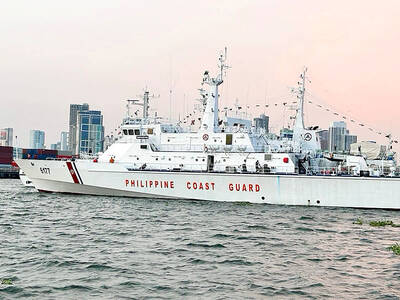
A patrol vessel donated by the Coast Guard Administration (CGA) to the Philippines was commissioned into the Philippine Coast Guard (PCG) on Friday, a Philippine non-governmental organization said. The CGA on Sept. 16 confirmed media reports that Taiwan had donated a retired 500-tonne patrol vessel to the Philippines. The Manila-based We Protect Our Seas (WPS) foundation, which served as an intermediary in the transfer, said that the vessel was formerly the CGA’s 500-tonne petrol vessel Kinmen (CG123). The WPS, in a statement issued on Friday, said the vessel, renamed as the BRP Sarangani, had been commissioned into the PCG the
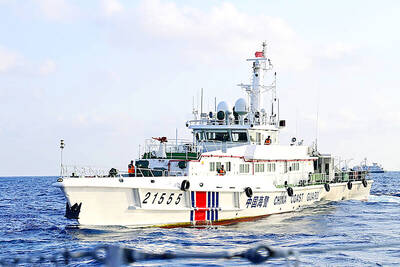
‘GRAY ZONE’ TACTICS: Beijing sent two China Coast Guard vessels to escort a ‘supposedly private research ship,’ a Philippine Coast Guard spokesman said The Coast Guard Administration (CGA) yesterday confirmed that it had recently deployed three patrol vessels to waters in Taiwan’s overlapping exclusive economic zone with the Philippines to monitor three Chinese vessels. CGA Deputy Director-General Hsieh Ching-chin (謝慶欽) said the agency regularly monitors Chinese vessels around Taiwan, and that the deployment south of Oluanpi (鵝鑾鼻), Taiwan proper’s southernmost point, was carried out in accordance with standard procedures. He added that the waters fall within the overlapping exclusive economic zones of Taiwan and the Philippines, which extend 200 nautical miles (370km) from their coastlines. Hsieh made the comments when asked about a


 RSS
RSS