


The Ministry of Transportation and Communications (MOTC) and Aviation Safety Council (ASC) appear to disagree on whether a single national transportation safety and investigation council should be formed, lawmakers said yesterday as they questioned Minister of Transportation and Communications Hochen Tan (賀陳旦) over apparent backtracking on the issue.
Officials from the two agencies attended a Transportation Committee meeting at the Legislative Yuan, in which they briefed lawmakers on whether they think one independent agency should investigate all transportation incidents.
The ASC investigates aviation incidents, while the ministry probes accidents or incidents on railways, freeways and waterways.
ASC Chairman Hwung Hwung-hweng (黃煌煇) said that establishing an independent investigation council is necessary.
However, the Institute of Transportation — the ministry’s think tank — said that the government would aim to reinforce the independence and professionalism of all existing agencies charged with investigating transportation-related incidents before forming a single agency for the task.
The ASC and the ministry appear to differ on the matter, lawmakers said.
The ministry does not oppose the establishment of a national agency, Hochen said, adding that it should be a long-term goal.
Similar organizations in other nations do not handle all types of investigation, Hochen said, using the example of the US National Transportation Safety Board, which handles mainly aviation and certain types of highway, marine and railway accidents.
Based on a plan proposed by the ASC, the proposed council would have between seven and 11 commissioners, and 50 personnel.
It would be practically impossible for such an agency to investigate all types of transportation incidents, Hochen said.
“It is easy to create an agency, but the most important thing is outlining how the agency would function and what types of accidents it would investigate. It would take at least six months to study the matter,” he said, adding that it would take another two to three years to form such an agency.
Transportation Committee members disagreed.
The number of aviation accidents has greatly fallen following the formation of the ASC, Democratic Progressive Party (DPP) Legislator Lee Kun-tse (李昆澤) said.
Lee asked if Hochen had reversed his position on establishing an independent safety council, since he and former premier Lin Chuan (林全) last year promised that they would do so.
The validity of the ministry’s investigations into railway and marine accidents are questionable because it is essentially the referee and player, DPP Legislator Chen Ou-po (陳歐珀) said.
There have been cases of retired Civil Aeronautics Administration officials becoming ASC chairpeople or investigators, Chen said, adding that people would be skeptical of investigation results if they are conducted by the same group of people.
However, an independent agency would ensure the transparency of investigations and results, DPP Legislator Lin Chun-hsien (林俊憲) said.
The ASC always makes investigations of aviation incidents public, but the ministry has never done so for railway accident investigations, Lin said.
Major freeway accidents that involve casualties are often investigated by prosecutors, who are not necessarily transportation experts, New Power Party Hung Tzu-yung (洪慈庸) said.
The Executive Yuan has planned to establish an independent investigative body since 2003, Hung said, questioning if and when such plans would be materialized.

Actor Darren Wang (王大陸) was sentenced to six months in prison, commutable to a fine, by the New Taipei District Court today for contravening the Personal Data Protection Act (個人資料保護法) in a case linked to an alleged draft-dodging scheme. Wang allegedly paid NT$3.6 million (US$114,380) to an illegal group to help him evade mandatory military service through falsified medical documents, prosecutors said. He transferred the funds to Chen Chih-ming (陳志明), the alleged mastermind of a draft-evasion ring, although he lost contact with him as he was already in detention on fraud charges, they said. Chen is accused of helping a

SECURITY: Starlink owner Elon Musk has taken pro-Beijing positions, and allowing pro-China companies to control Taiwan’s critical infrastructure is risky, a legislator said Starlink was reluctant to offer services in Taiwan because of the nation’s extremely high penetration rates in 4G and 5G services, the Ministry of Digital Affairs said yesterday. The ministry made the comments at a meeting of the legislature’s Transportation Committee, which reviewed amendments to Article 36 of the Telecommunications Management Act (電信管理法). Article 36 bans foreigners from holding more than 49 percent of shares in public telecommunications networks, while shares foreigners directly and indirectly hold are also capped at 60 percent of the total, unless specified otherwise by law. The amendments, sponsored by Chinese Nationalist Party (KMT) Legislator Ko
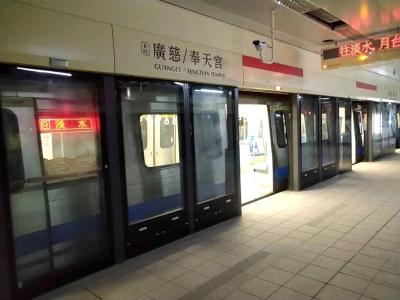
The eastern extension of the Taipei MRT Red Line could begin operations as early as late June, the Taipei Department of Rapid Transit Systems said yesterday. Taipei Rapid Transit Corp said it is considering offering one month of free rides on the new section to mark its opening. Construction progress on the 1.4km extension, which is to run from the current terminal Xiangshan Station to a new eastern terminal, Guangci/Fengtian Temple Station, was 90.6 percent complete by the end of last month, the department said in a report to the Taipei City Council's Transportation Committee. While construction began in October 2016 with an
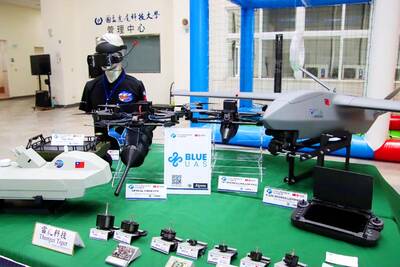
NON-RED SUPPLY: Boosting the nation’s drone industry is becoming increasingly urgent as China’s UAV dominance could become an issue in a crisis, an analyst said Taiwan’s drone exports to Europe grew 41.7-fold from 2024 to last year, with demand from Ukraine’s fight against Russian aggression the most likely driver of growth, a study showed. The Institute for Democracy, Society and Emerging Technology (DSET) in a statement on Wednesday said it found that many of Taiwan’s uncrewed aerial vehicle (UAV) sales were from Poland and the Czech Republic. These countries likely transferred the drones to Ukraine to aid it in its fight against the Russian invasion that started in 2022, it said. Despite the gains, Taiwan is not the dominant drone exporter to these markets, ranking second and fourth


 RSS
RSS