


Chinese Nationalist Party (KMT) Legislator Alicia Wang (王育敏) yesterday obstructed the passage of a draft law to establish a national human rights museum that the Cabinet approved in July.
The bill should be put aside until the promulgation of laws concerning the promotion of transitional justice, Wang said.
Minister of Culture Cheng Li-chiun (鄭麗君) made an emotional plea for urgent passage of the draft, citing the deaths of Tsui Hsiao-ping (崔小萍), Chen Meng-ho (陳孟和) and Su Yu-peng (蘇友鵬) this year, all of whom lived in the Martial Law era.
The museum is important for the consolation of the memories of remaining survivors of that period, Cheng said.
Democratic Progressive Party (DPP) Legislator Tuan Yi-kang (段宜康) said that as the rank of the museum curator is lower than that of sub-ministerial institution heads, he plans to propose an adjustment to the curator’s rank.
Foreign visitors are likely to question why the Chiang Kai-shek Memorial Hall celebrates a leader who is presented as an authoritarian dictator at the human rights museum, he said, adding that the curator must be sufficiently ranked to handle the issue.
Cheng said that promulgating the law is the only remaining step to establishing the museum, as exhibits have already been designed and a preparatory office has been established.
She said the memorial hall should see a transition and the rank of curator raised at the same time.
The proposed museum has consistently encountered obstructions from the KMT caucus since the DPP first established the museum’s preparatory office in May 2005, DPP caucus whip Ker Chien-ming (柯建銘) said.
When then-president Ma Ying-jeou (馬英九) signed two UN human rights covenants in the run-up to his re-election in 2009, then-Council for Cultural Affairs Minister Emile Sheng (盛治仁) also said that a preparatory office was needed, Ker said.
The need for the museum already has a consensus across pan-blue and pan-green camps, Ker said, adding that the laws for the museum and transitional justice promotion should be passed at the same time.
Both laws are about facing up to historical facts, he said.
KMT Legislator John Wu (吳志揚) said he supports passing the laws, but does not understand why the museum is being established under the Ministry of Culture.
Cheng said the responsibility for the preparatory office was assigned to the ministry during a 2010 Ma administration reshuffle and the office was formally established on Dec. 10, 2011.
The Legislative Yuan on Oct. 22, 2010, decided that the museum should be a sub-ministerial institution that would oversee museum facilities on Green Island (綠島) and in New Taipei City’s Jingmei District (景美).
The museum is not just a building, but rather an institution, Cheng said, adding that the institution would preserve the memories of those who suffered political persecution, as well as promoting human rights education.
The museum’s establishment as a sub-ministerial government institution would give it access to more government funds and resources in line with its importance to a democratic society, she said.
“Through the museum the government can honor its commitment to reflecting on the White Terror era,” Cheng added.
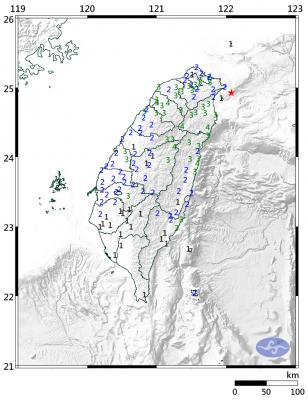
A magnitude 6.1 earthquake struck off the coast of Yilan County at 8:39pm tonight, the Central Weather Administration (CWA) said, with no immediate reports of damage or injuries. The epicenter was 38.7km east-northeast of Yilan County Hall at a focal depth of 98.3km, the CWA’s Seismological Center said. The quake’s maximum intensity, which gauges the actual physical effect of a seismic event, was a level 4 on Taiwan’s 7-tier intensity scale, the center said. That intensity level was recorded in Yilan County’s Nanao Township (南澳), Hsinchu County’s Guansi Township (關西), Nantou County’s Hehuanshan (合歡山) and Hualien County’s Yanliao (鹽寮). An intensity of 3 was
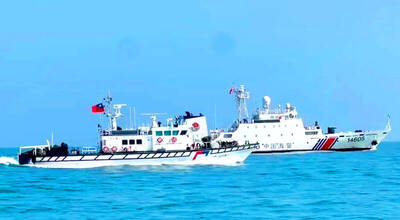
Instead of focusing solely on the threat of a full-scale military invasion, the US and its allies must prepare for a potential Chinese “quarantine” of Taiwan enforced through customs inspections, Stanford University Hoover fellow Eyck Freymann said in a Foreign Affairs article published on Wednesday. China could use various “gray zone” tactics in “reconfiguring the regional and ultimately the global economic order without a war,” said Freymann, who is also a nonresident research fellow at the US Naval War College. China might seize control of Taiwan’s links to the outside world by requiring all flights and ships entering or leaving Taiwan
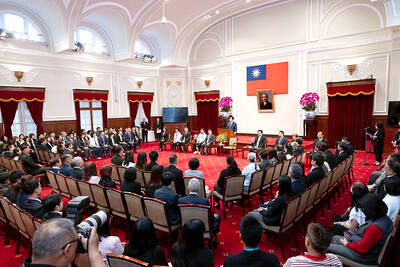
The next minimum wage hike is expected to exceed NT$30,000, President William Lai (賴清德) said yesterday during an award ceremony honoring “model workers,” including migrant workers, at the Presidential Office ahead of Workers’ Day today. Lai said he wished to thank the awardees on behalf of the nation and extend his most sincere respect for their hard work, on which Taiwan’s prosperity has been built. Lai specifically thanked 10 migrant workers selected for the award, saying that although they left their home countries to further their own goals, their efforts have benefited Taiwan as well. The nation’s industrial sector and small businesses lay
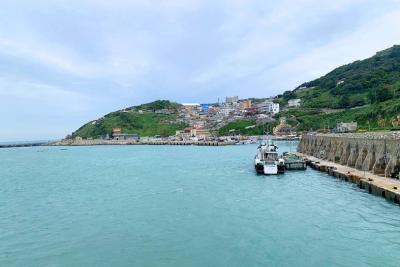
Taiwan has activated backup communications for its northernmost territory, the remote and strategically located island of Dongyin (東引), after poor weather conditions apparently shifted the wreckage of a ship onto an undersea cable causing it to break. The vulnerability of undersea communication cables linking Taiwan with its outlying islands has been a persistent cause of concern for Taipei, whose government has on several occasions blamed Chinese ships for intentionally causing damage. Dongyin, home to about 1,500 people, sits in a strategic position at the top of the Taiwan Strait and the island has a heavy military presence. It does not have an


 RSS
RSS