


The government’s use of its budget for the New Southbound Policy was unsatisfactory this year, and Democratic Progressive Party (DPP) lawmakers have called for a task force to improve implementation efficiency next year.
An analysis by the legislature’s Budget Center said that of the NT$4.5 billion (US$148.49 million) budgeted for the policy this fiscal year, only about NT$2.55 billion, or 56.3 percent, had been spent by the end of July, while a few agencies had spent more than half their budgets for the policy, which aims to boost the nation’s ties with South and Southeast Asian nations as well as Australia and New Zealand.
A budget of NT$7.19 billion has been earmarked for the policy for the next fiscal year, a 61.6 percent increase over this year.
The center’s analysis of the implementation of the policy covers its four major areas of focus: economic cooperation, talent exchange, resource sharing and regional connectivity.
Only the Council of Indigenous Peoples, the Ministry of Education, the Ministry of Economic Affairs, the Ministry of Transportation and Communications, the Environmental Protection Administration and the Ministry of Science and Technology spent more than half of their related budgets, while the performance of 14 other government bodies was unsatisfactory, the center said.
The Ministry of the Interior, the Presidential Office and the Public Construction Commission had the lowest budget execution rates: 0.51 percent, 3.49 percent and 4.27 percent respectively, the center said.
DPP Legislator Lo Chih-cheng (羅致政) said many of the projects connected with the southbound policy were still under way, as the policy was only launched this year, and full-fledged implementation would begin next year.
As the budget is distributed across different ministries, the Executive Yuan or coordinating agencies such as the National Development Council should form an inter-ministerial task force to supervise how Cabinet agencies and ministries are spending their funds, Lo said.
“The New Southbound Policy cannot achieve tangible results if there is only a budget without implementation,” DPP Legislator Chuang Ruei-hsiung (莊瑞雄) said, calling on the Cabinet to make improvements and the Legislative Yuan to supervise the use of the budgeted funds.
The low budget implementation is a “warning sign,” DPP Legislator Tsai Shih-ying (蔡適應) said, adding that the policy’s execution cannot be compromised as it is key to President Tsai Ing-wen’s (蔡英文) plans.
However, there is no need to establish an additional supervisory unit as Minister Without Portfolio John Deng (鄧振中) is the “chief executive officer” of the policy and he should be supervising it and be responsible for its implementation, Tsai Shih-ying said.
In related news, the Cabinet next year is to evaluate the feasibility of lifting visa restrictions for partner nations of the New Southbound Policy next year, after the government on Thursday said it would ease visa restrictions on Philippine nationals entering the nation by allowing them to visit for a maximum of 14 days without a visa.
Deng said the general policy direction is to lift visa restrictions if there are no security concerns.
Safety is key to any visa-waiver program, and safety concerns include the risk of public safety threats, crime and drug trafficking, unnamed Cabinet officials said.
Tourism, public woks and cross-border e-commerce are the three major categories of the New Southbound Policy, and visa-waiver programs would be evaluated based on those three categories to boost tourism and the economy, they said.
Judging from the population, visa regulations, flight connections and international travel potential, the Tourism Bureau has recognized the 10 members of ASEAN, India and Bhutan as the main potential sources of South and Southeast Asian tourists.
It has divided these nations into “main markets” (Malaysia, Thailand, Vietnam and Singapore), “growing markets” (India, Indonesia and the Philippines) and “potential markets” (Myanmar, Cambodia, Laos, Bhutan and Brunei).
Additional reporting by Lee Hsin-fang

US climber Alex Honnold is to attempt to scale Taipei 101 without a rope and harness in a live Netflix special on Jan. 24, the streaming platform announced on Wednesday. Accounting for the time difference, the two-hour broadcast of Honnold’s climb, called Skyscraper Live, is to air on Jan. 23 in the US, Netflix said in a statement. Honnold, 40, was the first person ever to free solo climb the 900m El Capitan rock formation in Yosemite National Park — a feat that was recorded and later made into the 2018 documentary film Free Solo. Netflix previewed Skyscraper Live in October, after videos

Starting on Jan. 1, YouBike riders must have insurance to use the service, and a six-month trial of NT$5 coupons under certain conditions would be implemented to balance bike shortages, a joint statement from transportation departments across Taipei, New Taipei City and Taoyuan announced yesterday. The rental bike system operator said that coupons would be offered to riders to rent bikes from full stations, for riders who take out an electric-assisted bike from a full station, and for riders who return a bike to an empty station. All riders with YouBike accounts are automatically eligible for the program, and each membership account
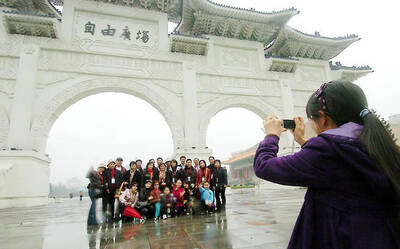
NUMBERS IMBALANCE: More than 4 million Taiwanese have visited China this year, while only about half a million Chinese have visited here Beijing has yet to respond to Taiwan’s requests for negotiation over matters related to the recovery of cross-strait tourism, the Tourism Administration said yesterday. Taiwan’s tourism authority issued the statement after Chinese-language daily the China Times reported yesterday that the government’s policy of banning group tours to China does not stop Taiwanese from visiting the country. As of October, more than 4.2 million had traveled to China this year, exceeding last year. Beijing estimated the number of Taiwanese tourists in China could reach 4.5 million this year. By contrast, only 500,000 Chinese tourists are expected in Taiwan, the report said. The report
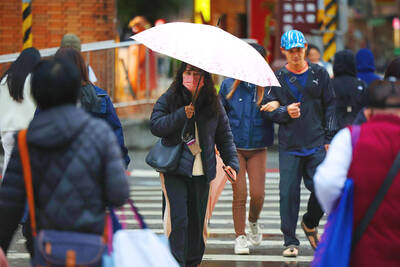
Temperatures are forecast to drop steadily as a continental cold air mass moves across Taiwan, with some areas also likely to see heavy rainfall, the Central Weather Administration (CWA) said. From today through early tomorrow, a cold air mass would keep temperatures low across central and northern Taiwan, and the eastern half of Taiwan proper, with isolated brief showers forecast along Keelung’s north coast, Taipei and New Taipei City’s mountainous areas and eastern Taiwan, it said. Lows of 11°C to 15°C are forecast in central and northern Taiwan, Yilan County, and the outlying Kinmen and Lienchiang (Matsu) counties, and 14°C to 17°C


 RSS
RSS