


The Kaohsiung Water Resources Bureau has angered local residents by demolishing a possibly 90-year-old Japanese-style wooden police dormitory without first assessing the property’s cultural value.
The bureau was accused of not respecting cultural heritage after it tore down the old dorm close to Kaohsiung’s Cishan Precinct, the history of which was described in a tourist brochure written by local history and culture groups.
Wang Chi-wei (王繼維), a member of local rock band Youth Banana, and a culture and creativity advocate, described the bureau’s action as “sneaky” and a violation of the Cultural Heritage Preservation Act (文化資產保存法).
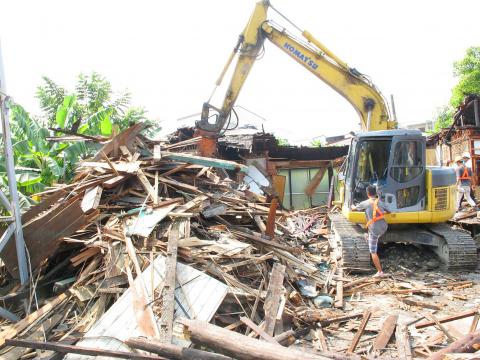
Photo: CNA
The demolition without prior notification and communication is “unacceptable,” Wang said.
Also, tearing down a historic building “has made culture-dominated tourism meaningless,” he said.
The Chinese-cypress building with black rooftiles was in good condition before it was torn down, Wang said, adding that elderly people living in the vicinity once told him that the building had been built nearly 90 years ago.
The water bureau on Monday ordered the dorm to be demolished to make space for people whose homes have been designated to be removed for a water drainage construction project.
As machines started tearing down the building, the noise alerted local residents, was well as Wang, who was walking by and called the city’s Bureau of Cultural Affairs to stop the demolition.
However, it was too late to save the building from demolition.
Kaohsiung Cultural Property Center head Lee Yu-min (李毓敏) said the incident happened because police and the water bureau were ignorant of the regulations that require a cultural value assessment before demolishing buildings that are more than 50 years old.
“An internal review will be performed” at both bureaus concerned, Lee said.
She said measures would be taken to raise awareness of the regulations, which were not written into the Cultural Heritage Preservation Act until last year, when the act was revised.
The culture bureau said the new regulations were drafted to protect properties with the potential to become cultural heritage sites.
Although the old dorm was not designated a cultural heritage site, it should not have been dismantled before an assessment of its cultural value, the bureau said, suggesting a comprehensive review of administrative procedures.
Bureau Deputy Director-General Han Jung-hua (韓榮華) said the office would “make up” for not completing the required administrative procedure for the demolition project, but did not elaborate.
The demolished dorm was the precinct commissioner’s foreign residence, said a police officer at Cishan Precinct, who wished to remain anonymous.
It had been left empty for years because of the high cost of renovation, the officer said.
However, the precinct had cleaned the house regularly and controlled access to the building, the officer said.
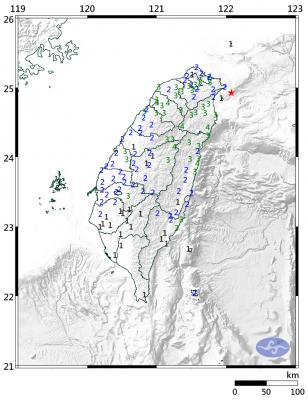
A magnitude 6.1 earthquake struck off the coast of Yilan County at 8:39pm tonight, the Central Weather Administration (CWA) said, with no immediate reports of damage or injuries. The epicenter was 38.7km east-northeast of Yilan County Hall at a focal depth of 98.3km, the CWA’s Seismological Center said. The quake’s maximum intensity, which gauges the actual physical effect of a seismic event, was a level 4 on Taiwan’s 7-tier intensity scale, the center said. That intensity level was recorded in Yilan County’s Nanao Township (南澳), Hsinchu County’s Guansi Township (關西), Nantou County’s Hehuanshan (合歡山) and Hualien County’s Yanliao (鹽寮). An intensity of 3 was
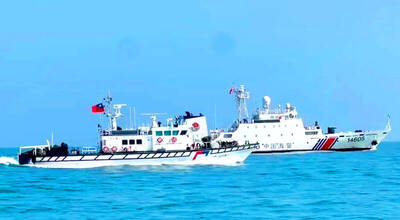
Instead of focusing solely on the threat of a full-scale military invasion, the US and its allies must prepare for a potential Chinese “quarantine” of Taiwan enforced through customs inspections, Stanford University Hoover fellow Eyck Freymann said in a Foreign Affairs article published on Wednesday. China could use various “gray zone” tactics in “reconfiguring the regional and ultimately the global economic order without a war,” said Freymann, who is also a nonresident research fellow at the US Naval War College. China might seize control of Taiwan’s links to the outside world by requiring all flights and ships entering or leaving Taiwan
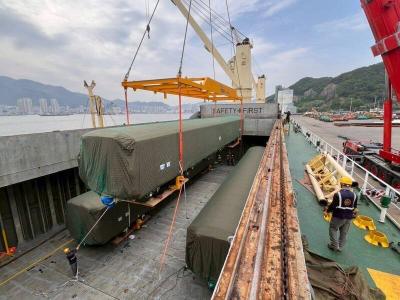
The first of 10 new high-capacity trains purchased from South Korea’s Hyundai Rotem arrived at the Port of Taipei yesterday to meet the demands of an expanding metro network, Taipei Rapid Transit Corp (TRTC) said yesterday. The train completed a three-day, 1,200km voyage from the Port of Masan in South Korea, the company said. Costing NT$590 million (US$18.79 million) each, the new six-carriage trains feature a redesigned interior based on "human-centric" transportation concepts, TRTC said. The design utilizes continuous longitudinal seating to widen the aisles and optimize passenger flow, while also upgrading passenger information displays and driving control systems for a more comfortable
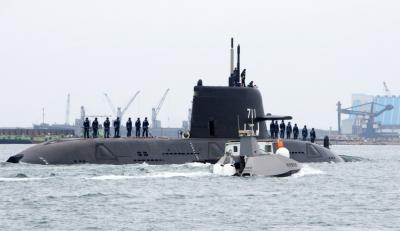
Taiwan's first indigenous defense submarine, the SS-711 Hai Kun (海鯤, or Narwhal), departed for its 13th sea trial at 7am today, marking its seventh submerged test, with delivery to the navy scheduled for July. The outing also marked its first sea deployment since President William Lai (賴清德) boarded the submarine for an inspection on March 19, drawing a crowd of military enthusiasts who gathered to show support. The submarine this morning departed port accompanied by CSBC Corp’s Endeavor Manta (奮進魔鬼魚號) uncrewed surface vessel and a navy M109 assault boat. Amid public interest in key milestones such as torpedo-launching operations and overnight submerged trials,


 RSS
RSS