


The Cabinet yesterday revised and resubmitted a general budget request for the current fiscal year, estimating the nation’s expenditures and revenue over the next 12 months at NT$1.991 trillion and NT$1.897 trillion (US$66.1 billion and US$63 billion) respectively.
The new budget includes a NT$7 billion stock exchange tax revenue increase and an additional NT$6.8 billion in annual spending.
The nation is forecast to run up a deficit of NT$94.4 billion, in addition to NT$79.2 billion in debt due next year, meaning that the government must borrow NT$173.6 billion, or 8.7 percent of the projected spending, to cover the shortfall.
Following a Cabinet reshuffle on Friday last week due to the resignation of former premier Lin Chuan (林全), the Executive Yuan withdrew and revised budget proposals for next year, which are to be reviewed by the Legislative Yuan.
The highlights of the budget proposals include a general wage increase of 3 percent for public employees and additional funds for labor insurance and sports, Premier William Lai (賴清德) said.
The pay raise is expected to benefit 1.15 million public employees nationwide and lead to a moderate increase in GDP, public spending and commodity prices.
While GDP was last month projected to grow 2.27 percent next year, the public-sector wage hike could boost it another 0.6 percentage points, Directorate-General of Budget, Accounting and Statistics Minister Chu Tzer-ming (朱澤民) said.
The raise could cause the consumer price index (CPI) to rise 0.04 percent, which could grow by another 0.28 percent if the private sector follows suit, Chu added.
After factoring in an across-the-board pay raise, the CPI was forecast to increase 1.1 percent next year, he added.
The public-sector pay raise would cost NT$18 billion, which is to be provided through budget cuts and tax increases, Chu said.
The central government is to subsidize NT$3.8 billion in personnel costs for 14 financially unstable cities and counties, he added.
Also included in the proposed budget is an additional NT$1 billion to promote sports and train athletes for the 2020 Tokyo Olympics and NT$1 billion to subsidize labor insurance due to a monthly minimum wage increase from NT$21,009 to NT$22,000 next year.
Policies that would receive the largest share of funding include public infrastructure and river management (NT$249.5 billion), education (NT$295.8 billion), technology development (NT$115.1 billion), long-term care services (NT$33.9 billion), industrial innovation (NT$62 billion), air pollution prevention (NT$14 billion), Aboriginal affairs (NT$8.22 billion), the New Southbound Policy (NT$7.19 billion), food safety (NT$4.81 billion) and drug prevention (NT$3.31 billion).
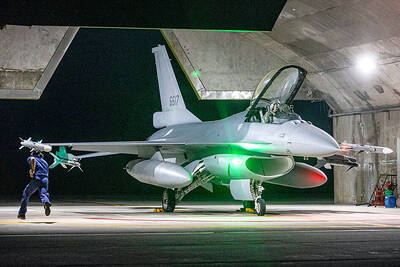
Taiwan has received more than US$70 million in royalties as of the end of last year from developing the F-16V jet as countries worldwide purchase or upgrade to this popular model, government and military officials said on Saturday. Taiwan funded the development of the F-16V jet and ended up the sole investor as other countries withdrew from the program. Now the F-16V is increasingly popular and countries must pay Taiwan a percentage in royalties when they purchase new F-16V aircraft or upgrade older F-16 models. The next five years are expected to be the peak for these royalties, with Taiwan potentially earning
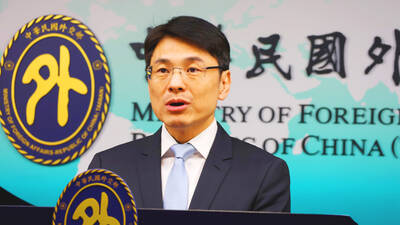
STAY IN YOUR LANE: As the US and Israel attack Iran, the ministry has warned China not to overstep by including Taiwanese citizens in its evacuation orders The Ministry of Foreign Affairs (MOFA) yesterday rebuked a statement by China’s embassy in Israel that it would evacuate Taiwanese holders of Chinese travel documents from Israel amid the latter’s escalating conflict with Iran. Tensions have risen across the Middle East in the wake of US and Israeli airstrikes on Iran beginning Saturday. China subsequently issued an evacuation notice for its citizens. In a news release, the Chinese embassy in Israel said holders of “Taiwan compatriot permits (台胞證)” issued to Taiwanese nationals by Chinese authorities for travel to China — could register for evacuation to Egypt. In Taipei, the ministry yesterday said Taiwan
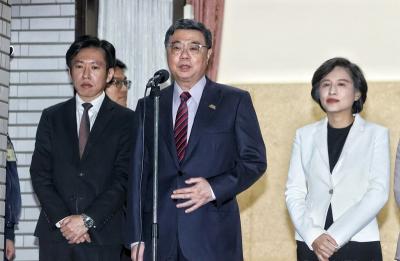
Taiwan is awaiting official notification from the US regarding the status of the Agreement on Reciprocal Trade (ART) after the US Supreme Court ruled US President Donald Trump's global tariffs unconstitutional. Speaking to reporters before a legislative hearing today, Premier Cho Jung-tai (卓榮泰) said that Taiwan's negotiation team remains focused on ensuring that the bilateral trade deal remains intact despite the legal challenge to Trump's tariff policy. "The US has pledged to notify its trade partners once the subsequent administrative and legal processes are finalized, and that certainly includes Taiwan," Cho said when asked about opposition parties’ doubts that the ART was
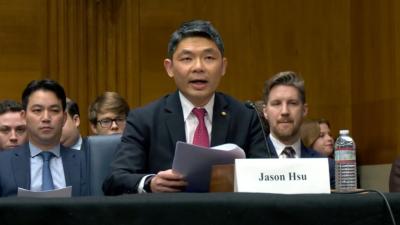
If China chose to invade Taiwan tomorrow, it would only have to sever three undersea fiber-optic cable clusters to cause a data blackout, Jason Hsu (許毓仁), a senior fellow at the Hudson Institute and former Chinese Nationalist Party (KMT) legislator, told a US security panel yesterday. In a Taiwan contingency, cable disruption would be one of the earliest preinvasion actions and the signal that escalation had begun, he said, adding that Taiwan’s current cable repair capabilities are insufficient. The US-China Economic and Security Review Commission (USCC) yesterday held a hearing on US-China Competition Under the Sea, with Hsu speaking on


 RSS
RSS