


Premier William Lai’s (賴清德) second day in office began with two consecutive labor rights protests outside the Executive Yuan yesterday morning, with one asking the government to allow blue-collar migrant workers the right to switch employers and the other demanding that the government not side with businesses if it changes the regulations regarding working hours.
The Taiwan International Workers’ Association (TIWA) and other groups advocating the rights of migrant workers urged Lai to investigate the death of a 27-year-old Vietnamese worker surnamed Nguyen.
The “runaway” foreign worker was shot nine times at close range by police after allegedly attempting to steal a police car and throwing stones at police.
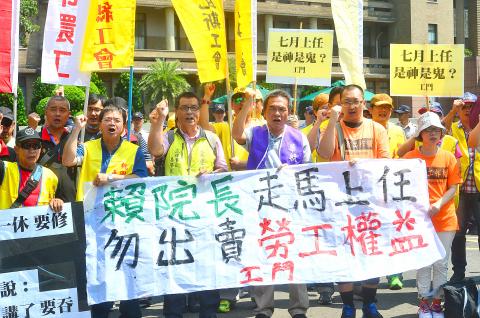
Photo: Wang Yi-sung, Taipei Times
The case has many unanswered questions, they said, adding that the police should release the footage showing how the officers handled Nguyen on Aug. 31 for his allegedly illegal acts.
While Lai ran away from his unfinished term in Tainan unscathed and became premier, the fate of the runaway worker was to be shot nine times, the advocates said.
The advocates shared a petition written by Nguyen’s father, urging the government to find out the truth and prevent similar incidents.
The group called for amending the Employment Service Act (就業服務法) to allow blue-collar migrant workers to switch employers.
People should ask why the workers are running away in the first place, association representative Hsu Wei-tung (許惟棟) said.
Migrant workers often pay a fee of about US$5,000 to labor brokers to work in Taiwan, he said.
They cannot pay the entire fee up front and have to work one to one-and-a-half years just to pay off the debt, Hsu said, adding that the act prevents migrant workers from freely choosing employers.
“This has caused some of the workers to put up with unfair treatment as much as they could and run away when they cannot stand it anymore,” he said.
The government’s procedure for classifying a migrant worker as a runaway is problematic, Hsu said, adding that a person can be classified as a runaway worker when their employer files a report with the police or the administrative agency in charge, without any further investigation by the authorities.
Once classified as a runaway worker, it would take workers a long time and a complicated process to redress the status, he said.
Migrant workers might violate an administrative act by becoming untraceable, which would invalidate their visas, he said, adding that the situation is different from committing a crime.
“People violating an administrative act, such as running through a red light or littering, need to pay fines. Police would not hunt down these people with guns,” he said.
However, police have the authority to track down runaway workers as if they were criminals, because of the stereotypical image society has of migrant workers, particularly those from Southeast Asia, Hsu said.
Meanwhile, Labor Struggle, a coalition of labor unions and student groups, asked Lai not to ignore workers’ rights if the Cabinet considers amending regulations that give workers “one fixed day off and one flexible rest day” each week.
The regulations do not significantly decrease the nation’s average work hours, they said, adding that the Executive Yuan should stipulate a national holiday act to restore previous national holidays and to further reduce work hours.
The changes to work regulations proposed by businesses are meant to encourage employees to make extra money by working overtime, they said.
The government should instead address the issue of some workers not benefiting from the regulations, as some employers avoid paying overtime by promising employees compensatory holidays, they said.

SHIPS, TRAINS AND AUTOMOBILES: The ministry has announced changes to varied transportation industries taking effect soon, with a number of effects for passengers Beginning next month, the post office is canceling signature upon delivery and written inquiry services for international registered small packets in accordance with the new policy of the Universal Postal Union, the Ministry of Transportation and Communications said yesterday. The new policy does not apply to packets that are to be delivered to China, the ministry said. Senders of international registered small packets would receive a NT$10 rebate on postage if the packets are sent from Jan. 1 to March 31, it added. The ministry said that three other policies are also scheduled to take effect next month. International cruise ship operators

NUMBERS IMBALANCE: More than 4 million Taiwanese have visited China this year, while only about half a million Chinese have visited here Beijing has yet to respond to Taiwan’s requests for negotiation over matters related to the recovery of cross-strait tourism, the Tourism Administration said yesterday. Taiwan’s tourism authority issued the statement after Chinese-language daily the China Times reported yesterday that the government’s policy of banning group tours to China does not stop Taiwanese from visiting the country. As of October, more than 4.2 million had traveled to China this year, exceeding last year. Beijing estimated the number of Taiwanese tourists in China could reach 4.5 million this year. By contrast, only 500,000 Chinese tourists are expected in Taiwan, the report said. The report
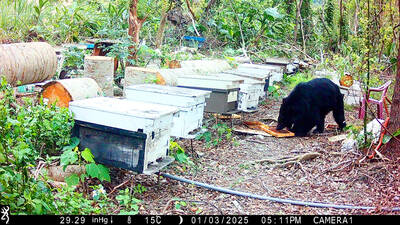
The Forestry and Nature Conservation Agency yesterday launched a gift box to market honey “certified by a Formosan black bear” in appreciation of a beekeeper’s amicable interaction with a honey-thieving bear. Beekeeper Chih Ming-chen (池明鎮) in January inspected his bee farm in Hualien County’s Jhuosi Township (卓溪) and found that more than 20 beehives had been destroyed and many hives were eaten, with bear droppings and paw prints near the destroyed hives, the agency said. Chih returned to the farm to move the remaining beehives away that evening when he encountered a Formosan black bear only 20m away, the agency said. The bear

Chinese embassy staffers attempted to interrupt an award ceremony of an international tea competition in France when the organizer introduced Taiwan and displayed the Republic of China flag, a Taiwanese tea farmer said in an interview published today. Hsieh Chung-lin (謝忠霖), chief executive of Juxin Tea Factory from Taichung's Lishan (梨山) area, on Dec. 2 attended the Teas of the World International Contest held at the Peruvian embassy in Paris. Hsieh was awarded a special prize for his Huagang Snow Source Tea by the nonprofit Agency for the Valorization of Agricultural Products (AVPA). During the ceremony, two Chinese embassy staffers in attendance


 RSS
RSS