


After a landmark court ruling in May cleared the way for Taiwan to become the first Asian country to legalize same-sex marriages, Taipei’s Museum of Contemporary Art (MOCA) is hosting what it claims is the first-ever lesbian, gay, bisexual and transgender (LGBTQ) art exhibition at a public museum in Asia.
Jointly organized by the museum and Hong Kong art promoter Sunpride Foundation, the exhibition, titled Spectrosynthesis? Asian LGBTQ Issues and Art Now, features 51 works by 22 artists from Taiwan, China, Hong Kong, Singapore, the US and Canada.
“The pieces span 50 years and tell the history and life stories of LGBTQ people in the greater Chinese community,” curator Sean Hu (胡朝聖) said on Friday.
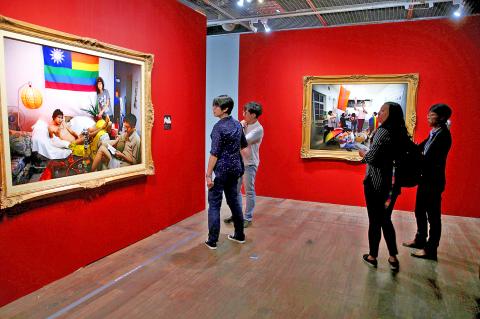
Photo: CNA
The works include paintings, videos, sound recordings, sculptures and photographs, and address a wide range of topics, such as self-identity, social oppression, illness, life and death, as well as desire and lust.
“I hope the exhibition will give the public a chance to communicate different viewpoints and allow visitors to listen to life stories that are different from their own,” Hu said, adding that he hoped the exhibit will help increase public understanding of LGBTQ rights and issues.
Among the works are two oil paintings titled Young Girl (1960) and Male Youth in Yellow Shirt (1967) by late Taiwanese artist Shiy De-jinn (席德進), who was thought to be gay, even though he never publicly came out.
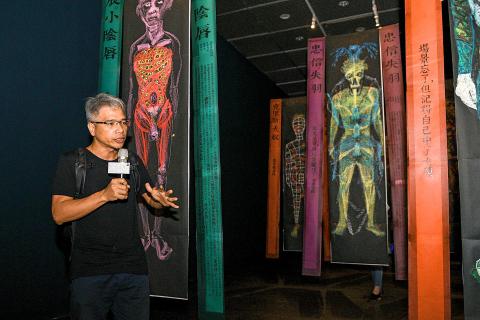
Photo courtesy of the Museum of Contemporary Art
The two iconic paintings are displayed side by side at the beginning of the exhibition to make a statement that “we are all the same, whether we are a girl or a boy,” Hu said.
Chinese artist Xiyadie (西亞蝶) is showcasing colorful paper cuts from his “Door,” “Train” and “Pleasure” series at the exhibition, including the piece Sew Up, which shows a person trapped inside a house and sewing up his penis as the large needle pokes through the roof.
“I want to poke a needle through tradition,” Xiyadie said, adding that he often felt trapped by tradition and the pain made him want to end his life.
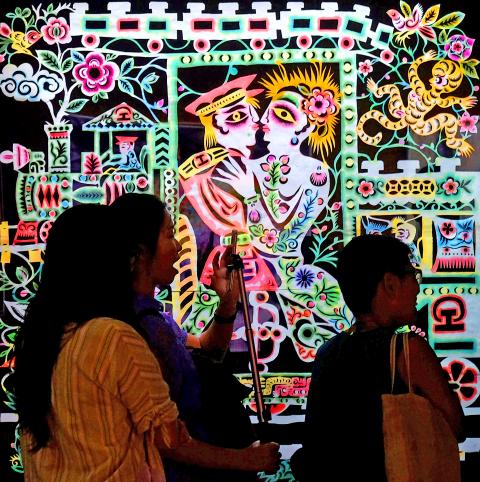
Photo: AFP
Another of his pieces features two men outside a house having sex, while a woman with a baby can be seen inside the house.
Xiyadie, who survived China’s Cultural Revolution, when gay people were severely persecuted, said the autobiographical art mirrors how he feels.
He is happy with his boyfriend, but he is constantly reminded of the pain he caused his wife, the artist said.
Two photographs by Taiwanese artist Tzeng Yi-hsin (曾怡馨), feature people posing as figures from Edouard Manet’s painting Olympia and Eugene Delacroix’s 1830 painting Liberty Leading the People.
“I want to subvert traditional art education that often puts forward a single perspective. The art textbooks that we have read since childhood often feature the views of Western, white, heterosexual men,” she said.
In Tzeng’s photographs, a man poses as the female nude in ?, while members of the Taiwan Alliance to Promote Civil Partnership pose as figures in Delacroix’s painting.
“I want to revisit mainstream artworks from a queer perspective,” said Tzeng, who specializes in mixed media.
Taiwanese artist Wen Hsin (溫馨), who is showcasing four large digital prints from her “Half” series, said her photographs featuring topless people were meant to challenge gender stereotypes and people’s perception of their bodies.
“One of my models was a man who adored his elder sister when he was little. However, past a certain age he was not allowed to imitate his sister’s gestures and voice, and would be mocked by others when he did,” Wen said.
“In the work, he tried to imagine what he would be like today if he had never been wounded in that way and had been allowed to be like his sister,” she said.
Hu said he hoped the exhibition would be able to tour other Asian countries “even though it is difficult.”
He said he is in talks with people in Hong Kong and Thailand about the possibilities.
The exhibition opened yesterday and runs until Nov. 5 at MOCA in Taipei’s Datong District (大同).
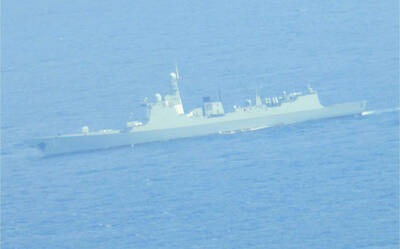
The military has spotted two Chinese warships operating in waters near Penghu County in the Taiwan Strait and sent its own naval and air forces to monitor the vessels, the Ministry of National Defense (MND) said. Beijing sends warships and warplanes into the waters and skies around Taiwan on an almost daily basis, drawing condemnation from Taipei. While the ministry offers daily updates on the locations of Chinese military aircraft, it only rarely gives details of where Chinese warships are operating, generally only when it detects aircraft carriers, as happened last week. A Chinese destroyer and a frigate entered waters to the southwest
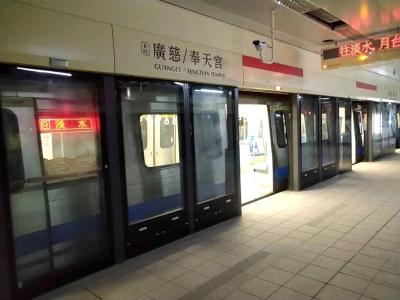
The eastern extension of the Taipei MRT Red Line could begin operations as early as late June, the Taipei Department of Rapid Transit Systems said yesterday. Taipei Rapid Transit Corp said it is considering offering one month of free rides on the new section to mark its opening. Construction progress on the 1.4km extension, which is to run from the current terminal Xiangshan Station to a new eastern terminal, Guangci/Fengtian Temple Station, was 90.6 percent complete by the end of last month, the department said in a report to the Taipei City Council's Transportation Committee. While construction began in October 2016 with an
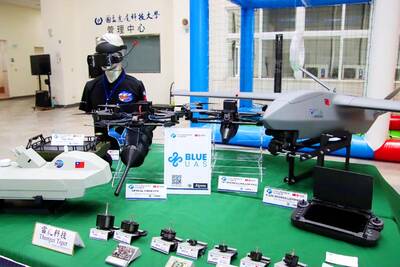
NON-RED SUPPLY: Boosting the nation’s drone industry is becoming increasingly urgent as China’s UAV dominance could become an issue in a crisis, an analyst said Taiwan’s drone exports to Europe grew 41.7-fold from 2024 to last year, with demand from Ukraine’s fight against Russian aggression the most likely driver of growth, a study showed. The Institute for Democracy, Society and Emerging Technology (DSET) in a statement on Wednesday said it found that many of Taiwan’s uncrewed aerial vehicle (UAV) sales were from Poland and the Czech Republic. These countries likely transferred the drones to Ukraine to aid it in its fight against the Russian invasion that started in 2022, it said. Despite the gains, Taiwan is not the dominant drone exporter to these markets, ranking second and fourth

Japanese Prime Minister Sanae Takaichi’s comment last year on Tokyo’s potential reaction to a Taiwan-China conflict has forced Beijing to rewrite its invasion plans, a retired Japanese general said. Takaichi told the Diet on Nov. 7 last year that a Chinese naval blockade or military attack on Taiwan could constitute a “survival-threatening situation” for Japan, potentially allowing Tokyo to exercise its right to collective self-defense. Former Japan Ground Self-Defense Force general Kiyofumi Ogawa said in a recent speech that the remark has been interpreted as meaning Japan could intervene in the early stages of a Taiwan Strait conflict, undermining China’s previous assumptions


 RSS
RSS