


Members of the pro-Taiwanese independence group From Ethnos to Nation (FETN, 蠻番島嶼社) yesterday said their right to freedom of expression was violated by law enforcement officials when one of their members was roughed up and arrested for displaying a banner bearing the word “Taiwan” at the Taipei Summer Universiade’s closing ceremony on Wednesday
Chen Yu-chang (陳俞璋), the FETN member who was arrested, accused the security personnel of overstepping their authority by roughing him up and forcefully taking him away from the closing ceremony to a police station, adding that he sustained minor injuries and bruises in the process.
“I had no problem passing through the security check and I entered the venue,” Chen told a news conference yesterday. “Later I took out the ‘Taiwan’ banner, but four security personnel clad in black swiftly came and grabbed the banner, and they grappled me. They roughed me up and held me down on the ground, saying I was under arrest, and carried me out of the venue to the police station.”
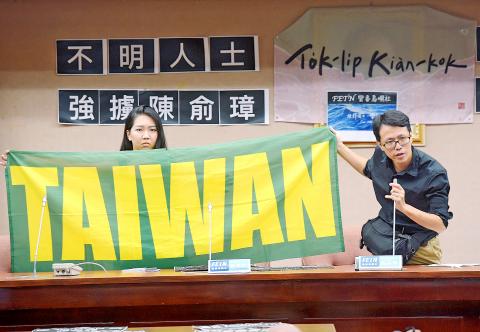
Photo: Huang Yao-cheng, Taipei Times
The men said they were military police officers only after arriving at the police station, Chen said, adding that they would not give the reasons for his detention and his forceful removal from the event.
Other FETN members said military police conducted an “illegal arrest” of a citizen without giving a proper reason, and demanded an explanation from the Taipei City Government, the Ministry of the Interior and the Ministry of National Defense as to who ordered military police to seize pro-Taiwanese identity flags and banners.
Showing a medical report obtained from a hospital, Chen said he sustained bruises, internal bleeding, swelling and other minor injuries on his arms and legs during the ordeal, adding that he was questioned and detained at Taipei City Sungshan District Police Precinct.
“I cannot understand why I was treated like a criminal just because I, as a Taiwanese citizen, wanted to cheer Taiwanese athletes,” Chen said. “Regrettably, this incident showed that a citizen of Taiwan has no dignity left in this nation. We are Taiwanese, but we are still being ruled by the Republic of China regime.”
Chen’s lawyer Lin Chien-hung (林建宏) requested the authorities to explain what offenses Chen had committed and what evidence they had to detain him.
“Our Constitution guarantees the freedom of expression and the protection of a citizen’s life and property from coming under threat. However, the military police did not identify themselves and did not follow the proper procedure to make an arrest, but went on to conduct an illegal arrest on Chen and put him under illegal detention.”
FETN members said they plan to press charges against the military police on offenses of physical assault to cause injury, illegal seizure of personal property, kidnapping and forced confinement.
Sungshan District Police Precinct Chief Huang Jung-chih (黃永志) said that Chen was carrying a “forbidden item” as deemed by the Universiade organizers, so he was taken to the police station.
“Officials from the event’s organizing committee deemed Chen’s banner to have born a political slogan that was banned at the event. Therefore personnel from the military police unit from within our jurisdiction took him to the police precinct for questioning. During the process, he uttered offensive words and therefore he was charged with Offenses of Obstructing an Officer In Discharge of Duties (妨害公務罪), and the case was transferred to public prosecutors,” he said.
Chen denied he had used offensive words and said that he did not act in a violent manner.

NATIONAL SECURITY: Authorities are working to confirm the identities of the military personnel involved and investigating possible illegal conduct and regulatory violations Authorities are probing possible national security implications after Kinmen police and immigration officers on Sunday found a Chinese woman allegedly posing as a tourist while engaging in prostitution involving more than 10 military personnel. The woman, surnamed Chen (陳), has since been deported, authorities said, adding that investigators are still working to confirm the identities of those implicated, as the records only listed code names and aliases. The case stemmed from a report received by the Kinmen District Prosecutors’ Office on Friday last week from the Jinhu Precinct of the Kinmen County Police Bureau. On Sunday, police, along with the National Immigration

GLOBALGIVING: ‘ Caving to external pressure is not acceptable for an organization that has cultivated justice reform and human rights for 30 years,’ one NGO said A slew of non-government organizations (NGOs) have withdrawn from the GlobalGiving fundraising platform after it announced it would use “Chinese Taipei” instead of “Taiwan” from next month. The Taiwan Good Rice Association wrote on Facebook on Friday that it was informed on April 28 via a teleconference call of the change, which was made because the platform wanted to operate in China. Taiwan Good Rice is to terminate all cooperative relationships with GlobalGiving in response to the platform’s “unilateral and non-negotiable” decision to remove references to Taiwan, the NGO said. “Taiwan is in the official name of Taiwan Good Rice Association and the

HEAVY WEATHER: Typhoon Jangmi is due to crash straight into the Ryukyus as airlines look to shift flights to larger aircraft or cancel flights to Okinawa entirely Taiwan’s international air carriers announced flight adjustments over the weekend as Typhoon Jangmi is forecast to hit the Ryukyu Islands today and tomorrow. The Central Weather Administration (CWA) upgraded Jangmi from a tropical storm to a typhoon at 8am yesterday, with the eye located 580km south of Naha city. It was moving north at 19kph. Today, China Airlines’ CI-120, CI-121, CI-122 and CI-123 flights between Taoyuan and Naha, Okinawa, have been canceled as well as CI-132 and CI-133 between Kaohsiung and Naha. EVA Air’s BR-112, BR-113, BR-186 and BR-185 flights between Taoyuan and Naha are also canceled. Low-cost carrier Tigerair Taiwan canceled IT-230,

Chinese Nationalist Party (KMT) Chairwoman Cheng Li-wun (鄭麗文) yesterday briefed her party’s Central Standing Committee regarding her scheduled visit to the US between Monday next week and June 16, saying that her purpose would be to persuade the US that the Republic of China (ROC) Constitution was a “one China” constitution that would foster stable and peaceful cross-strait relations. The ROC Constitution is the most important defense for all Taiwanese citizens, as it upholds our democracy and has contributed to our robust economy, which aligns with international and US interests, she said. “We would not be troublemakers and drag the US under,”


 RSS
RSS