


Easy access to the insecticide fipronil and some farmers’ misconceptions about the use of insecticides on hens could explain the discovery of eggs contaminated with fipronil, a government official said yesterday.
Hens often have lice or insects on them that need to be removed, Changhua County Animal Disease Control Center Director Tung Mang-chih (董孟治) said.
Eggs from 13 farms in the county have been found to contain excessive levels of fipronil.
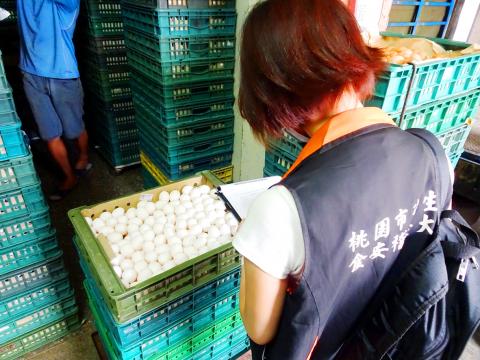
Photo provided by the Taoyuan Department of Health
Veterinarians have provided farmers with disinfectant water to treat their hens and told them not to use certain insecticides on poultry, he said.
However, some poultry farmers misuse insecticides and rely on previous experience or information from peers, Tung said.
There are also no restrictions on the purchase of fipronil and customers are not required to present their ID when buying the insecticide, he said.
A nationwide inspection found contaminated eggs at 44 farms, 13 of which were in the county.
Restrictions on four of the farms have since been lifted, while nine are still undergoing inspections.
As of yesterday, 803 boxes of eggs weighing about 8,000kg were still sealed at the farms.
An official from the county’s Public Health Bureau yesterday said that inspectors had discovered 10 bottles of fipronil at a livestock farm while trying to establish the whereabouts of the contaminated eggs.
Although the owner of the farm denied ever using the insecticide, the manufacturing date on the bottles was 2015 and they were to expire by December, indicating that the farmer could have been using fipronil for years.
The Council of Agriculture on Friday said that concentrations of the insecticide in samples from the 44 farms exceeded 5 parts per billion, or 0.005mg/kg — the maximum residue amount as determined by the EU.
Taiwan follows the EU standard.
Following the findings, the council barred the farms in Changhua, Nantou, Chiayi and Pingtung counties and Kaohsiung, Taichung and Tainan from removing any eggs from their premises.
The discovery of contaminated eggs in Taiwan follows similar incidents in Europe and Asia.
The WHO considers fipronil to be “moderately toxic” to humans.
Long-term exposure can cause damage to the kidneys, liver and the thyroid gland, it says.
It can also cause “nausea, vomiting, abdominal pain, dizziness and epileptic seizures,” the WHO says.
The US Environmental Protection Agency has classified fipronil as a possible human carcinogen based on studies that have found an increase in thyroid follicular cell tumors in rats.

NATIONAL SECURITY: Authorities are working to confirm the identities of the military personnel involved and investigating possible illegal conduct and regulatory violations Authorities are probing possible national security implications after Kinmen police and immigration officers on Sunday found a Chinese woman allegedly posing as a tourist while engaging in prostitution involving more than 10 military personnel. The woman, surnamed Chen (陳), has since been deported, authorities said, adding that investigators are still working to confirm the identities of those implicated, as the records only listed code names and aliases. The case stemmed from a report received by the Kinmen District Prosecutors’ Office on Friday last week from the Jinhu Precinct of the Kinmen County Police Bureau. On Sunday, police, along with the National Immigration

GLOBALGIVING: ‘ Caving to external pressure is not acceptable for an organization that has cultivated justice reform and human rights for 30 years,’ one NGO said A slew of non-government organizations (NGOs) have withdrawn from the GlobalGiving fundraising platform after it announced it would use “Chinese Taipei” instead of “Taiwan” from next month. The Taiwan Good Rice Association wrote on Facebook on Friday that it was informed on April 28 via a teleconference call of the change, which was made because the platform wanted to operate in China. Taiwan Good Rice is to terminate all cooperative relationships with GlobalGiving in response to the platform’s “unilateral and non-negotiable” decision to remove references to Taiwan, the NGO said. “Taiwan is in the official name of Taiwan Good Rice Association and the

HEAVY WEATHER: Typhoon Jangmi is due to crash straight into the Ryukyus as airlines look to shift flights to larger aircraft or cancel flights to Okinawa entirely Taiwan’s international air carriers announced flight adjustments over the weekend as Typhoon Jangmi is forecast to hit the Ryukyu Islands today and tomorrow. The Central Weather Administration (CWA) upgraded Jangmi from a tropical storm to a typhoon at 8am yesterday, with the eye located 580km south of Naha city. It was moving north at 19kph. Today, China Airlines’ CI-120, CI-121, CI-122 and CI-123 flights between Taoyuan and Naha, Okinawa, have been canceled as well as CI-132 and CI-133 between Kaohsiung and Naha. EVA Air’s BR-112, BR-113, BR-186 and BR-185 flights between Taoyuan and Naha are also canceled. Low-cost carrier Tigerair Taiwan canceled IT-230,

Chinese Nationalist Party (KMT) Chairwoman Cheng Li-wun (鄭麗文) yesterday briefed her party’s Central Standing Committee regarding her scheduled visit to the US between Monday next week and June 16, saying that her purpose would be to persuade the US that the Republic of China (ROC) Constitution was a “one China” constitution that would foster stable and peaceful cross-strait relations. The ROC Constitution is the most important defense for all Taiwanese citizens, as it upholds our democracy and has contributed to our robust economy, which aligns with international and US interests, she said. “We would not be troublemakers and drag the US under,”


 RSS
RSS