


The Summer Universiade, which is to begin on Saturday, is being touted by the Taipei City Government as an opportunity to promote Taiwanese firms to the world, but much of the games’ official merchandise has been manufactured in China.
The games’ official merchandise is divided into nine categories, including clothing, accessories, souvenirs, collectibles, stationery, personal products, consumer electronics, gift packages and others. This is divided into 165 subcategories for a total of 520 items.
A number of products at a souvenir shop in Taipei City Hall were labeled “Made in China,” the majority of which depicted the event’s mascot, Bravo, including a NT$80 (US$2.64) coaster, a NT$99 badge, a NT$120 cloth badge, a NT$120 smartphone stand, a NT$149 silicon purse, a NT$150 key chain, a NT$220 embroidered name tag, a NT$250 stirrer, a NT$290 tote bag, a NT$390 fragrant candle, a NT$550 container and two plush Bravo toys priced at NT$550 and NT$680 respectively.
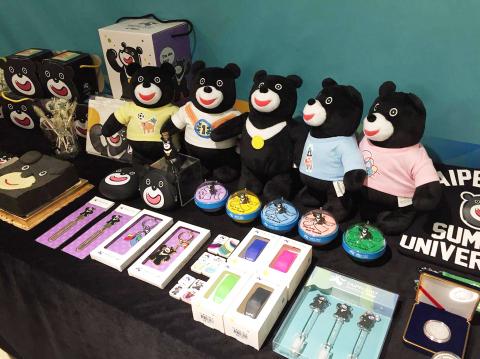
Photo: Chou Yen-yu, Taipei Times
A selection of coins have been minted, the cheapest of which, at NT$25, are made in China and the most expensive of which, at NT$68,000 and made from pure gold, are made in Taiwan.
In general, Chinese manufactures were lower-range goods.
The Taipei Universiade Organizing Committee Marketing and Communication Department said about 30 percent of the products were manufactured in China.
The contract between the Taipei Universiade Organizing Committee and Taiwan-based Cheerful Fashion Goods — the games’ official merchandise manufacturer — does not contain any terms governing the country of manufacture, department director Chuo Chien-hung (卓建宏) said.
The percentage of merchandise made in China falls within the expected range, Chuo said, adding that all items them were designed in Taiwan.
The company might have outsourced manufacturing to Chinese factories, which are likely operated by Taiwanese, he said.
Cheerful Fashion Goods chief executive officer Hou Sheng-tun (侯勝敦) said that all of the merchandise would have been made in China if it had it not been for disadvantaged people, charity groups and social enterprises joining the manufacturing process.
His company has no right to bar such local organizations from producing some of the merchandise, Hou added.
Where materials could not be sourced locally or Taiwanese factories were unable to manufacture an item, production was outsourced to China, he said.
“However, we tried to ensure that the products made in Chinese factories are run by Taiwanese to ensure quality control and support Taiwanese enterprises,” he said.
According to the licensing agreement, the Taipei City Government is entitled to 12 percent of Cheerful Fashion Goods’ proceeds from merchandise sales for the first NT$20 million in earnings, 10 percent for earnings between NT$20 million and NT$60 million and 8 percent for earnings that surpass NT$60 million to encourage the company to boost sales, Chuo said.
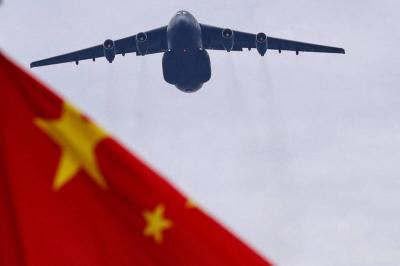
Beijing could eventually see a full amphibious invasion of Taiwan as the only "prudent" way to bring about unification, the US Department of Defense said in a newly released annual report to Congress. The Pentagon's "Annual Report to Congress: Military and Security Developments Involving the People's Republic of China 2025," was in many ways similar to last year’s report but reorganized the analysis of the options China has to take over Taiwan. Generally, according to the report, Chinese leaders view the People's Liberation Army's (PLA) capabilities for a Taiwan campaign as improving, but they remain uncertain about its readiness to successfully seize
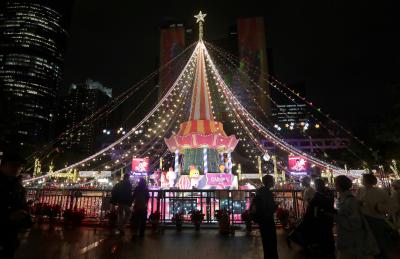
Taiwan is getting a day off on Christmas for the first time in 25 years. The change comes after opposition parties passed a law earlier this year to add or restore five public holidays, including Constitution Day, which falls on today, Dec. 25. The day marks the 1947 adoption of the constitution of the Republic of China, as the government in Taipei is formally known. Back then the Chinese Nationalist Party (KMT) governed China from Nanjing. When the KMT, now an opposition party in Taiwan, passed the legislation on holidays, it said that they would help “commemorate the history of national development.” That

Taiwan has overtaken South Korea this year in per capita income for the first time in 23 years, IMF data showed. Per capita income is a nation’s GDP divided by the total population, used to compare average wealth levels across countries. Taiwan also beat Japan this year on per capita income, after surpassing it for the first time last year, US magazine Newsweek reported yesterday. Across Asia, Taiwan ranked fourth for per capita income at US$37,827 this year due to sustained economic growth, the report said. In the top three spots were Singapore, Macau and Hong Kong, it said. South

Snow fell on Yushan (Jade Mountain, 玉山) yesterday morning as a continental cold air mass sent temperatures below freezing on Taiwan’s tallest peak, the Central Weather Administration (CWA) said. Snowflakes were seen on Yushan’s north peak from 6:28am to 6:38am, but they did not fully cover the ground and no accumulation was recorded, the CWA said. As of 7:42am, the lowest temperature recorded across Taiwan was minus-5.5°C at Yushan’s Fengkou observatory and minus-4.7°C at the Yushan observatory, CWA data showed. On Hehuanshan (合歡山) in Nantou County, a low of 1.3°C was recorded at 6:39pm, when ice pellets fell at Songsyue Lodge (松雪樓), a


 RSS
RSS