


National Congress on Judicial Reform preparatory committee members yesterday presented their recommendations at its final meeting, while some abstained from the meeting in protest, saying that their views on gender equality and children’s rights were ignored.
Women’s rights advocate and lawyer Lai Fang-yu (賴芳玉), Garden of Hope Foundation chief executive Chi Hui-jung (紀惠容), Taiwan Healthcare Reform Foundation chief executive Joanne Liu (劉淑瓊) and social studies professor Lai Yueh-mi (賴月蜜) did not attend the meeting.
While Lai Yueh-mi was reportedly ill, the other four had said they were dissatisfied and felt “let down” when many of their recommendations were watered down or excluded from the subcommittee’s resolutions.
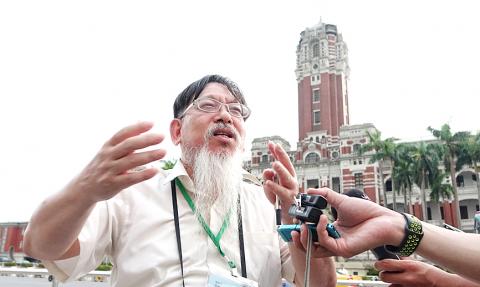
Photo: Liu Hsin-de, Taipei Times
Taiwan Jury Association chairman and former judge Chang Ching (張靜) had threatened to boycott the deliberations, saying the subcommittee failed to decide on how to include civic participation in the judiciary to improve transparency.
Chang criticized the meeting agenda and said that the proposed final resolutions do not meet public expectations and do not improve judicial independence.
Chang left the meeting in protest after he raised a motion on requirements for passing the resolution, and then decried the congress for not discussing implementing a jury system.
Controversy over two committee members, professor Lin Yu-hsiung (林鈺雄) and lawyer Chen Chung-yen (陳重言), stalled the meeting after the two had earlier resigned from the committee, but questions still remained over their status and voter eligibility.
The Presidential Office said it took care to invite important government figures and representatives from various political parties to attend the meeting.
Among those invited were Democratic Progressive Party (DPP) caucus convenor Ker Chien-ming (柯建銘), New Power Party (NPP) Executive Chairman Huang Kuo-chang (黃國昌), People First Party Chairman James Soong (宋楚瑜) and Republican Party Chairperson Hsu Hsing-ying (徐欣瑩).
Top Chinese Nationalist Party (KMT) officials were also invited, but none attended yesterday.
Huang said he opposes the proposal that the Judicial Yuan appoint an internal committee to decide on civic participation — whether Taiwan should employ a 12-person jury system or a limited participatory jury system or appoint citizen judges.
The Judicial Yuan is a very conservative force and has vested interests in opposing a jury system, Huang said, adding that political parties should take responsibility and hold a series of public hearings to decide what would be the best for the nation.
The agenda did not give him time to speak, Soong said on social media, but added that he supports implementing a jury system.
“Many people do not trust the judicial system and our priority is to regain that trust. Many people have said they want effective participation in court decisions so that cases are not decided upon by one judge. The best way to make a change is to implement a jury system,” Soong said.
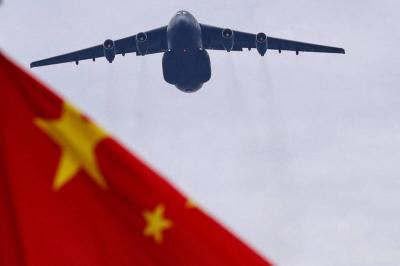
Beijing could eventually see a full amphibious invasion of Taiwan as the only "prudent" way to bring about unification, the US Department of Defense said in a newly released annual report to Congress. The Pentagon's "Annual Report to Congress: Military and Security Developments Involving the People's Republic of China 2025," was in many ways similar to last year’s report but reorganized the analysis of the options China has to take over Taiwan. Generally, according to the report, Chinese leaders view the People's Liberation Army's (PLA) capabilities for a Taiwan campaign as improving, but they remain uncertain about its readiness to successfully seize

Taiwan is getting a day off on Christmas for the first time in 25 years. The change comes after opposition parties passed a law earlier this year to add or restore five public holidays, including Constitution Day, which falls on today, Dec. 25. The day marks the 1947 adoption of the constitution of the Republic of China, as the government in Taipei is formally known. Back then the Chinese Nationalist Party (KMT) governed China from Nanjing. When the KMT, now an opposition party in Taiwan, passed the legislation on holidays, it said that they would help “commemorate the history of national development.” That

Taiwan has overtaken South Korea this year in per capita income for the first time in 23 years, IMF data showed. Per capita income is a nation’s GDP divided by the total population, used to compare average wealth levels across countries. Taiwan also beat Japan this year on per capita income, after surpassing it for the first time last year, US magazine Newsweek reported yesterday. Across Asia, Taiwan ranked fourth for per capita income at US$37,827 this year due to sustained economic growth, the report said. In the top three spots were Singapore, Macau and Hong Kong, it said. South

Snow fell on Yushan (Jade Mountain, 玉山) yesterday morning as a continental cold air mass sent temperatures below freezing on Taiwan’s tallest peak, the Central Weather Administration (CWA) said. Snowflakes were seen on Yushan’s north peak from 6:28am to 6:38am, but they did not fully cover the ground and no accumulation was recorded, the CWA said. As of 7:42am, the lowest temperature recorded across Taiwan was minus-5.5°C at Yushan’s Fengkou observatory and minus-4.7°C at the Yushan observatory, CWA data showed. On Hehuanshan (合歡山) in Nantou County, a low of 1.3°C was recorded at 6:39pm, when ice pellets fell at Songsyue Lodge (松雪樓), a


 RSS
RSS