


The New Party yesterday said it would launch a petition for a referendum asking the public whether it is willing to shoulder the cost of suspending construction of the Fourth Nuclear Power Plant in New Taipei City’s Gongliao District (貢寮) because of the Democratic Progressive Party’s (DPP) hardline stance against nuclear energy.
“The inconveniences caused by sporadic power outages and Premier Lin Chuan’s (林全) ordering of central government agencies to turn off air-conditioners over the past week pale in comparison to the Fourth Nuclear Power Plant, which would cost the public NT$283.8 billion [US$9.36 billion] if left unused,” New Party spokesman Wang Ping-chung (王炳忠) told a news conference in Taipei.
The figure is based on Taiwan Power Co’s estimate of the suspended plant’s construction cost.
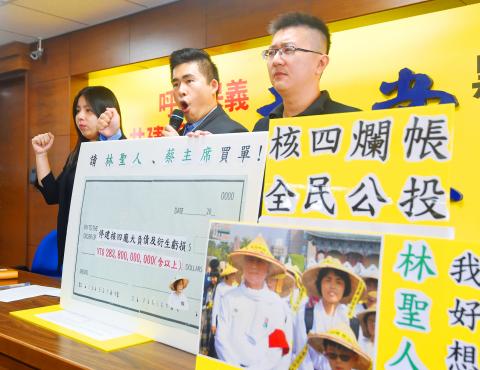
Photo: Liao Chen-huei, Taipei Times
The proposed referendum says: “Do you agree that the public should pay — through larger electricity bills, taxes or budget allocations — the cost of suspending the construction of the Fourth Nuclear Power Plant, NT$283.8 billion, as a result of the government’s flawed policies and extortion by extremists?”
“Extremists” originally referred to anti-nuclear civic groups, but the party had narrowed its scope to one person: People Rule Foundation founder Lin I-hsiung (林義雄), who in 2014 “threatened former president Ma Ying-jeou’s (馬英九) administration with his life” by staging a hunger strike against the construction of the plant.
“If nuclear energy is phased out, there will not be enough electricity, even if people pay more in electricity bills or taxes,” Wang said, referring to the DPP’s goal of achieving a “nuclear-free homeland” by 2025.
The party seeks to gather at least 61,424 signatures, or 0.05 percent of the number of votes cast in last year’s presidential election, to pass the first phase of the signature drive for a referendum, Wang said.
Saying that Lin has been a lifelong advocate of referendums, but has remained silent as the nation’s electricity reserves fell to critically low levels, Wang said he would “seek Lin out from hiding” to show him the petition and ask him to sign a NT$283.8 billion check.
President Tsai Ing-wen (蔡英文) should also help pay the bill given her reluctance to clarify her stance on the fate of the plant, Wang said.
If Tsai and Lin cannot afford to pay, the DPP should correct its energy policy, Wang said.
By abolishing nuclear energy, the nation would have to rely on coal-fired power plants, which cause considerable air pollution, New Party member Su Heng (蘇恆) said.
She also asked whether the nation would be able to attain the goal it made in 2015 at the UN Climate Change Conference to reduce greenhouse gas emissions by 20 percent to 2005 levels if nuclear power were phased out.
Beijing could eventually see a full amphibious invasion of Taiwan as the only "prudent" way to bring about unification, the US Department of Defense said in a newly released annual report to Congress. The Pentagon's "Annual Report to Congress: Military and Security Developments Involving the People's Republic of China 2025," was in many ways similar to last year’s report but reorganized the analysis of the options China has to take over Taiwan. Generally, according to the report, Chinese leaders view the People's Liberation Army's (PLA) capabilities for a Taiwan campaign as improving, but they remain uncertain about its readiness to successfully seize

Taiwan is getting a day off on Christmas for the first time in 25 years. The change comes after opposition parties passed a law earlier this year to add or restore five public holidays, including Constitution Day, which falls on today, Dec. 25. The day marks the 1947 adoption of the constitution of the Republic of China, as the government in Taipei is formally known. Back then the Chinese Nationalist Party (KMT) governed China from Nanjing. When the KMT, now an opposition party in Taiwan, passed the legislation on holidays, it said that they would help “commemorate the history of national development.” That

Taiwan has overtaken South Korea this year in per capita income for the first time in 23 years, IMF data showed. Per capita income is a nation’s GDP divided by the total population, used to compare average wealth levels across countries. Taiwan also beat Japan this year on per capita income, after surpassing it for the first time last year, US magazine Newsweek reported yesterday. Across Asia, Taiwan ranked fourth for per capita income at US$37,827 this year due to sustained economic growth, the report said. In the top three spots were Singapore, Macau and Hong Kong, it said. South

Snow fell on Yushan (Jade Mountain, 玉山) yesterday morning as a continental cold air mass sent temperatures below freezing on Taiwan’s tallest peak, the Central Weather Administration (CWA) said. Snowflakes were seen on Yushan’s north peak from 6:28am to 6:38am, but they did not fully cover the ground and no accumulation was recorded, the CWA said. As of 7:42am, the lowest temperature recorded across Taiwan was minus-5.5°C at Yushan’s Fengkou observatory and minus-4.7°C at the Yushan observatory, CWA data showed. On Hehuanshan (合歡山) in Nantou County, a low of 1.3°C was recorded at 6:39pm, when ice pellets fell at Songsyue Lodge (松雪樓), a


 RSS
RSS