


A dialogue between Taiwan and the US on trade and investment that began yesterday is expected to help ties between the two countries, American Institute in Taiwan (AIT) spokeswoman Sonia Urbom said.
The dialogue concludes tomorrow and covers a wide range of topics, such as intellectual property rights protection, pharmaceuticals, medical devices, agriculture, investment and technical barriers to trade, Urbom said.
An AIT delegation is taking part in the talks with a Taiwanese delegation organized by the Office of Trade Negotiations and headed by deputy chief negotiator Yang Jen-ni (楊珍妮).
The talks are the first of their kind since US President Donald Trump took office in January.
Yang is also director of the Ministry of Economic Affairs’ Bureau of Foreign Trade.
The US delegation is to meet with trade authorities in Taiwan and “will continue to work to expand US-Taiwan bilateral trade and investment relations,” Urbom said in a statement.
According to the Office of Trade Negotiations, the US delegation is comprised of representatives from the Office of the US Trade Representative, the US Department of Commerce and the US Department of Agriculture.
Tseng Hsien-chao (曾顯照), a negotiator with the Office of Trade Negotiations, said the latest annual negotiations are expected to focus on topics raised in previous talks, including US pork and beef imports.
During last year’s dialogue, held in Washington under the Trade and Investment Framework Agreement, a bilateral mechanism between the two countries, the US delegation also raised the pork and beef import issue.
Taiwan bans imports of US meat products that contain traces of the leanness-enhancing drug ractopamine.
It relented on beef in 2012, after maximum residue limits for ractopamine in beef and pork were set by a UN food standards body.
In addition, both sides are expected to talk about the huge trade surplus Taiwan enjoys with the US, Tseng said.
Taiwan has the 14th-largest trade surplus with the US, exporting US$9.1 billion more than it imports from the US, according to US Department of Commerce data.
Tseng said that his office had explained the trade surplus to the US, emphasizing that the figure excludes the purchase of military vessels and military personnel training, so that Taiwan is not a major cause of the country’s huge trade imbalance.
In fact, Taipei and Washington complement each other in terms of global trade, he said.
This year’s negotiations are expected to resolve technical issues rather than come up with any substantive advances in bilateral economic and trade policies, he said.
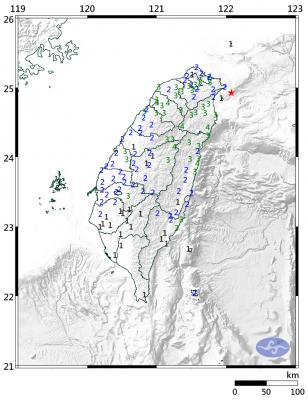
A magnitude 6.1 earthquake struck off the coast of Yilan County at 8:39pm tonight, the Central Weather Administration (CWA) said, with no immediate reports of damage or injuries. The epicenter was 38.7km east-northeast of Yilan County Hall at a focal depth of 98.3km, the CWA’s Seismological Center said. The quake’s maximum intensity, which gauges the actual physical effect of a seismic event, was a level 4 on Taiwan’s 7-tier intensity scale, the center said. That intensity level was recorded in Yilan County’s Nanao Township (南澳), Hsinchu County’s Guansi Township (關西), Nantou County’s Hehuanshan (合歡山) and Hualien County’s Yanliao (鹽寮). An intensity of 3 was
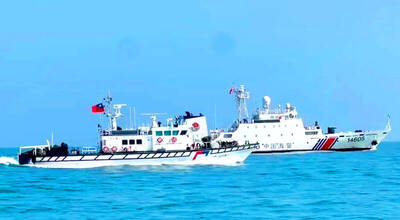
Instead of focusing solely on the threat of a full-scale military invasion, the US and its allies must prepare for a potential Chinese “quarantine” of Taiwan enforced through customs inspections, Stanford University Hoover fellow Eyck Freymann said in a Foreign Affairs article published on Wednesday. China could use various “gray zone” tactics in “reconfiguring the regional and ultimately the global economic order without a war,” said Freymann, who is also a nonresident research fellow at the US Naval War College. China might seize control of Taiwan’s links to the outside world by requiring all flights and ships entering or leaving Taiwan
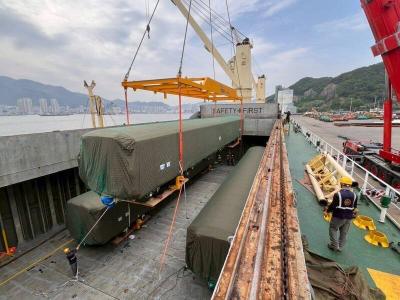
The first of 10 new high-capacity trains purchased from South Korea’s Hyundai Rotem arrived at the Port of Taipei yesterday to meet the demands of an expanding metro network, Taipei Rapid Transit Corp (TRTC) said yesterday. The train completed a three-day, 1,200km voyage from the Port of Masan in South Korea, the company said. Costing NT$590 million (US$18.79 million) each, the new six-carriage trains feature a redesigned interior based on "human-centric" transportation concepts, TRTC said. The design utilizes continuous longitudinal seating to widen the aisles and optimize passenger flow, while also upgrading passenger information displays and driving control systems for a more comfortable
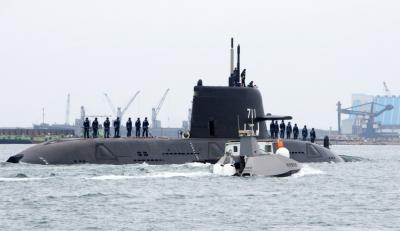
Taiwan's first indigenous defense submarine, the SS-711 Hai Kun (海鯤, or Narwhal), departed for its 13th sea trial at 7am today, marking its seventh submerged test, with delivery to the navy scheduled for July. The outing also marked its first sea deployment since President William Lai (賴清德) boarded the submarine for an inspection on March 19, drawing a crowd of military enthusiasts who gathered to show support. The submarine this morning departed port accompanied by CSBC Corp’s Endeavor Manta (奮進魔鬼魚號) uncrewed surface vessel and a navy M109 assault boat. Amid public interest in key milestones such as torpedo-launching operations and overnight submerged trials,


 RSS
RSS